
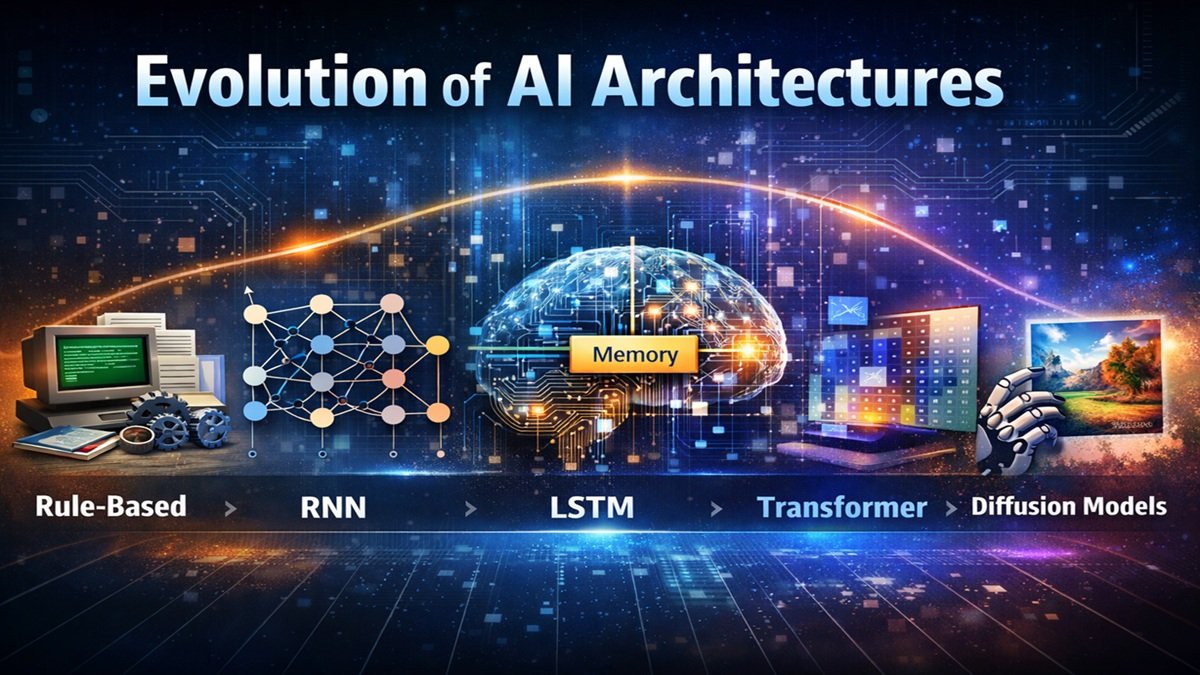
Artificial Intelligence Architectures Explained: From Rule-Based Systems to Transformers and Modern LLMs
Introduction
Artificial Intelligence today feels intelligent — it writes code, explains physics, answers questions, and even reasons step‑by‑step. However, AI does not think like humans. Instead, it is built on mathematical architectures that learn patterns from data.
To understand modern AI systems such as chat assistants and coding copilots, we must understand the evolution of AI architectures — the internal designs that define how machines process information.
This article explains the complete journey from early rule‑based AI to modern Transformer‑based large language models.
What Is an AI Architecture?
An AI architecture is the mathematical structure of a neural network — the way neurons are connected, how information flows, and how the system learns patterns.
In simple terms:
Architecture = The brain design
Model = A trained brain using that design
Just like different CPU designs (ARM, x86) run software differently, different AI architectures process information differently.
1. Rule‑Based AI (Pre‑Machine Learning Era)
How It Worked
Early AI systems did not learn. Engineers manually wrote rules:
IF condition → THEN action
Example:
- IF temperature > 30 → turn fan ON
- IF user says hello → respond hello
Limitations
- No learning ability
- No general intelligence
- Impossible to scale to real language
These systems were deterministic programs, not intelligent systems.
2. Recurrent Neural Networks (RNN)
RNNs were the first major step toward language understanding.
Idea
Language is sequential. Words depend on previous words.
RNN processes text one word at a time while maintaining memory.
word → memory → next word → memory → next word
Problem
RNN forgets long‑distance context.
Example:
A paragraph mentioning a subject at the start cannot be remembered at the end.
This is called the vanishing gradient problem.
3. LSTM and GRU — Memory‑Improved Networks
LSTM (Long Short‑Term Memory) and GRU improved RNN by adding memory gates.
The network decides:
- what to remember
- what to forget
- what to output
Advantages
- Better context retention
- Improved translation and speech recognition
Still a Problem
They process text sequentially. That means:
- slow training
- poor GPU utilization
- difficult scaling
Modern LLMs require massive parallel computation — LSTM could not scale enough.
4. Convolutional Neural Networks (CNN) for Text
CNNs are famous for images but were also used in NLP tasks like:
- sentiment analysis
- spam detection
- topic classification
They detect local patterns but not deep context.
Good for classification, bad for reasoning.
5. The Transformer Architecture (The Breakthrough)
Introduced in 2017, Transformer changed AI completely.
Instead of reading text sequentially, the model reads the entire sentence at once and measures relationships between words using attention.
Core Idea: Attention Mechanism
Each word checks how important every other word is in the sentence.
Example:
“The bank approved the loan”
“The bank of the river”
The same word gets different meaning based on context.
Why It Was Revolutionary
- Understands long context
- Parallel processing (GPU friendly)
- Scales to billions of parameters
- Enables reasoning‑like behavior
Transformer Processing Pipeline
Text → Tokenization → Embedding → Attention Layers → Feed Forward → Probability Output
The system predicts the most probable next token repeatedly to generate text.
Large Language Models (LLMs)
An LLM is simply a very large Transformer trained on massive datasets.
Training Stages
Pretraining
The model learns language patterns by predicting missing or next words from large text corpora.
Fine‑Tuning (Human Alignment)
Humans rank good and bad answers.
The model learns safe and useful responses using reinforcement learning from human feedback (RLHF).
Important Insight
The model does not store facts like a database.
It learns statistical relationships in language that encode knowledge patterns.
Diffusion Models (Different Type of AI)
Unlike LLMs, diffusion models generate images instead of text.
They start with noise and gradually remove randomness to produce a picture.
Used in:
- image generation
- video generation
- audio synthesis
They do not predict next word — they denoise data.
Modern Hybrid AI Systems
Today’s AI assistants are not just LLMs. They combine multiple components:
- Transformer language model
- Retrieval system (search memory/database)
- Tool usage (calculator, coding runtime, browser)
- Planning module
This creates the illusion of reasoning and real intelligence.
Inference: How AI Generates an Answer
When a user asks a question:
- Text is converted into tokens
- Tokens become vectors (embeddings)
- Transformer layers compute relationships
- Model predicts next token probabilities
- Tokens are generated repeatedly to form a response
Important: AI predicts — it does not think consciously.
Local Model Runtimes
A trained model can run locally using runtime software that loads weights into CPU/GPU memory and executes inference.
The runtime is not the AI brain — it is the execution environment.
Why Transformers Dominate Modern AI
| Feature | Old Architectures | Transformer |
|---|---|---|
| Context Memory | Short | Long |
| Speed | Slow | Parallel Fast |
| Scaling | Limited | Massive |
| Reasoning Ability | Weak | Strong |
| Training Efficiency | Poor | Excellent |
Because of these advantages, nearly all modern language AI systems use Transformer‑based architectures.
Conclusion
Artificial Intelligence did not suddenly become smart. It evolved through multiple architectures:
Rule Systems → RNN → LSTM → CNN → Transformer → Hybrid AI
The Transformer architecture enabled large‑scale language understanding by allowing models to analyze relationships between all words simultaneously. Modern AI systems combine Transformers with tools and memory systems to simulate reasoning.
AI does not truly understand — it predicts patterns at extraordinary scale. Yet those patterns encode human knowledge, making the system appear intelligent.


