
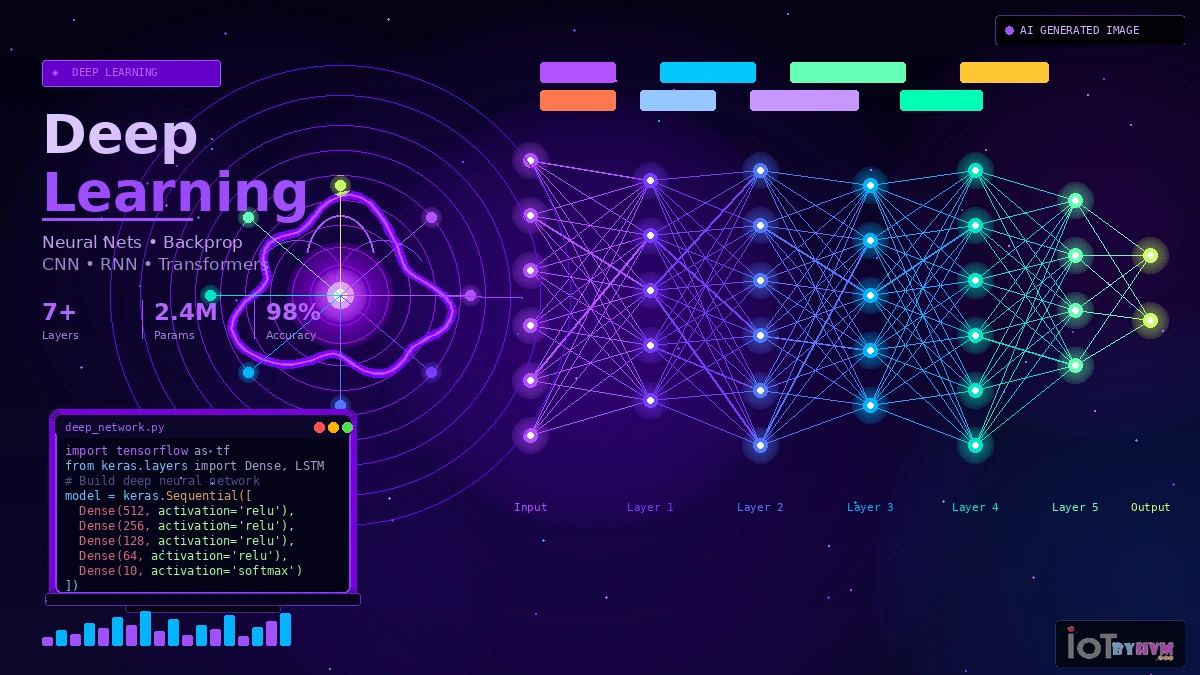
Deep Learning Explained: Neural Networks, CNNs, and RNNs in Artificial Intelligence
Deep learning is one of the most powerful and rapidly advancing areas of artificial intelligence. It enables machines to process complex data such as images, audio, and natural language with remarkable accuracy.
Many modern AI applications—including voice assistants, image recognition systems, and language translation tools—are powered by deep learning models.
Deep learning builds upon machine learning by using neural networks with multiple layers, allowing computers to learn complex patterns from large datasets.
If you want to understand how deep learning fits into the full AI learning journey, you can explore Complete Roadmap to Learn AI from Zero to LLMs and Generative AI:
https://iotbyhvm.ooo/complete-roadmap-to-learn-ai-from-zero-to-llms-and-generative-ai/
This roadmap explains the step-by-step progression from programming fundamentals to advanced technologies such as transformers and generative AI.
What is Deep Learning?
Deep learning is a subset of machine learning that uses artificial neural networks with multiple layers to analyze and learn patterns from data.
Traditional machine learning algorithms often require manual feature extraction. Deep learning models, however, can automatically learn important features directly from raw data.
Deep learning models are particularly effective for tasks involving large and complex datasets, including:
- Image recognition
- Speech recognition
- Natural language processing
- Autonomous driving
- Medical image analysis
The term “deep” refers to the multiple layers in neural networks that process information in stages.
Artificial Neural Networks
Artificial neural networks are the foundation of deep learning. They are inspired by the structure of the human brain.
A neural network consists of multiple interconnected nodes called neurons that process information.
A typical neural network contains three main components:
Input Layer
The input layer receives the raw data that will be processed by the network.
For example:
- Pixel values in images
- Words in text data
- Sensor readings
Hidden Layers
Hidden layers perform complex calculations and transformations on the input data.
Deep learning networks may contain many hidden layers, allowing them to detect complex patterns in data.
Each neuron applies a mathematical function to its input and passes the result to the next layer.
Output Layer
The output layer produces the final prediction or classification.
Examples include:
- Identifying objects in an image
- Predicting whether an email is spam
- Generating text responses
Activation Functions
Activation functions determine whether a neuron should be activated based on its input.
They introduce non-linearity into neural networks, enabling them to learn complex patterns.
Common activation functions include:
ReLU (Rectified Linear Unit)
ReLU is one of the most widely used activation functions in deep learning because it improves training efficiency.
Sigmoid
Sigmoid functions convert outputs into values between 0 and 1, making them useful for probability predictions.
Tanh
The hyperbolic tangent function outputs values between -1 and 1 and is used in certain neural network architectures.
Convolutional Neural Networks (CNN)
Convolutional Neural Networks are specialized neural networks designed for image and visual data processing.
CNNs automatically detect visual features such as edges, shapes, and textures.
They are widely used in:
- Image classification
- Facial recognition
- Medical image analysis
- Self-driving cars
CNN architectures typically include:
- Convolution layers
- Pooling layers
- Fully connected layers
These layers allow the model to extract important visual features from images.
Recurrent Neural Networks (RNN)
Recurrent Neural Networks are designed to process sequential data, where the order of information matters.
Unlike traditional neural networks, RNNs maintain a memory of previous inputs.
This makes them useful for tasks such as:
- Language translation
- Speech recognition
- Time-series forecasting
- Text generation
However, traditional RNNs sometimes struggle with long sequences, which led to the development of improved architectures such as LSTM (Long Short-Term Memory) networks.
Deep Learning Frameworks
Several powerful frameworks allow developers to build and train deep learning models efficiently.
TensorFlow
TensorFlow is one of the most widely used deep learning frameworks. It is developed by Google and supports large-scale machine learning applications.
PyTorch
PyTorch is popular among researchers because of its flexibility and dynamic computation graphs.
Keras
Keras is a high-level deep learning library that runs on top of TensorFlow and simplifies neural network development.
These frameworks provide tools for building, training, and deploying neural networks.
Applications of Deep Learning
Deep learning has revolutionized many fields by enabling machines to process complex data more effectively.
Some important applications include:
- Image recognition systems
- Voice assistants
- Autonomous vehicles
- Healthcare diagnostics
- Natural language processing
- Fraud detection
Deep learning continues to drive innovations in artificial intelligence and machine learning.
Challenges in Deep Learning
Despite its powerful capabilities, deep learning also presents several challenges.
Large Data Requirements
Deep learning models often require massive datasets to achieve high accuracy.
High Computational Cost
Training deep neural networks requires significant computing resources, including GPUs.
Model Interpretability
Deep learning models are often considered “black boxes,” making it difficult to fully understand how they make decisions.
Researchers are actively working on improving explainability and efficiency in deep learning models.
What Comes After Deep Learning?
After understanding deep learning, the next stage in the AI learning journey focuses on Natural Language Processing (NLP).
NLP allows machines to understand and process human language, enabling technologies such as chatbots, language translation systems, and conversational AI.
To see how deep learning connects with the entire AI learning journey, explore Complete Roadmap to Learn AI from Zero to LLMs and Generative AI:
https://iotbyhvm.ooo/complete-roadmap-to-learn-ai-from-zero-to-llms-and-generative-ai/
This roadmap explains how learners progress toward advanced AI technologies such as transformers, large language models, and generative AI systems.


