
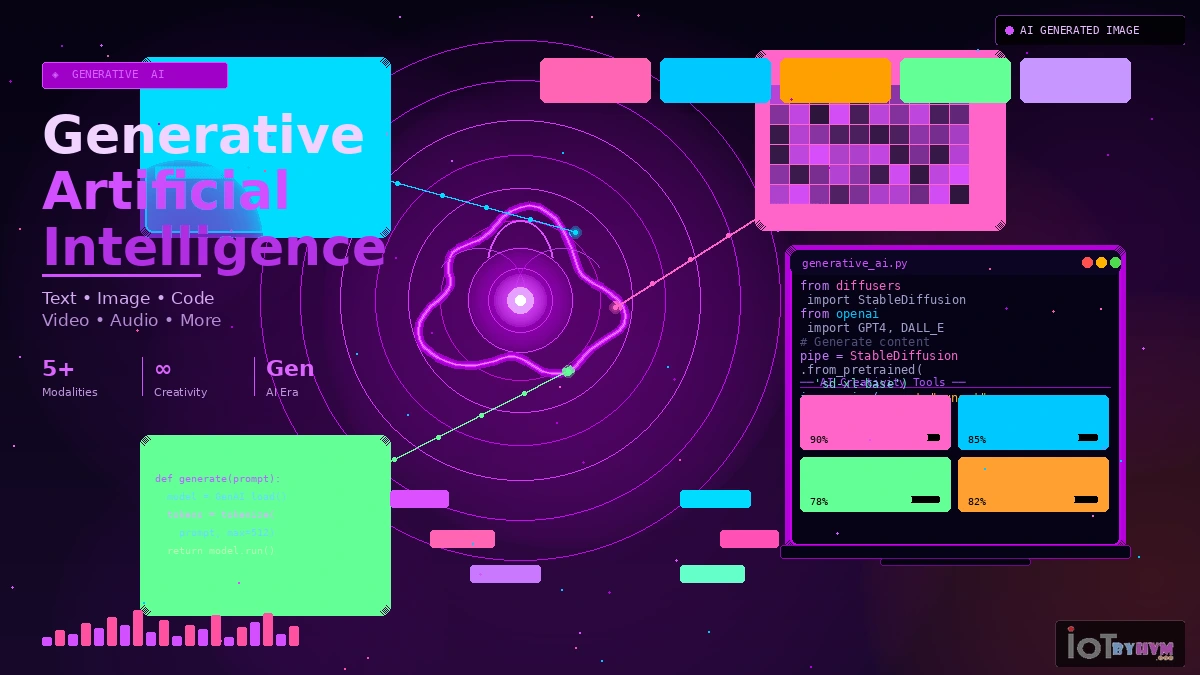
Generative AI Explained: How AI Creates Text, Images, Code, and Videos
Generative AI is one of the most revolutionary developments in artificial intelligence. Unlike traditional AI systems that analyze data and make predictions, generative AI can create entirely new content such as text, images, music, videos, and computer code.
In recent years, generative AI has transformed industries including media, design, marketing, education, and software development. Tools powered by generative AI can write articles, generate realistic images, compose music, and even assist in programming tasks.
If you want to understand how generative AI fits into the complete artificial intelligence learning journey, you can explore Complete Roadmap to Learn AI from Zero to LLMs and Generative AI:
https://iotbyhvm.ooo/complete-roadmap-to-learn-ai-from-zero-to-llms-and-generative-ai/
This roadmap explains the full progression from programming fundamentals and machine learning to advanced AI technologies used in modern applications.
What is Generative AI?
Generative AI refers to artificial intelligence systems that can generate new content based on patterns learned from training data.
Instead of simply analyzing existing data, generative AI models learn the structure and patterns of information and use that knowledge to create new outputs.
For example, generative AI can:
- Write articles and stories
- Generate realistic images
- Create music and audio
- Produce videos and animations
- Generate programming code
These capabilities make generative AI one of the most powerful technologies in modern artificial intelligence.
How Generative AI Works
Generative AI models are trained using large datasets containing examples of text, images, audio, or other types of content.
During training, the model learns patterns and structures within the data.
Once trained, the model can generate new content that resembles the patterns it learned.
The process typically involves:
- Training the model on large datasets
- Learning patterns and relationships within the data
- Generating new outputs based on prompts or inputs from users
Many generative AI systems rely on deep learning architectures such as transformers and neural networks.
Types of Generative AI Models
Several types of models are used to build generative AI systems.
Large Language Models (LLMs)
Large language models generate text by predicting the next word in a sequence based on context.
They are used for:
- chatbots
- content generation
- question answering
- language translation
Generative Adversarial Networks (GANs)
GANs consist of two neural networks working together:
- a generator that creates new data
- a discriminator that evaluates whether the generated data is realistic
GANs are widely used for generating realistic images and videos.
Diffusion Models
Diffusion models generate images by gradually transforming random noise into structured images.
These models have become popular for high-quality image generation.
They are used in modern AI image generation systems.
Applications of Generative AI
Generative AI is being used across many industries and technologies.
Content Creation
Generative AI can produce articles, blog posts, marketing copy, and social media content.
This helps businesses create content faster and more efficiently.
Image Generation
AI tools can generate images from text descriptions.
These tools are widely used in design, advertising, and digital art.
Code Generation
Generative AI can assist developers by generating code snippets, debugging programs, and suggesting improvements.
Video and Audio Generation
Generative AI systems can create synthetic voices, music compositions, and video content.
This technology is transforming the entertainment and media industries.
Education
AI-powered educational tools can generate explanations, quizzes, and study materials for students.
These systems help personalize the learning experience.
Benefits of Generative AI
Generative AI offers several advantages.
Increased Productivity
AI tools can automate creative tasks and accelerate content creation.
Creativity and Innovation
Generative AI enables new forms of digital art and design.
Personalization
AI systems can generate personalized content based on user preferences.
Automation
Many tasks that previously required manual effort can now be automated using generative AI.
Challenges and Concerns
Despite its benefits, generative AI also raises several challenges.
Ethical Concerns
Generated content can sometimes be used to create misleading information or deepfakes.
Copyright Issues
Questions arise about the ownership of AI-generated content.
Computational Cost
Training large generative models requires massive computational resources.
Accuracy and Reliability
Generative AI systems may sometimes generate incorrect or misleading information.
Researchers and policymakers are working to address these challenges while promoting responsible AI development.
The Future of Generative AI
Generative AI is expected to continue evolving rapidly.
Future developments may include:
- more realistic AI-generated media
- advanced human-AI collaboration tools
- improved personalization systems
- more efficient AI models
As technology advances, generative AI will likely become an integral part of many industries and daily applications.
What Comes After Generative AI?
After learning about generative AI, the final stage in the AI learning journey focuses on building real-world AI applications and projects.
This stage involves combining all the skills learned in previous stages—programming, machine learning, deep learning, NLP, transformers, and generative AI—to develop practical AI solutions.
To understand how generative AI fits into the full AI learning journey, explore Complete Roadmap to Learn AI from Zero to LLMs and Generative AI:
https://iotbyhvm.ooo/complete-roadmap-to-learn-ai-from-zero-to-llms-and-generative-ai/
This roadmap provides a complete guide to becoming proficient in artificial intelligence and modern AI technologies.


