
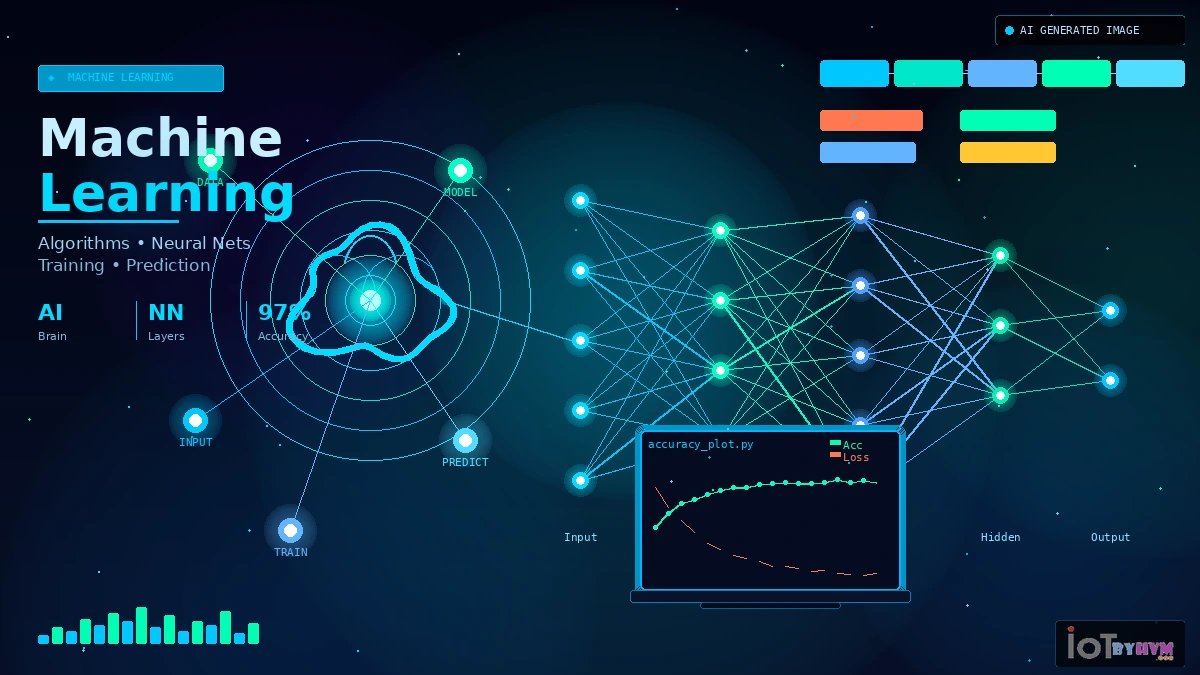
Machine Learning Fundamentals: Algorithms Every AI Developer Should Understand
Machine learning is one of the most important components of artificial intelligence. Instead of programming computers with explicit instructions for every task, machine learning allows systems to learn patterns directly from data and improve their performance over time.
Machine learning is used in many real-world applications such as recommendation systems, fraud detection, medical diagnosis, speech recognition, and autonomous vehicles.
If you want to understand how machine learning fits into the complete AI learning journey, you can explore Complete Roadmap to Learn AI from Zero to LLMs and Generative AI:
https://iotbyhvm.ooo/complete-roadmap-to-learn-ai-from-zero-to-llms-and-generative-ai/
This roadmap explains how learners progress from programming fundamentals and mathematics to advanced technologies such as large language models and generative AI.
What is Machine Learning?
Machine learning is a branch of artificial intelligence that focuses on building algorithms that can learn from data and make predictions or decisions without being explicitly programmed.
Traditional software works using predefined rules written by programmers. In contrast, machine learning systems learn these rules automatically by analyzing datasets.
A typical machine learning process involves:
- Collecting data
- Preparing and cleaning the data
- Training a machine learning model
- Evaluating model performance
- Using the model to make predictions
The more relevant data a model receives, the better it can learn patterns and improve its predictions.
Types of Machine Learning
Machine learning can generally be divided into three main categories.
Supervised Learning
Supervised learning is the most common type of machine learning. In this approach, models are trained using labeled datasets, where both input data and correct output values are provided.
The model learns the relationship between inputs and outputs so it can make predictions on new data.
Examples of supervised learning tasks include:
- Email spam detection
- House price prediction
- Medical diagnosis
- Image classification
Common supervised learning algorithms include:
- Linear Regression
- Logistic Regression
- Decision Trees
- Support Vector Machines
Unsupervised Learning
In unsupervised learning, models work with unlabeled data. The algorithm tries to discover hidden patterns or structures within the dataset.
This approach is useful for exploring large datasets where the correct outputs are not known.
Examples of unsupervised learning applications include:
- Customer segmentation
- Market basket analysis
- Pattern discovery in datasets
Common unsupervised learning algorithms include:
- K-Means Clustering
- Hierarchical Clustering
- Principal Component Analysis (PCA)
Reinforcement Learning
Reinforcement learning is a type of machine learning where an agent learns by interacting with an environment and receiving rewards or penalties based on its actions.
The goal of the agent is to maximize cumulative rewards over time.
Reinforcement learning is commonly used in:
- Robotics
- Game AI
- Autonomous vehicles
- Recommendation systems
One well-known example is AI systems that learn to play complex games such as chess or Go.
Important Machine Learning Algorithms
Understanding key algorithms is essential for anyone learning machine learning.
Linear Regression
Linear regression is one of the simplest machine learning algorithms used for predicting continuous values.
It works by finding the best-fit line that describes the relationship between input variables and the output.
For example, linear regression can be used to predict:
- House prices
- Sales forecasts
- Temperature trends
Logistic Regression
Logistic regression is used for classification tasks where the output belongs to a specific category.
Examples include:
- Spam vs non-spam email detection
- Fraud detection
- Disease prediction
Although it is called regression, logistic regression is primarily used for classification problems.
Decision Trees
Decision trees are models that make predictions by splitting data into branches based on feature values.
They are easy to understand and interpret because the decision process resembles a flowchart.
Decision trees are commonly used for:
- Customer analysis
- Risk assessment
- Classification tasks
K-Nearest Neighbors (KNN)
KNN is a simple algorithm that classifies data points based on their similarity to nearby data points.
When making predictions, the algorithm looks at the closest neighbors in the dataset and determines the most common category.
This algorithm is often used for:
- Recommendation systems
- Pattern recognition
- Image classification
Support Vector Machines (SVM)
Support Vector Machines are powerful algorithms used for classification and regression tasks.
They work by finding the optimal boundary that separates different classes in the dataset.
SVMs are effective for high-dimensional datasets and are widely used in:
- Image classification
- Text classification
- Bioinformatics
Model Training and Evaluation
After selecting a machine learning algorithm, the next step is training the model using a dataset.
The dataset is typically divided into two parts:
- Training data
- Testing data
The training data is used to teach the model patterns, while the testing data evaluates how well the model performs on unseen data.
Common Evaluation Metrics
Machine learning models are evaluated using various performance metrics.
Some commonly used metrics include:
Accuracy
Accuracy measures the percentage of correct predictions made by the model.
Precision
Precision evaluates how many predicted positive results are actually correct.
Recall
Recall measures how many actual positive cases the model successfully identifies.
F1 Score
The F1 score combines precision and recall into a single performance metric.
Choosing the correct evaluation metric depends on the type of machine learning problem.
Real-World Applications of Machine Learning
Machine learning is used in many industries and technologies.
Examples include:
- Recommendation systems used by streaming platforms
- Fraud detection in banking systems
- Image recognition in smartphones
- Voice assistants and speech recognition
- Healthcare diagnostics
As machine learning models continue to improve, they are becoming increasingly important in modern technology.
What Comes After Machine Learning?
After understanding machine learning fundamentals, the next stage in the AI learning journey is deep learning.
Deep learning uses neural networks with multiple layers to solve complex problems such as image recognition, speech processing, and natural language understanding.
To understand how machine learning connects with the full AI learning journey, explore Complete Roadmap to Learn AI from Zero to LLMs and Generative AI:
https://iotbyhvm.ooo/complete-roadmap-to-learn-ai-from-zero-to-llms-and-generative-ai/
This roadmap explains how learners progress from programming and mathematics to advanced AI technologies such as transformers and generative AI systems.


