
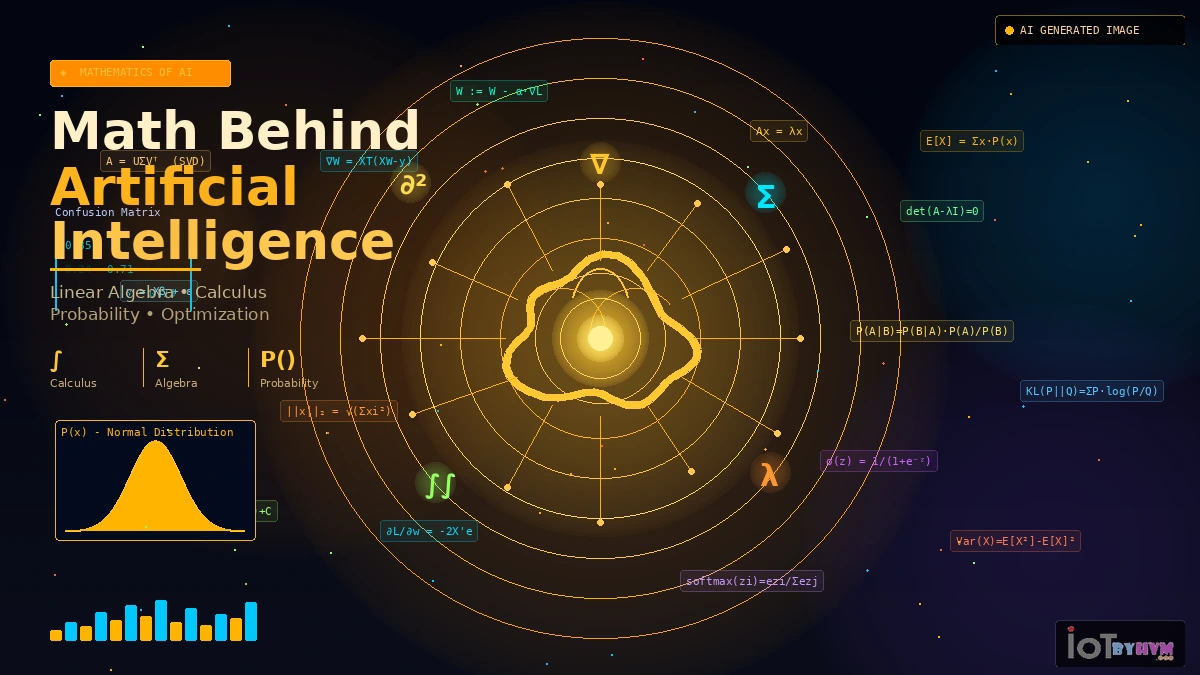
Mathematics for Artificial Intelligence: Linear Algebra, Probability, and Calculus Explained
Artificial Intelligence systems are powered by algorithms, but behind those algorithms lies a strong mathematical foundation. Mathematics helps AI models understand patterns, optimize decisions, and process large datasets efficiently.
Many beginners try to jump directly into machine learning libraries without understanding the mathematics behind them. While libraries can help you build models quickly, understanding mathematical concepts allows you to truly understand how AI systems work.
If you want to follow the full step-by-step AI learning journey, you can explore Complete Roadmap to Learn AI from Zero to LLMs and Generative AI:
https://iotbyhvm.ooo/complete-roadmap-to-learn-ai-from-zero-to-llms-and-generative-ai/
This roadmap explains every stage required to move from beginner programming skills to advanced AI systems such as large language models and generative AI.
Why Mathematics is Important for Artificial Intelligence
Artificial intelligence models rely heavily on mathematical concepts to learn patterns from data. Algorithms use mathematical formulas to calculate predictions, adjust parameters, and improve performance.
Mathematics helps AI systems perform tasks such as:
- Optimizing model parameters
- Understanding relationships between variables
- Processing large datasets efficiently
- Measuring prediction errors
- Improving model accuracy
Without mathematical understanding, AI development becomes a “black box,” where models work but developers cannot fully explain why.
Core Mathematical Areas Required for AI
Artificial intelligence primarily depends on three major branches of mathematics:
- Linear Algebra
- Probability and Statistics
- Calculus
Each of these areas plays a crucial role in machine learning and deep learning algorithms.
Linear Algebra
Linear algebra is one of the most important mathematical foundations of artificial intelligence. Many AI algorithms rely on vectors, matrices, and matrix operations to process data.
In machine learning, datasets are usually represented as matrices, where rows represent observations and columns represent features.
Important concepts in linear algebra include:
Vectors
Vectors represent quantities that have both magnitude and direction. In AI, vectors are commonly used to represent features in datasets.
Example:
A dataset describing houses may contain vectors representing:
- Size of the house
- Number of rooms
- Location rating
These features together form a vector that machine learning models can analyze.
Matrices
Matrices are rectangular arrays of numbers arranged in rows and columns.
In machine learning:
- Rows represent data samples
- Columns represent features
Many AI operations involve matrix multiplication and transformations.
For example, neural networks use matrix operations to compute predictions and update model weights.
Eigenvalues and Eigenvectors
Eigenvalues and eigenvectors are used in many machine learning techniques such as Principal Component Analysis (PCA).
PCA helps reduce the dimensionality of datasets while preserving important information.
This is useful when working with high-dimensional datasets such as images or text data.
Probability and Statistics
Probability and statistics help AI models deal with uncertainty and make predictions based on data.
Most machine learning algorithms rely on statistical principles to estimate relationships between variables.
Important concepts include:
Probability
Probability measures the likelihood of an event occurring.
In AI systems, probability helps determine:
- The likelihood of predictions
- Model confidence
- Uncertainty in decision-making
For example, a spam detection model might predict:
- 90% probability of spam
- 10% probability of non-spam
Distributions
Statistical distributions describe how values are spread across a dataset.
Common distributions used in AI include:
- Normal distribution
- Bernoulli distribution
- Binomial distribution
Understanding distributions helps developers analyze patterns in data.
Mean, Median, and Variance
These statistical measures help summarize datasets.
Mean represents the average value, while variance measures how much values differ from the average.
These metrics are frequently used during data preprocessing and model evaluation.
Calculus in Artificial Intelligence
Calculus plays an important role in optimizing machine learning models.
Many AI algorithms rely on optimization techniques that use calculus to minimize prediction errors.
Derivatives
Derivatives measure how a function changes when its input changes.
In machine learning, derivatives are used to calculate how model parameters should change to reduce prediction error.
Gradient Descent
Gradient descent is one of the most important optimization algorithms in artificial intelligence.
It helps models learn by adjusting parameters step by step to minimize the loss function.
Neural networks use gradient descent during training to update their weights.
Partial Derivatives
In deep learning, models often contain thousands or millions of parameters.
Partial derivatives help calculate how each parameter affects the overall model output.
This process is used during backpropagation, which is essential for training neural networks.
Do You Need Advanced Mathematics for AI?
Many beginners worry that AI requires extremely advanced mathematics. In reality, you do not need to be a mathematician to start learning artificial intelligence.
For beginners, understanding the following concepts is usually enough:
- Basic linear algebra
- Basic probability and statistics
- Introductory calculus
As you progress into advanced machine learning and deep learning, you can gradually deepen your mathematical knowledge.
Best Resources to Learn AI Mathematics
Some recommended resources include:
- Khan Academy for linear algebra and calculus
- MIT OpenCourseWare lectures
- Books such as Mathematics for Machine Learning
- YouTube lectures on probability and statistics
Combining theoretical learning with practical coding exercises helps build a stronger understanding of AI concepts.
What Comes After Mathematics for AI?
After developing a basic understanding of mathematics, the next stage in the AI learning journey is data analysis and data science.
In this stage, learners focus on working with real datasets, cleaning data, visualizing patterns, and preparing datasets for machine learning models.
To see how mathematics fits into the entire AI learning path, you can explore Complete Roadmap to Learn AI from Zero to LLMs and Generative AI:
https://iotbyhvm.ooo/complete-roadmap-to-learn-ai-from-zero-to-llms-and-generative-ai/
This roadmap explains the step-by-step progression from programming fundamentals to advanced AI technologies such as transformers and large language models.


