
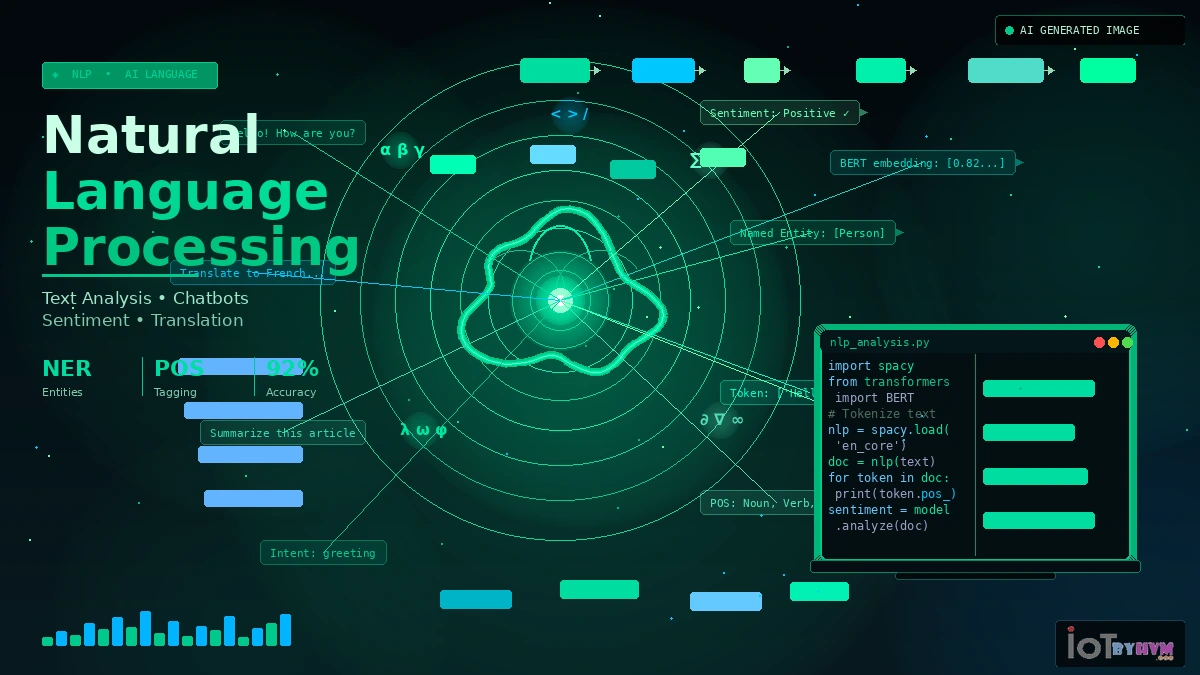
Natural Language Processing (NLP): How AI Understands Human Language
Natural Language Processing (NLP) is one of the most exciting areas of artificial intelligence. It focuses on enabling computers to understand, interpret, and generate human language in a meaningful way.
From chatbots and voice assistants to translation systems and search engines, NLP powers many technologies that interact with human language daily. As AI systems become more advanced, NLP is playing an increasingly important role in how machines communicate with people.
If you want to understand how NLP fits into the complete AI learning journey, you can explore Complete Roadmap to Learn AI from Zero to LLMs and Generative AI:
https://iotbyhvm.ooo/complete-roadmap-to-learn-ai-from-zero-to-llms-and-generative-ai/
This roadmap explains the entire path from beginner programming concepts to advanced AI technologies such as transformers, large language models, and generative AI.
What is Natural Language Processing?
Natural Language Processing is a branch of artificial intelligence that enables computers to understand, analyze, and generate human language.
Human languages such as English, Hindi, and Spanish are complex and full of ambiguity. NLP helps computers process these languages by combining techniques from:
- Artificial Intelligence
- Linguistics
- Machine Learning
- Deep Learning
By using NLP techniques, machines can perform tasks such as reading text, understanding meaning, and generating human-like responses.
Why NLP is Important in Artificial Intelligence
Most human knowledge is stored in text form, including books, websites, articles, and documents. NLP allows machines to extract useful information from this massive amount of textual data.
NLP makes it possible for AI systems to:
- Understand written text
- Process spoken language
- Translate between languages
- Analyze customer feedback
- Generate human-like responses
These capabilities make NLP essential for building intelligent conversational systems and modern AI applications.
Common Applications of NLP
Natural Language Processing is widely used in many technologies and industries.
Chatbots and Virtual Assistants
Chatbots and AI assistants use NLP to understand user queries and respond with relevant information.
Examples include:
- Customer support chatbots
- Voice assistants
- AI-powered help systems
Machine Translation
NLP enables automatic translation between languages.
Translation systems analyze sentence structure, grammar, and context to produce accurate translations.
Sentiment Analysis
Sentiment analysis is used to determine the emotional tone behind a piece of text.
Businesses use sentiment analysis to understand:
- Customer reviews
- Social media feedback
- Public opinion about products
Text Summarization
NLP systems can automatically summarize long documents by extracting key information.
This technology is used in:
- News summarization
- Research document analysis
- Automated report generation
Search Engines
Search engines rely heavily on NLP to understand user queries and deliver relevant results.
NLP helps search engines interpret the meaning behind search phrases rather than just matching keywords.
Important NLP Concepts
Understanding several key concepts is essential when learning natural language processing.
Tokenization
Tokenization is the process of breaking text into smaller units called tokens.
Tokens may include:
- Words
- Sentences
- Subwords
For example, the sentence:
“Artificial Intelligence is transforming technology.”
May be tokenized into:
Artificial | Intelligence | is | transforming | technology
Tokenization is usually the first step in NLP pipelines.
Stop Words Removal
Stop words are common words that often carry little meaning in text analysis.
Examples include:
- the
- is
- and
- in
- of
Removing stop words helps NLP models focus on the most meaningful parts of the text.
Stemming and Lemmatization
These techniques reduce words to their base form.
Example:
Running → Run
Played → Play
This helps models treat different forms of the same word as the same concept.
Word Embeddings
Word embeddings represent words as numerical vectors that capture semantic meaning.
This allows AI models to understand relationships between words.
For example:
King – Man + Woman ≈ Queen
Popular word embedding techniques include:
- Word2Vec
- GloVe
- FastText
These methods convert words into mathematical representations that machine learning models can process.
NLP Libraries and Tools
Several powerful tools help developers build NLP applications.
NLTK (Natural Language Toolkit)
NLTK is one of the most widely used libraries for NLP tasks.
It supports:
- Tokenization
- Text processing
- Sentiment analysis
- Language modeling
SpaCy
SpaCy is a modern NLP library designed for efficiency and production use.
It provides tools for:
- Named entity recognition
- Dependency parsing
- Text classification
Hugging Face Transformers
Hugging Face provides powerful transformer models used for modern NLP tasks such as text generation, summarization, and translation.
These models are widely used in advanced AI applications.
Challenges in Natural Language Processing
Despite significant progress, NLP still faces several challenges.
Ambiguity in Language
Words and sentences can have multiple meanings depending on context.
Complex Grammar
Human languages have complex grammatical structures that can be difficult for machines to interpret.
Cultural and Contextual Understanding
Understanding cultural context and nuanced meaning remains challenging for AI systems.
Researchers continue to develop advanced models to improve language understanding.
What Comes After NLP?
After learning natural language processing fundamentals, the next stage in the AI learning journey focuses on transformer architectures.
Transformers are the technology that revolutionized modern NLP and enabled the development of powerful systems such as large language models.
To understand how NLP connects with the complete AI learning path, explore Complete Roadmap to Learn AI from Zero to LLMs and Generative AI:
https://iotbyhvm.ooo/complete-roadmap-to-learn-ai-from-zero-to-llms-and-generative-ai/
This roadmap explains the entire journey from programming fundamentals to advanced technologies such as transformers and generative AI.


