
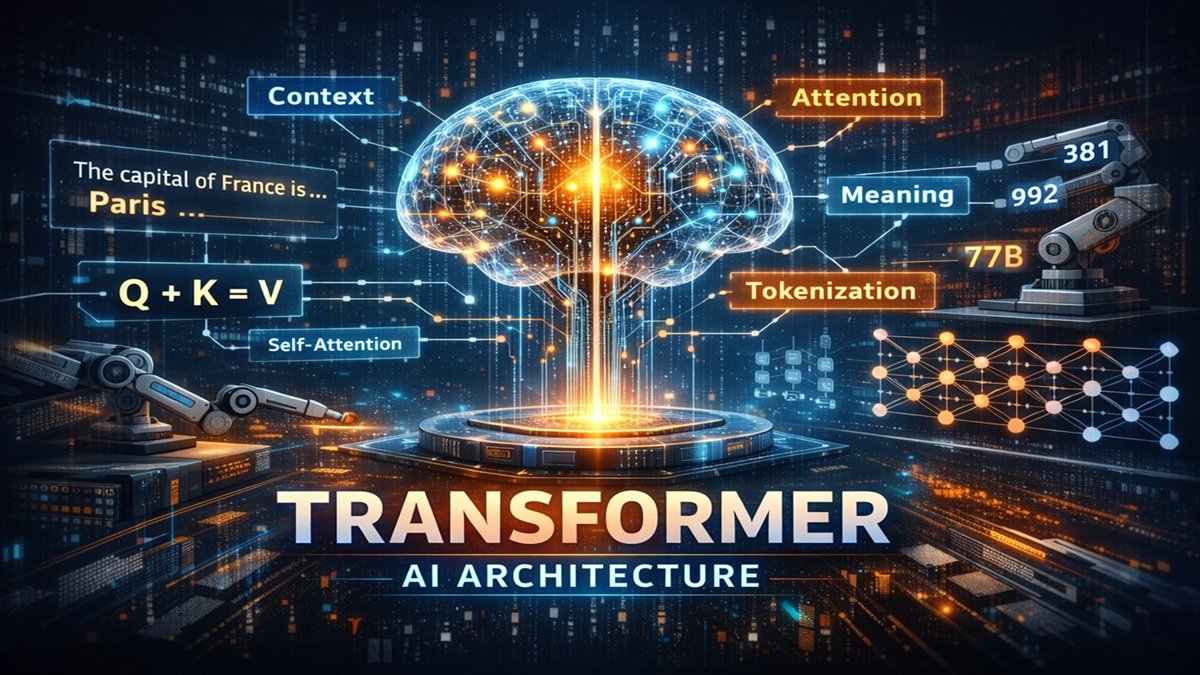
Transformer Architecture in Artificial Intelligence — A Complete Beginner-to-Advanced Guide
Artificial Intelligence changed forever after one research paper in 2017:
“Attention Is All You Need”
That paper introduced the Transformer — the brain design used today in ChatGPT-like models, LLaMA, Gemini-style systems, code generators, translation engines, and even image generators.
If you understand Transformer, you understand modern AI.
This article explains it from zero → deep technical clarity in simple English.
1. The Core Idea (One Sentence)
A Transformer is a neural network that understands language by looking at all words at the same time and calculating how strongly they relate to each other.
It does not read word-by-word.
It reads the whole sentence together.
2. Why Old AI Models Failed
Before Transformers, models used:
- RNN (Recurrent Neural Networks)
- LSTM
- GRU
They processed text like a human reading letter-by-letter:
The → cat → sat → on → the → mat
Problems
| Problem | Result |
|---|---|
| Sequential reading | Very slow training |
| Forget long sentences | Bad understanding |
| Weak context memory | Wrong answers |
| Hard to scale | Could not build large AI |
Example failure:
“The trophy did not fit in the suitcase because it was too big.”
Old models could not reliably know what “it” refers to.
3. The Breakthrough: Self-Attention
Transformers introduced a new concept:
Self-Attention
Instead of reading left-to-right, the model compares every word with every other word.
It builds a relationship map.
For example:
“The dog chased the cat because it was scared.”
The model calculates:
| Word | Pays Attention To |
|---|---|
| it | cat |
| chased | dog |
| scared | cat |
Now the AI understands meaning, not just order.
4. How Text Becomes Numbers
Computers don’t understand words.
They understand numbers.
Step 1 — Tokenization
Text is broken into tokens (pieces):
"Transformers are powerful"
↓
["Transform", "ers", "are", "power", "ful"]
↓
[3812, 992, 45, 7712, 332]
Step 2 — Embedding (Meaning Space)
Each token becomes a vector (a coordinate in high-dimensional space).
Words with similar meanings are placed close together.
King - Man + Woman ≈ Queen
Paris - France + Italy ≈ Rome
The AI now has a mathematical meaning map.
Step 3 — Positional Encoding
Transformers read everything simultaneously — so they need word order manually added.
I love dogs
Dogs love I
Same words, different meaning.
So position numbers are injected into embeddings.
5. The Heart of Transformer — Attention Math (Simple Explanation)
Each word creates three vectors:
| Vector | Purpose |
|---|---|
| Query | What am I looking for? |
| Key | What do I represent? |
| Value | What information I carry |
The model calculates:
Similarity(Query, Key) → importance score
importance × Value → meaning contribution
This produces contextual meaning.
So the word bank becomes:
- river bank (nature context)
- money bank (finance context)
No dictionary required — context decides.
6. Multi-Head Attention (Multiple Brains)
One attention is not enough.
The Transformer runs many attentions in parallel:
| Attention Head | Learns |
|---|---|
| Grammar | Subject-verb relation |
| Semantics | Meaning |
| Topic | Subject domain |
| Tone | Emotion |
| Logic | Reasoning |
All combined → deep understanding.
7. Deep Layers (Stacked Understanding)
A real Transformer has many layers:
Layer 1 → basic relations
Layer 5 → phrases
Layer 12 → sentences
Layer 24 → reasoning
Layer 80+ → abstract thinking
More layers = smarter model.
This is why 70B models reason better than 7B models.
8. Encoder vs Decoder
There are two types of Transformers.
Encoder (Understanding Models)
Reads text and understands it.
Used in:
- BERT
- Classification
- Search engines
- Embeddings
Input → Meaning
Decoder (Generation Models)
Predicts next word repeatedly.
Used in:
- ChatGPT
- LLaMA
- Mistral
- Phi-3
Meaning → Text generation
Encoder-Decoder (Translator Models)
Used in:
- Google Translate
- T5
Input language → Output language
9. How an LLM Actually Talks
An LLM never “thinks”.
It only predicts next token repeatedly:
User: The capital of France is
Model: Paris
Process:
- Read all tokens
- Calculate attention
- Predict most probable next token
- Append token
- Repeat
Conversation = thousands of probability predictions.
10. Why GPUs Are Required
Transformer calculations are matrix multiplications:
Millions of them simultaneously.
CPU = few big workers
GPU = thousands of small workers
Since Transformer is parallel, GPU makes it fast.
This is why local LLM on CPU is slow.
Read This: CPU vs GPU: What’s the Difference and Why It Matters for AI, Gaming, and Everyday Computing
11. Scaling Law (Why Bigger Models Are Smarter)
Performance grows with:
- Parameters
- Data
- Compute
| Size | Ability |
|---|---|
| 3B | basic chat |
| 7B | decent answers |
| 13B | good reasoning |
| 70B | expert-level |
| 1T+ | near human-level patterns |
More neurons = more relationships learned.
12. What Transformers Can Do
Because attention finds patterns, the same architecture works everywhere:
| Field | Example |
|---|---|
| Chat | ChatGPT |
| Coding | Copilot |
| Images | Stable Diffusion |
| Video | Sora-type models |
| Audio | Speech recognition |
| Biology | Protein folding |
| Search | Semantic search |
Transformer is not a language model.
Language is just one application.
13. The Most Important Insight
The Transformer does not store knowledge like a database.
It stores relationships between patterns.
It doesn’t remember facts.
It predicts what text usually follows similar patterns.
That is why:
- It can reason
- But can hallucinate
14. Complete Flow of a Transformer Model
Text Input
   ↓
Tokenization
   ↓
Embedding
   ↓
Add Position Info
   ↓
Self Attention Layers
   ↓
Deep Neural Processing
   ↓
Probability Distribution
   ↓
Next Token Output
   ↓
Repeat (generation)
Final Understanding
A Transformer is essentially:
A giant probability engine that understands relationships between words, not the words themselves.
It builds a dynamic meaning map every time you type a sentence.
That single idea enabled modern AI.


