
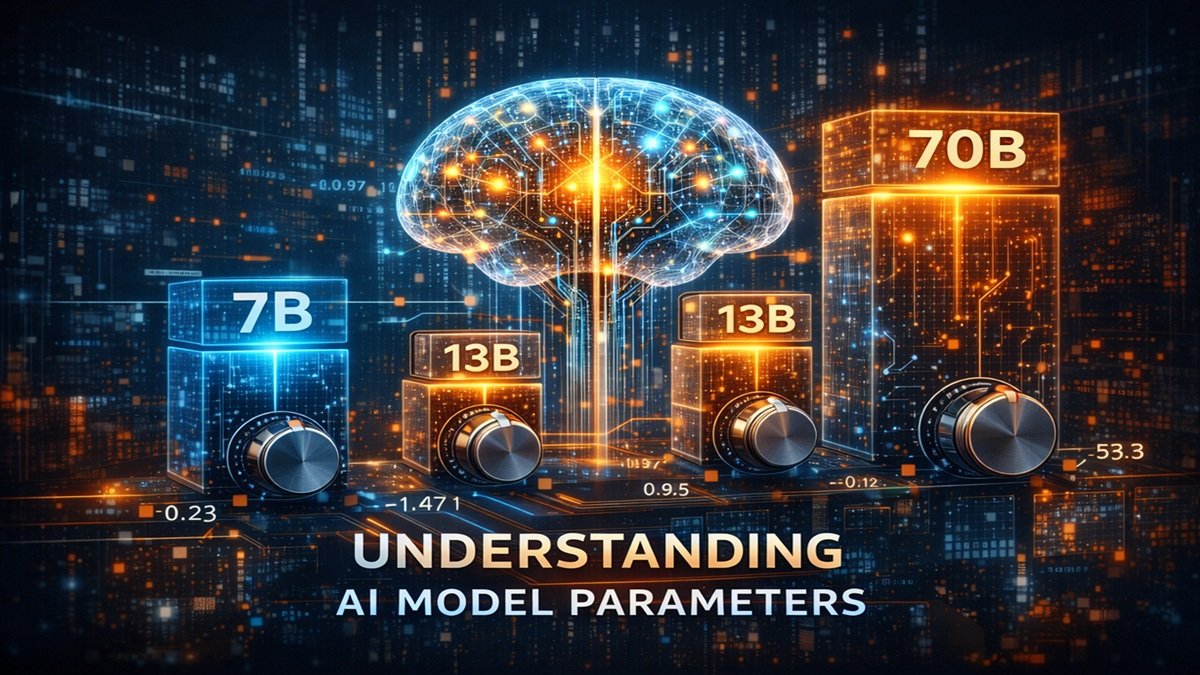
Understanding 7B, 13B, and 70B in AI Models — What “Parameters” Really Mean
When people download or run an AI model, they usually see names like:
- 7B model
- 13B model
- 70B model
Most beginners assume this means:
Bigger number = more knowledge stored
But that is not true.
The number does not represent stored data.
It represents how complex the brain of the AI is.
To truly understand modern AI and LLMs, you must understand one word:
Parameters
What Is a Parameter?
A parameter is a learned numerical value inside a neural network.
In simple terms:
A parameter is a tiny adjustable connection strength between artificial neurons.
Imagine the AI brain as a giant control panel with billions of knobs.
Each knob adjusts how strongly one concept influences another.
Small AI → fewer knobs
Large AI → billions of knobs
| Model Size | Meaning |
|---|---|
| 7B | 7 billion adjustable connections |
| 13B | 13 billion adjustable connections |
| 70B | 70 billion adjustable connections |
The model becomes more intelligent because it can represent more relationships between ideas.
The Math Behind a Parameter
Every neural network layer performs a calculation like this:
Output=Activation(Input×Weight+Bias)
The weight is the parameter.
During training, the AI adjusts these numbers millions of times until predictions become accurate.
So a 70B model literally contains:
70,000,000,000 learned numbers
Not facts. Not sentences. Just numbers that shape behavior.
Read This: Transformer Architecture in Artificial Intelligence — A Complete Beginner-to-Advanced Guide
Where Do Billions of Parameters Come From?
Modern AI models are based on the Transformer architecture.
Each layer inside the Transformer contains multiple large matrices.
Let’s simplify.
If the model’s internal representation size is 4096:
4096×4096=16,777,216parametersinonematrix
And each layer contains many such matrices.
So:
| Layers | Approx Parameters |
|---|---|
| ~32 layers | 7B |
| ~40 layers | 13B |
| ~80+ layers | 70B |
The difference between models is not just width — it is depth and complexity.
What Increasing Parameters Actually Improves
1. Understanding Relationships
Small model:
“Einstein discovered gravity”
Large model:
Understands difference between Newtonian gravity and relativity
Because it has enough capacity to separate concepts.
2. Reasoning Ability
AI does not use logic rules.
It learns patterns of reasoning from data.
Large models can represent patterns like:
If A causes B
and B causes C
then A may influence C
Small models cannot fit enough reasoning patterns.
3. Long Context Understanding
A small model struggles with long conversations because it compresses meaning poorly.
A larger model builds a higher dimensional representation of context and remembers relationships across paragraphs.
4. Reduced Hallucination
Hallucination happens when the same neuron must represent too many meanings.
Small model:
- One neuron = many concepts
Large model:
- Separate internal structures for separate concepts
More parameters = clearer concept boundaries
Parameters vs Memory Usage
People often confuse parameter count with RAM usage.
Approximate memory requirement in FP16 precision:
| Model | RAM Required |
|---|---|
| 7B | ~14 GB |
| 13B | ~26 GB |
| 70B | ~140 GB |
Quantization reduces RAM usage but does not reduce learned intelligence structure proportionally.
Important Truth: AI Does Not Store Facts
The model does not remember:
Paris is the capital of France
Instead it learns probability behavior:
After the phrase “capital of France is”, the token “Paris” has extremely high probability.
So an LLM is a probability engine, not a database.
Why Intelligence Suddenly Appears in Large Models
When parameter count crosses certain thresholds, models gain new abilities.
This is called emergent capability.
Small models → pattern matching
Large models → abstraction and reasoning
That is why a 70B model feels dramatically smarter than a 7B model, not just ten times better.
Read This: Regular LLM vs Reasoning LLM: What’s Actually Different and Why It Matters
Final Mental Model
Think of AI as a map of reality.
- Small model → low resolution map
- Large model → high resolution simulation
More parameters do not add knowledge directly.
They increase the resolution of understanding.
Now when you see model names like 7B, 13B, or 70B, you can interpret them correctly:
They describe how detailed the AI’s internal world model is — not how much text it memorized.


