
Understanding Centrifugal Switches
What is a Centrifugal Switch?
The centrifugal switch is a switch that utilizes the effect of centrifugal force to control a circuit. It is principally used for starting and stopping a single-phase motor. Centrifugal switches thus serve to engage and disengage the running and starting windings with respect to motor speed to allow for smooth starts and efficient operation in a motor application.

Structural Components of Centrifugal Switch
Magnet: The magnet is the central component to the centrifugal switch; hence it consists of two control magnets and one movable magnet engaged by means of a spring. Based on power signal changes, the function of the magnet involves creating optimal magnetic fields to drive the movement of the swing arm.
Swing rod: The swing rod is the working element of the centrifugal switch. It consists of a weight and a pin, connected by a sliding mechanism. The swing rod provides varying centrifugal forces acting on the pin in response to the driving action for movement by the magnet.
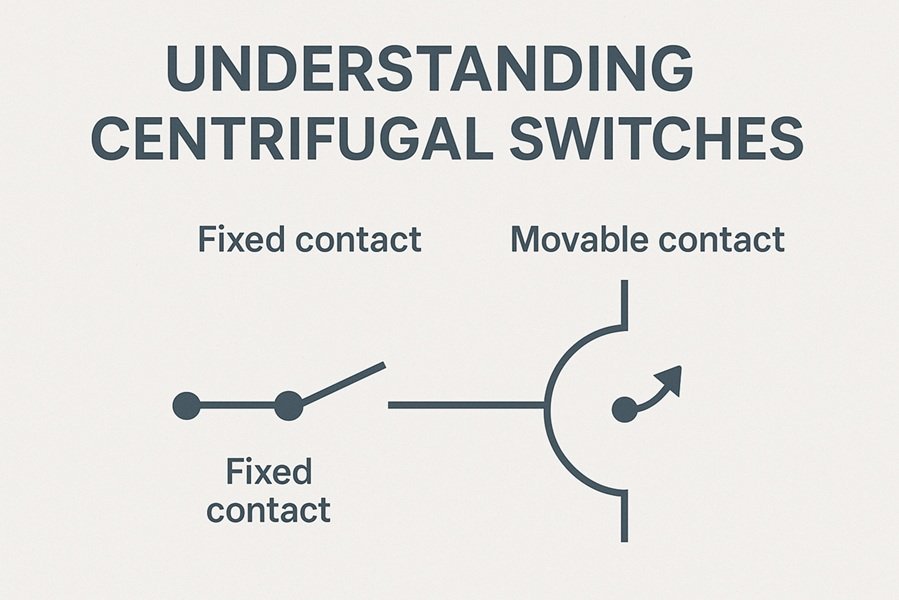
Contactor: The contactor is the control element of the centrifugal switch; it consists of a fixed contact and a movable contact, associated by a spring. The function of the contactor is to make or break connections due to the movement of the pin.
Special wiring body: The special wiring body is the connecting part of the centrifugal switch. It is composed of a wire and a plug, and they are connected by welding. The function of the special wiring body is to introduce power signals from the outside to provide current to the magnets.
The Principle of the Centrifugal Switch
A centrifugal switch uses the principle of centrifugal force to operate a circuit. It is primarily used to start and stop single-phase motors. The working of the centrifugal switch is as follows:
When the motor is at rest, the magnet attracts the swing rod and closes the contactor so the start winding and run winding can work in parallel. At this time, the motor’s speed is low and requires larger starting current and starting torque.
When the motor reaches a certain speed, the swing rod is affected by centrifugal force, pushing the pin to move, causing the contactor to disconnect, the starting winding to exit, and only the running winding to work. At this time, the motor speed is higher and requires smaller operating current and operating torque.
Upon stopping the motor, the swing rod returns to its original position under the influence of spring force, closing the contactor and creating another parallel connection between the start and running winding.

Advantages and Disadvantages of Centrifugal Switches
Advantages:
The centrifugal switch automatically starts and stops the motor without any man-in-the-loop controls and is easy to operate.
The centrifugal switch accomplishes a progressive action in connecting and disconnecting the starting and running winding as a function of motor speed, granting smooth run up of the motor in operation condition.
The centrifugal switch ideally avoids the chances of getting either a heavy load due to motor run up or excess heat development in the starting winding, hence safeguarding the safety of a motor and capacitor.
Centrifugal switches save electrical energy and less motor loss and noise.
Disadvantages:
The centrifugal switch is a mechanical switch that undergoes mechanical wear and tear, being liable to sincere mechanical malfunction and is in dire need of inspection and maintenance at frequent intervals.
Speed of disconnection is one of the most common drawbacks of the centrifugal switch which is caused by other factors like load, supply voltage, and temperature. This may result in premature or shy disconnection and, in severe cases, lead to device failure or general motor failure.
Sparks or adhesion between centrifugal switch contacts raise safety issues concerning short circuiting and fires.
Test Methods for Centrifugal Switches
Test method of electronic centrifugal switch: The electronic centrifugal switch, as stated, becomes an intelligent electronic switch that automatically establishes the motor frequency and the pole number through feedback of motor speed. The method of testing involves connecting the centrifugal switch with power supply, reading the supply voltage and frequency-first establishing the motor frequency at either 50Hz or 60Hz-then proceeding to tests on the poles of the motor and then controlling the motor under the frequency and number of poles determining corresponding correct motor conditions.
Test method of mechanical centrifugal switch: A mechanical centrifugal switch is one that uses a swing rod and a contactor to control a circuit. To perform tests, the centrifugal switch is powered directly, observing that the swing rod and contactor operate normally, making sure that the contactor does not present sparks or adhere, and checking to ensure the windings are in working condition and measuring to confirm that they meet the directives.
Multimeter test method: A multimeter is an instrument designed for measuring a wide variety of physical quantities, among them voltage, current, resistances, etc. The test method consists of switching the multimeter to the ohm position and measuring the resistance values at both terminals of the centrifugal switch. The closed position of the centrifugal switch should show a very low resistance value whereas an open position should show an infinite resistance value.
Test lamp method: A test lamp is a simple tool that can be used to determine if a specific circuit is connected or disconnected. This is performed by connecting the test lamp, with its end at spiral switch points. When the centrifuge switch closes, the test lamp glows; when it is opened, the light goes out.
Application of Centrifugal Switch
The centrifugal switch is used in perhaps all kinds of single-phase motors: grinders, mixers, compressors, blowers, pumps, cranes, submersible motors, and cleaners. The centrifugal switch provides protection against overload and overheating, saves electricity, reduces noise, and increases efficiency and lifespan. In addition to single-phase motors, centrifugal switches have applications such as electronic centrifugal and signal switches.


