
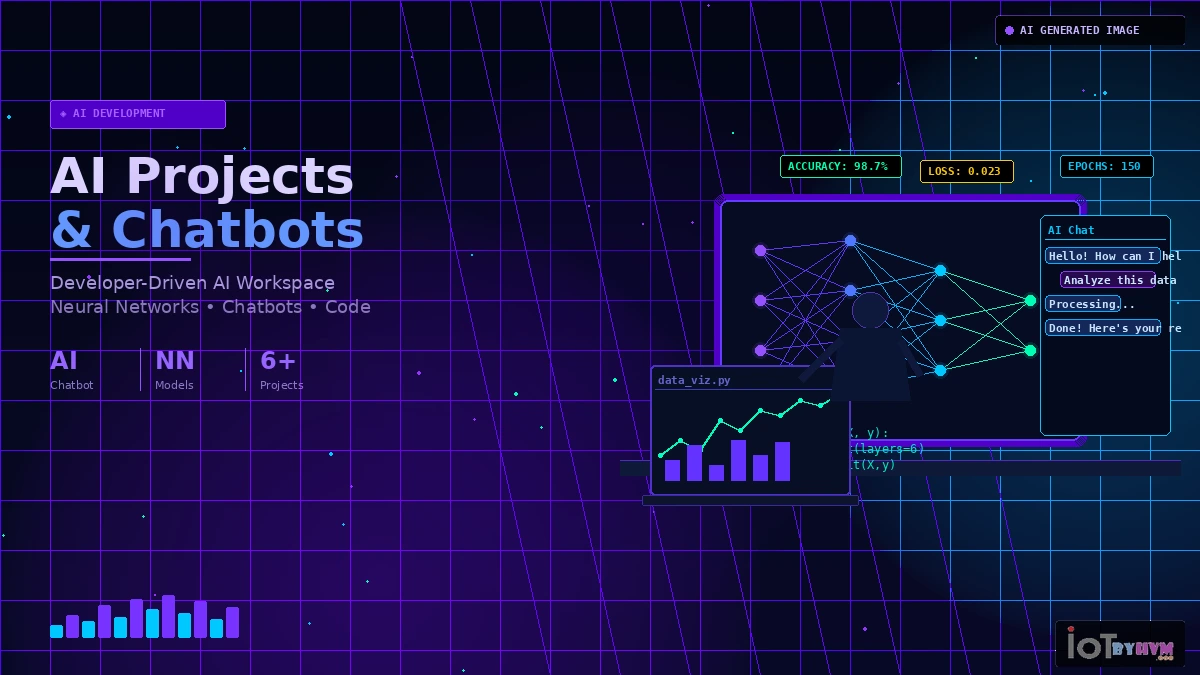
Building Real AI Projects: Applying Artificial Intelligence Skills in Real-World Applications
Learning artificial intelligence involves understanding concepts such as programming, mathematics, machine learning, deep learning, natural language processing, transformers, and generative AI. However, the final and most important stage of the AI journey is building real-world projects.
Practical projects allow you to apply theoretical knowledge to solve real problems. They help you gain hands-on experience, strengthen your understanding of AI systems, and build a strong portfolio for career opportunities.
If you want to see how this stage fits into the entire AI learning journey, explore Complete Roadmap to Learn AI from Zero to LLMs and Generative AI:
https://iotbyhvm.ooo/complete-roadmap-to-learn-ai-from-zero-to-llms-and-generative-ai/
This roadmap explains the complete path from beginner programming fundamentals to advanced AI technologies and real-world AI applications.
Why Real AI Projects Are Important
Learning AI concepts through tutorials and courses is helpful, but building projects is what truly develops practical expertise.
Working on real AI projects helps you:
- Apply theoretical knowledge to practical problems
- Understand real-world data challenges
- Improve problem-solving skills
- Build a professional portfolio
- Gain experience with AI tools and deployment systems
Employers and clients often value real projects and practical experience more than theoretical knowledge alone.
Types of Real AI Projects You Can Build
Once you understand the fundamentals of AI, you can begin building practical applications. These projects combine different AI technologies to solve real-world problems.
AI Chatbot
An AI chatbot is one of the most popular beginner projects in artificial intelligence.
Chatbots use natural language processing and large language models to understand user queries and provide responses.
Common chatbot applications include:
- Customer support automation
- Educational assistants
- Virtual help desks
- AI tutoring systems
Building a chatbot helps you understand conversational AI systems and NLP pipelines.
AI Search Engine
AI-powered search engines use machine learning and natural language processing to understand user queries and retrieve relevant information.
Unlike traditional keyword-based search engines, AI search systems can interpret the meaning behind a query.
Key components of an AI search engine include:
- Text embeddings
- Semantic search
- Document indexing
- Ranking algorithms
This type of project is useful for understanding large-scale information retrieval systems.
Document Question-Answering System
A document question-answering system allows users to ask questions about documents and receive accurate answers extracted from the text.
These systems are commonly used in:
- research platforms
- corporate knowledge bases
- legal document analysis
- technical documentation systems
Modern systems often combine language models with document retrieval techniques.
Image Generation Application
Image generation systems allow users to create images using text prompts.
These applications rely on advanced generative models such as diffusion models.
Examples of image generation projects include:
- AI art generation tools
- marketing design assistants
- creative illustration tools
This type of project helps developers understand generative AI systems.
AI Content Generation Tool
AI content generation tools automatically create text content for blogs, marketing, education, and business communication.
These systems use large language models to generate:
- articles
- summaries
- marketing copy
- social media posts
Developing such a tool helps learners understand prompt engineering and AI content workflows.
RAG-Based Chatbot for Documents
Retrieval-Augmented Generation (RAG) is a powerful approach that combines language models with external knowledge sources.
A RAG-based chatbot can retrieve relevant information from documents and use it to generate accurate responses.
This approach is widely used in:
- enterprise AI assistants
- knowledge management systems
- document analysis tools
Building a RAG system is one of the most valuable modern AI projects.
Tools for Deploying AI Applications
After building an AI model, the next step is deploying it so that users can interact with it.
Several tools are commonly used for deploying AI applications.
FastAPI
FastAPI is a modern web framework used for building APIs with Python.
It is commonly used to create APIs for AI models so they can be accessed through web applications.
Advantages include:
- high performance
- easy integration with machine learning models
- automatic API documentation
Docker
Docker allows developers to package applications along with their dependencies into containers.
This ensures that AI applications run consistently across different environments.
Docker is widely used in production AI systems.
Cloud GPU Platforms
Training and running AI models often requires powerful computing resources.
Cloud platforms provide access to GPUs that accelerate AI workloads.
Common platforms include:
- Google Colab
- Kaggle
- cloud GPU servers
These platforms allow developers to train and deploy AI models without expensive hardware.
Building a Strong AI Portfolio
When learning artificial intelligence, it is helpful to create a portfolio that demonstrates your skills.
A strong AI portfolio may include:
- machine learning projects
- NLP applications
- generative AI tools
- deployed web-based AI applications
- open-source contributions
Sharing projects on platforms such as GitHub helps demonstrate your abilities to employers, collaborators, and clients.
The Goal of This Stage
The goal of this stage is to transform theoretical knowledge into practical expertise by building real AI applications.
At this point in the learning journey, you should be able to:
- build AI models
- integrate machine learning into applications
- deploy AI systems for real users
- create end-to-end AI solutions
This stage represents the transition from learning AI concepts to becoming a real AI developer or engineer.
Completing the AI Learning Journey
By reaching this stage, you have completed the full learning path that covers:
- Programming fundamentals
- Mathematics for AI
- Data analysis and data science
- Machine learning
- Deep learning
- Natural language processing
- Transformers
- Large language models
- Generative AI
- Real AI projects
To review the entire structured learning path again, explore Complete Roadmap to Learn AI from Zero to LLMs and Generative AI:
https://iotbyhvm.ooo/complete-roadmap-to-learn-ai-from-zero-to-llms-and-generative-ai/
Following this roadmap step-by-step can help learners gradually build the knowledge required to work with modern artificial intelligence technologies.


