
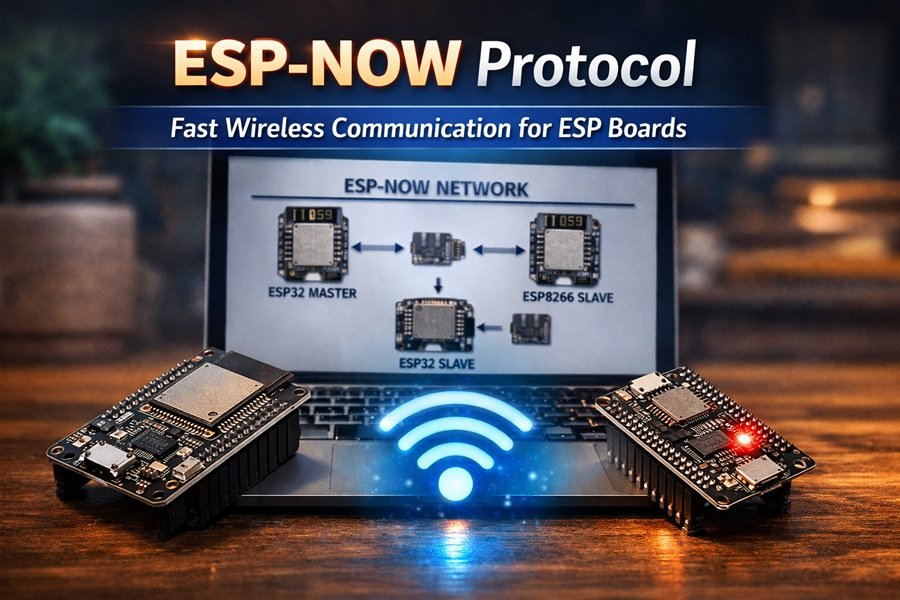
ESP-NOW Protocol: A Complete Guide for ESP32 and ESP8266
The ESP-NOW protocol is a powerful wireless communication technology developed by Espressif for its ESP microcontroller series. It enables fast, low-power, and connectionless device-to-device communication without the need for traditional Wi-Fi networking.
In this in-depth guide, you will learn what ESP-NOW is, how it works, why it is useful, and how it can be implemented in real IoT projects using ESP32 and ESP8266 boards.
Table of Contents
- What Is ESP-NOW Protocol?
- Key Features of ESP-NOW
- How ESP-NOW Works
- ESP-NOW vs Traditional Wi-Fi
- ESP-NOW Network Topologies
- Pairing and MAC Address Concept
- Security in ESP-NOW
- Practical Applications
- Limitations of ESP-NOW
- Getting Started with ESP-NOW Development
- Wrapping Up
What Is ESP-NOW Protocol?
ESP-NOW is a proprietary wireless protocol designed by Espressif that allows multiple ESP devices to exchange short messages directly using the 2.4 GHz band.
Unlike normal Wi-Fi communication where:
- devices connect to a router,
- obtain an IP address,
- and communicate through TCP/IP,
ESP-NOW works in a completely different way:
👉 No router
👉 No internet
👉 No Wi-Fi connection required
It is similar in concept to:
- NRF24L01 communication,
- Zigbee,
- or Bluetooth Low Energy broadcasting,
but optimized specifically for ESP hardware.
Supported Hardware
ESP-NOW is available on:
| Board | Compatibility |
|---|---|
| ESP32 | ✔ Fully supported |
| ESP8266 / NodeMCU | ✔ Fully supported |
This makes it ideal for mixed environments where ESP32 and ESP8266 boards need to work together.
Key Features of ESP-NOW
The popularity of ESP-NOW in embedded systems comes from its unique advantages.
1. Connectionless Communication
- Devices communicate using MAC addresses.
- No need to establish a session.
2. Very Low Power Consumption
- Suitable for battery-powered nodes.
- No constant Wi-Fi overhead.
3. Fast Data Transmission
- Latency is much lower than HTTP/TCP.
- Messages are sent almost instantly.
4. Peer-to-Peer Architecture
- Direct ESP ↔ ESP communication.
- Works even when Wi-Fi signal is congested.
5. Small Packet Size
- Up to 250 bytes per message.
- Perfect for sensor values and commands.
How ESP-NOW Works
ESP-NOW uses the same hardware radio as Wi-Fi but bypasses the TCP/IP layer.
The workflow is:
- Each ESP device has a unique MAC address.
- A sender adds the MAC address of the receiver.
- Data packets are sent directly to that address.
- The receiver gets the data through a callback function.
There are mainly two roles:
| Role | Function |
|---|---|
| Sender (Controller) | Transmits data |
| Receiver (Responder) | Accepts data |
Communication happens using unicast packets or broadcast packets.
MAC Address-Based Pairing
Before ESP-NOW devices can talk, they must know each other’s MAC addresses.
For example:
- ESP32 A wants to send data to ESP32 B.
- A must register B as a peer.
This pairing replaces IP addresses used in normal networking.
Data Flow Model
Traditional Wi-Fi:
ESP → Router → Internet → Server
ESP-NOW:
ESP (Sender) → ESP (Receiver)
This direct flow is what makes ESP-NOW extremely lightweight.
ESP-NOW vs Traditional Wi-Fi
Understanding the difference is essential.
| Parameter | ESP-NOW | Normal Wi-Fi |
|---|---|---|
| Needs Router | No | Yes |
| Internet Required | No | Often yes |
| Protocol Layer | MAC layer | TCP/IP layer |
| Power Use | Very low | High |
| Speed | Very fast | Slower |
| Packet Size | 250 bytes max | KB/MB possible |
ESP-NOW is not meant for large files, images, or webpages.
It is designed for short, frequent IoT messages.
ESP-NOW Network Topologies
ESP-NOW supports flexible architectures.
1. One-Way Communication
- A single sender sends to multiple receivers.
Example:
Temperature Node → Display Node
2. Two-Way Communication
- Devices act as both sender and receiver.
Remote Control ↔ Sensor Node
3. Many-to-One
Multiple nodes send data to a central hub.
ESP8266 Node 1
ESP8266 Node 2   → ESP32 Gateway
ESP32 Node 3
This topology is most common in WSN projects.
4. Mesh-Like System
Each ESP can communicate with several peers simultaneously.
Peer Limits
- ESP32 can have up to 20 encrypted peers or more unencrypted.
- ESP8266 has smaller peer limits due to memory constraints.
Security in ESP-NOW
ESP-NOW supports optional encryption.
Encryption Features
- AES-128 based security.
- Messages between paired peers can be encrypted.
Why this matters:
- In open environments,
- industrial deployments,
- or sensitive control systems,
you can prevent packet sniffing or spoofing.
Broadcast Mode Security
- Broadcast packets are normally unencrypted.
- Only unicast peer communication can be secured.
Practical Applications of ESP-NOW
A) Wireless Sensor Networks
Since you conduct experiments to mitigate signal interference, ESP-NOW is extremely helpful.
Example uses:
- Multiple sensor nodes spread across a field.
- Each node sends:
| Data | Example |
|---|---|
| Soil moisture | 68% |
| Temperature | 29.5 C |
| Battery level | 3.9 V |
All to one ESP32 receiver.
No internet or router needed.
B) Smart Home Control
- Light switches
- Relay boards
- Motor controllers
ESP-NOW can replace Bluetooth remotes.
C) Industrial Automation
- Conveyor control
- Machine status signals
- Emergency triggers
Very fast and reliable.
D) Data Transfer Between Projects
For instance:
- ESP32 gateway connected to the internet can GET cloud data.
- But internal nodes talk to gateway using ESP-NOW.
Limitations of ESP-NOW
Every technology has boundaries.
1. Small Packet Size
- Maximum 250 bytes.
Not suitable for:
- OTA firmware updates,
- large JSON datasets,
- or multimedia.
2. No TCP/IP Layer
- You cannot ping ESP-NOW devices.
- No IP addresses involved.
3. Range Constraints
- Works on 2.4 GHz.
- Typical range similar to Wi-Fi (30–100 meters depending on environment).
4. Vendor Specific
- Only ESP boards support ESP-NOW.
- Not cross-compatible with Arduino Uno or Raspberry Pi directly.
5. Debugging Complexity
Callbacks and peer management require structured code.
ESP-NOW Pairing Concept in Detail
This is the heart of the protocol.
What Is a MAC Address?
Every ESP32 and ESP8266 has a unique 6-byte identifier like:
A4:CF:12:34:AB:90
ESP-NOW uses this as:
- destination address,
- device identity,
- and peer reference.
Getting MAC Address (Typical Development Step)
During ESP-NOW projects, developers usually run a small script once to print MAC address and note it down.
This address is then hardcoded or configured in the sender device.
ESP-NOW Working Modes
ESP boards can still use Wi-Fi alongside ESP-NOW.
Dual Mode Example
- ESP32 connected to internet via Wi-Fi.
- At the same time:
- It communicates with local peers using ESP-NOW.
This makes ESP-NOW very flexible for hybrid IoT systems.
Getting Started with ESP-NOW Development
Although Arduino IDE is most popular for ESP-NOW programming, the protocol can also be used in:
- Espressif IDF
- MicroPython (with limited support)
Basic Development Requirements
- ESP32/ESP8266 board
- Good USB cable
- Knowledge of MAC addresses
- ESP-NOW library in Arduino
Typical Arduino Libraries
esp_now.h  (for ESP32)
espnow.h   (for ESP8266)
Example Project Ideas
If you are planning future tutorials for your sites, here are some engaging topics:
- ESP-NOW: Send Sensor Data Between ESP8266 and ESP32
- Wireless Button Control Using ESP-NOW
- ESP-NOW with OLED Display
- Many-to-One ESP-NOW Datalogger
Advantages for Interference Experiments
Personalizing directly to your work:
You run labs to reduce signal interference. ESP-NOW helps because:
- It avoids router reconnections.
- Works even if Wi-Fi channels are noisy.
- Allows you to build controlled test environments.
For RSSI testing, multi-node synchronization, or packet-loss measurement, ESP-NOW is one of the best tools.
Wrapping Up
ESP-NOW is an exceptional protocol for fast, low-power communication between ESP devices. It simplifies wireless sensor networks and enables reliable peer-to-peer messaging without the complexity of TCP/IP.
For anyone building distributed IoT nodes—especially in India where network conditions can be unpredictable—ESP-NOW provides a robust alternative to normal Wi-Fi communication.


