
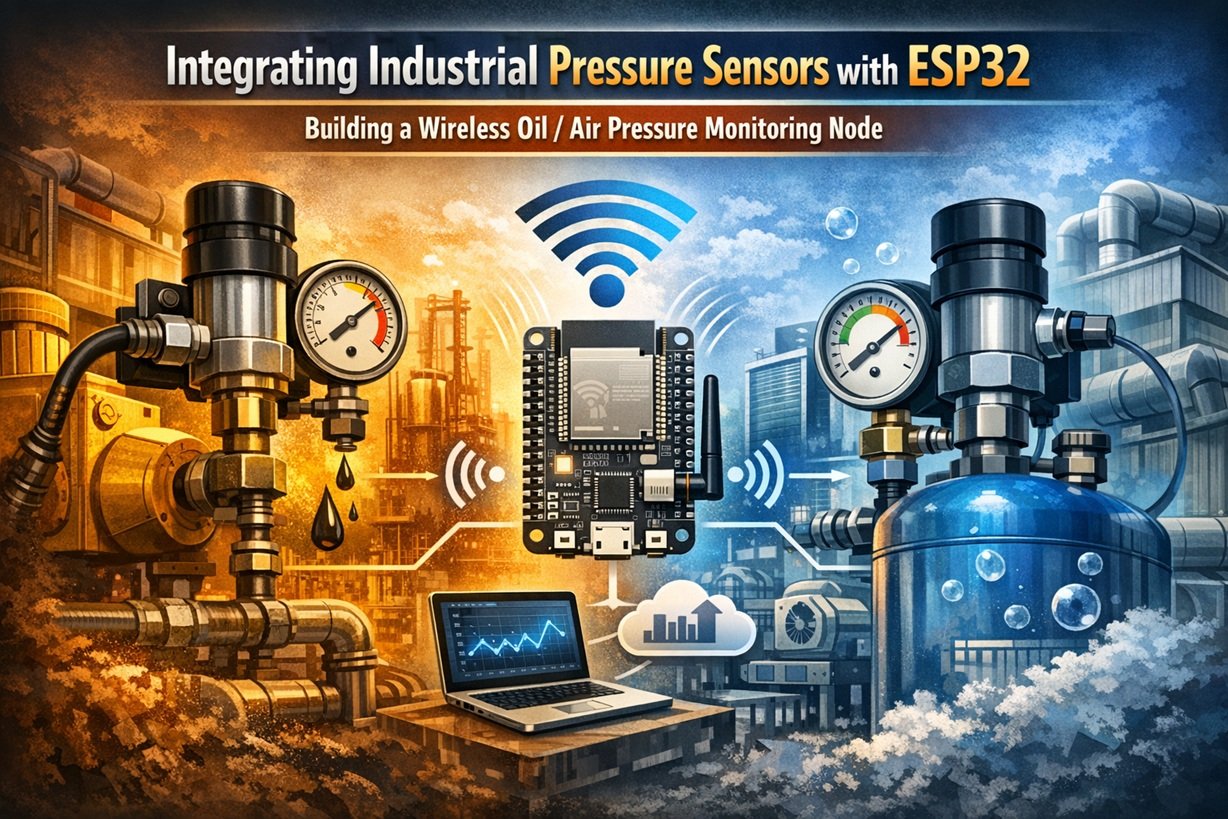
Integrating Industrial Pressure Sensors with ESP32: Building a Wireless Oil/Air Pressure Monitoring Node
Industrial pressure monitoring has transformed dramatically with the introduction of wireless sensor networks and microcontroller technology. The ESP32 microcontroller, combined with industrial-grade pressure sensors, creates powerful monitoring solutions that deliver real-time data without the complexity and cost of traditional wired systems. This comprehensive guide explores how to build a reliable wireless pressure monitoring node suitable for oil and air pressure applications in industrial environments.
Key Takeaways
- Industrial pressure sensors integrate effectively with ESP32 microcontrollers, enabling wireless monitoring solutions at a fraction of traditional system costs
- Proper signal conditioning and voltage matching are essential for accurate measurements and protecting the ESP32’s ADC inputs
- Calibration procedures significantly improve accuracy, compensating for both sensor and ADC non-linearities
- Wireless communication via WiFi or BLE enables flexible deployment options from local monitoring to cloud-based analytics
- Industrial environments require attention to noise immunity, reliable communication, and robust enclosures for long-term operation
- Multi-sensor integration and advanced features like data logging and OTA updates expand system capabilities beyond simple pressure monitoring
Understanding Industrial Pressure Sensors for ESP32 Integration
Industrial pressure sensors convert physical pressure into electrical signals that microcontrollers can process. When selecting sensors for ESP32 integration, you need to understand the different output types and their compatibility with the ESP32’s input capabilities.
Modern industrial pressure transducers typically provide analog voltage outputs between 0.5V to 4.5V or current loop signals at 4-20mA. The ESP32’s built-in analog-to-digital converter (ADC) naturally accepts voltage signals, making voltage-output sensors the most straightforward choice for direct connection. For comprehensive specifications and selection guidance, resources like sendo-sensor.com offer detailed technical documentation on various industrial pressure sensor types suitable for wireless integration projects.
Key Sensor Specifications for ESP32 Projects
When choosing an industrial pressure sensor for your ESP32 monitoring node, several specifications directly impact performance. Operating voltage compatibility is critical since the ESP32 operates at 3.3V logic levels, though it can accept power supplies from 3.0V to 3.6V for optimal operation. Many industrial sensors require 5V to 24V supply voltage, necessitating careful power management design.
Pressure range selection depends entirely on your application. Hydraulic systems might require sensors rated for 3000 PSI or higher, while HVAC air pressure monitoring typically needs only 0-100 PSI range. Accuracy specifications, typically expressed as a percentage of full scale, determine measurement reliability. Industrial applications generally demand accuracy of ±0.5% or better.
Temperature compensation is another crucial factor. Industrial environments expose sensors to temperature variations that can cause measurement drift. Quality sensors incorporate temperature compensation to maintain accuracy across their operating range, typically from -40°C to 125°C for industrial-grade units.
Hardware Components and Circuit Design
Building a wireless pressure monitoring node requires careful component selection and proper circuit design to ensure reliability and measurement accuracy.
Essential Hardware Components
- ESP32 Development Board: Select a board with adequate GPIO pins, built-in WiFi/Bluetooth, and stable power regulation. Popular choices include the ESP32-DevKitC or ESP32-WROOM-32 modules
- Industrial Pressure Sensor: Choose a sensor with voltage output compatible with ESP32’s 3.3V ADC input or plan for voltage division
- Power Supply Module: Buck/boost converters to provide stable voltage for both ESP32 (3.3V) and sensor (typically 5V or 12V)
- Signal Conditioning Circuit: Operational amplifiers or voltage dividers to match sensor output to ESP32’s 0-3.3V input range
- Protection Components: TVS diodes for overvoltage protection, filtering capacitors for noise reduction
- Enclosure: IP65 or higher rated enclosure for industrial environments
Basic Connection Schematic
The fundamental circuit connects the pressure sensor to the ESP32’s ADC input with appropriate signal conditioning. For a 0-5V output sensor, a simple voltage divider using two precision resistors (10kΩ and 20kΩ) scales the output to 0-3.3V range suitable for the ESP32.
Power supply design requires attention to current requirements. The ESP32 consumes approximately 160-260mA during WiFi transmission, while industrial sensors typically draw 10-50mA. A quality power supply with at least 500mA capacity ensures stable operation during peak loads.
Adding a low-pass filter at the ADC input reduces electrical noise that industrial environments generate. A simple RC filter with 10kΩ resistor and 0.1µF capacitor provides adequate filtering for most applications.
Pressure Sensor Calibration and ADC Configuration
Accurate pressure measurements require proper sensor calibration and optimized ADC configuration on the ESP32.
ESP32 ADC Characteristics
The ESP32 features two 12-bit ADCs capable of measuring voltages from 0 to 3.3V, divided into 4096 discrete levels. However, the ESP32’s ADC has known non-linearity issues, particularly at the extremes of its range. For precision applications, use the middle 80% of the ADC range (approximately 0.2V to 3.1V) where linearity is best.
The ESP32’s ADC also suffers from noise and can be affected by WiFi transmission activity. Implementing multiple sample averaging and using the ADC attenuation settings appropriately improves measurement stability.
Calibration Process
Professional calibration requires a known reference pressure source. The two-point calibration method provides sufficient accuracy for most applications. Record the ADC reading at zero pressure (offset) and at a known pressure corresponding to the sensor’s full scale (span). These values create a linear equation converting ADC readings to actual pressure values.
For enhanced accuracy, multi-point calibration across the sensor’s range compensates for non-linearity. Record ADC values at five to ten pressure points across the operating range, then use polynomial curve fitting or lookup table interpolation to convert raw readings to calibrated pressure values.
Temperature compensation further improves accuracy. By measuring ambient temperature and applying correction factors based on the sensor’s temperature coefficient, you can maintain accuracy across varying environmental conditions.
ESP32 Programming for Pressure Data Acquisition
Programming the ESP32 for pressure monitoring involves configuring the ADC, implementing filtering algorithms, and establishing wireless communication.
ADC Reading and Filtering
The basic pressure reading function configures the ADC, takes multiple samples, applies averaging, and converts the result to engineering units. Implementing a moving average filter with 10-20 samples significantly reduces noise while maintaining reasonable response time.
For applications requiring faster response with good noise rejection, consider implementing a median filter or exponential moving average. These algorithms provide better transient response compared to simple averaging while still suppressing noise effectively.
Key Programming Considerations
- Use the ADC1 controller for pressure readings and reserve ADC2 for other sensors, as ADC2 is unavailable during WiFi operation
- Implement deep sleep modes between readings to conserve power in battery-operated applications
- Configure ADC attenuation to 11dB for the full 0-3.3V range
- Apply calibration using the esp_adc_cal library for improved accuracy
- Implement watchdog timers to recover from communication failures
Wireless Communication Protocols
The ESP32’s built-in WiFi and Bluetooth capabilities enable flexible wireless connectivity options for pressure monitoring applications.
WiFi-Based Communication
WiFi connectivity allows integration with existing network infrastructure and enables remote monitoring through cloud platforms or local servers. The ESP32 can operate as a WiFi station connecting to existing networks or as an access point for direct connection from mobile devices.
MQTT protocol is ideal for IoT pressure monitoring applications. It provides lightweight, efficient communication with quality of service levels ensuring message delivery even with unreliable network connections. Publishing pressure readings to an MQTT broker every few seconds enables real-time monitoring while minimizing network traffic.
HTTP REST APIs offer another communication option, particularly for systems requiring direct web server interaction. The ESP32 can POST pressure data to web services or respond to GET requests with current readings.
Bluetooth Low Energy (BLE) Option
For applications requiring lower power consumption or operation in WiFi-restricted environments, BLE provides an excellent alternative. BLE’s mesh networking capabilities allow multiple ESP32 nodes to form a sensor network, with one node acting as a gateway to connect to other systems.
BLE is particularly suitable for mobile app-based monitoring where technicians with smartphones can connect directly to pressure sensors during maintenance activities.
Industrial Application Case Study: Oil Pressure Monitoring
Consider a practical implementation for monitoring hydraulic oil pressure in an industrial press machine. This application requires real-time pressure monitoring to prevent equipment damage from pressure spikes and detect gradual pressure loss indicating pump wear or system leaks.
System Requirements and Implementation
The system uses an industrial pressure transducer rated for 0-5000 PSI with 0-5V output. The sensor connects to the ESP32 through a voltage divider and signal conditioning circuit. Power comes from the machine’s 24V DC supply, regulated down to appropriate voltages for the sensor and ESP32.
The ESP32 samples pressure at 10Hz and applies a moving average filter with 20 samples. Calibrated readings are published via MQTT to a local broker every second. The system implements three alarm thresholds: low pressure warning, high pressure warning, and critical over-pressure shutdown.
For reliability in the industrial environment, the entire circuit is housed in an IP67 enclosure with industrial M12 connectors. EMI filtering on power and signal lines protects against electrical noise from the press machine’s contactors and motors.
Performance Results
This implementation achieves ±1% full-scale accuracy across the operating range, meeting the application requirements for preventive maintenance monitoring. The system successfully detected a gradual pressure drop over three weeks indicating pump wear, allowing scheduled maintenance before catastrophic failure.
Power consumption averaged 180mA during WiFi transmission and 80mA during measurement cycles, well within the power budget. The system maintained stable operation in temperatures ranging from 10°C to 60°C in the factory environment.
Advanced Features and Optimizations
Beyond basic pressure monitoring, several advanced features enhance system capability and reliability.
Data Logging and Trending
Implementing local data storage on the ESP32’s flash memory or an attached SD card provides historical data even when network connectivity is lost. Storing pressure readings with timestamps enables trend analysis to predict maintenance needs before failures occur.
Circular buffer implementation allows efficient storage while automatically overwriting oldest data when memory fills. For critical applications, implement data synchronization that uploads stored data to servers once network connectivity returns.
Multi-Sensor Systems
Expanding the monitoring node to include temperature, vibration, or flow sensors alongside pressure creates a comprehensive condition monitoring system. The ESP32’s multiple ADC channels and digital interfaces support various sensor types simultaneously.
Sensor fusion algorithms combining data from multiple sensors provide deeper insights. For example, correlating pressure with temperature reveals thermal expansion effects, while combining pressure and vibration data detects cavitation in pump systems.
Over-the-Air (OTA) Updates
Implementing OTA update capability allows firmware updates without physical access to deployed sensors. This capability is crucial for sensors installed in hard-to-reach locations or for managing large sensor deployments.
Secure OTA updates using HTTPS connections and firmware verification prevent unauthorized code from compromising the system. Implementing rollback mechanisms ensures the system can recover if an update fails.
Troubleshooting Common Integration Challenges
Several common issues arise when integrating industrial pressure sensors with ESP32 systems. Understanding these challenges and their solutions ensures reliable operation.
Noise and Measurement Instability
Industrial environments generate significant electrical noise from motors, relays, and switching power supplies. This noise couples into sensor signals causing unstable readings. Solutions include proper grounding, twisted pair wiring for sensor signals, ferrite beads on power lines, and enhanced software filtering.
Inadequate power supply filtering also causes measurement instability. Adding bulk capacitance near the ESP32 and sensor power inputs stabilizes operation. A 100µF electrolytic capacitor in parallel with a 0.1µF ceramic capacitor at each power input provides effective filtering.
ADC Non-linearity and Accuracy
The ESP32’s built-in ADC suffers from non-linearity, particularly at measurement extremes. Using the ADC calibration features in ESP-IDF significantly improves accuracy. For applications demanding highest precision, external ADC chips like the ADS1115 provide 16-bit resolution and better linearity.
Implementing multi-point calibration compensates for both sensor and ADC non-linearity. Storing calibration coefficients in non-volatile memory ensures they persist across power cycles.
Communication Reliability
WiFi connection drops in industrial environments with metal structures and RF interference disrupt data transmission. Implementing automatic reconnection with exponential backoff prevents excessive connection attempts. Local data buffering ensures no measurements are lost during temporary connectivity issues.
Using MQTT with appropriate quality of service settings guarantees message delivery even with unreliable networks. For critical applications, implement dual communication paths using both WiFi and BLE or cellular backup.
Practical Sensor Selection Guide
Choosing the right industrial pressure sensor significantly impacts project success. Different applications require different sensor characteristics and construction.
When working with oil pressure monitoring, sensors with stainless steel construction and oil-compatible seals are essential. For detailed specifications on industrial pressure transducers suitable for various media including oils and compressed air, you can read more about specialized solutions designed for harsh industrial environments.
For air pressure applications, sensors designed for gas service with appropriate sealing prevent moisture ingress. Differential pressure sensors are ideal for filter monitoring applications, while gauge pressure sensors suit tank and compressor monitoring.
Consider the installation requirements as well. Thread types must match your piping system, whether NPT, BSP, or metric threads. Electrical connections range from bare wire leads to industrial connectors like M12 or Deutsch connectors, each suited to different installation scenarios.
Frequently Asked Questions
Can I connect a 4-20mA industrial pressure sensor directly to the ESP32?
No, the ESP32’s ADC measures voltage, not current. You need to convert the current signal to voltage using a precision resistor across the sensor output. A 250Ω resistor converts 4-20mA to 1-5V, which then requires voltage division to match the ESP32’s 0-3.3V input range.
What accuracy can I expect from an ESP32-based pressure monitoring system?
With proper calibration and signal conditioning, you can achieve ±1-2% full-scale accuracy, suitable for most industrial monitoring applications. For higher precision requirements, consider using external 16-bit ADCs which can improve accuracy to ±0.1% or better.
How do I protect the ESP32 from industrial electrical noise?
Implement multiple protection layers including shielded cables for sensor connections, ferrite beads on power lines, TVS diodes for overvoltage protection, proper grounding, and both hardware (RC filters) and software (averaging, median filtering) noise reduction techniques.
What is the maximum distance I can place the pressure sensor from the ESP32?
For voltage output sensors, limit cable runs to under 3 meters to minimize noise pickup and signal degradation. For longer distances, use 4-20mA sensors which are designed for extended cable runs up to 100 meters or more without signal degradation.
How long will a battery-powered ESP32 pressure monitoring node operate?
Battery life depends on sampling frequency and communication intervals. With deep sleep implementation, sampling every 10 minutes and transmitting once per hour, a 3000mAh battery can power the system for several months. Continuous monitoring with frequent WiFi transmission reduces battery life to days rather than months.
Can multiple ESP32 pressure sensors communicate with each other?
Yes, ESP32 devices can form mesh networks using ESP-WIFI-MESH protocol or implement peer-to-peer communication. This allows distributed sensor networks where multiple pressure monitoring nodes share data and coordinate operations without requiring constant connection to a central server.
Conclusion:
In conclusion, integrating industrial pressure sensors with the ESP32 enables a cost-effective, flexible, and scalable solution for oil and air pressure monitoring in demanding environments. With proper sensor selection, signal conditioning, calibration, and enclosure design, ESP32-based systems can deliver reliable, real-time pressure data comparable to traditional wired solutions.
By leveraging wireless communication, advanced filtering, and features like data logging and OTA updates, these monitoring nodes go beyond basic measurement. They support predictive maintenance, reduce downtime, and adapt easily to evolving industrial requirements, making them a practical choice for modern industrial automation.


