
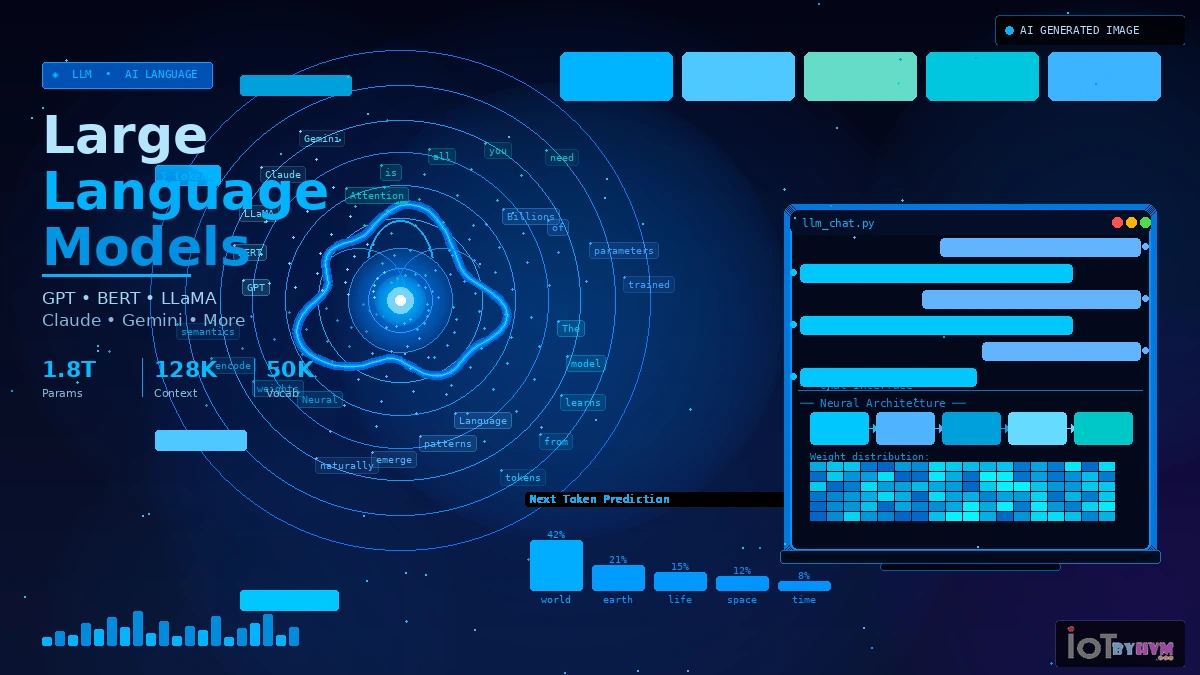
Large Language Models (LLMs): How Modern AI Understands and Generates Text
Large Language Models (LLMs) are one of the most significant advancements in modern artificial intelligence. These models are capable of understanding human language, generating text, answering questions, translating languages, and even writing code.
LLMs are built using transformer architectures and trained on massive datasets containing books, articles, websites, and other text sources. By learning patterns from this data, these models can produce human-like responses and perform complex language tasks.
If you want to understand how large language models fit into the complete AI learning journey, you can explore Complete Roadmap to Learn AI from Zero to LLMs and Generative AI:
https://iotbyhvm.ooo/complete-roadmap-to-learn-ai-from-zero-to-llms-and-generative-ai/
This roadmap explains the step-by-step progression from programming fundamentals to advanced AI technologies such as generative AI systems.
What Are Large Language Models?
Large Language Models are deep learning systems trained to understand and generate natural language.
They work by predicting the most probable sequence of words based on the context provided in the input text.
For example, when given a prompt such as:
“Artificial intelligence is transforming…”
The model predicts the most likely next words based on patterns it learned during training.
Because these models are trained on enormous datasets and contain billions of parameters, they can generate highly coherent and contextually relevant responses.
How Large Language Models Work
Large language models are built using transformer neural networks that rely on attention mechanisms to understand relationships between words in a sentence.
The basic working process of LLMs includes:
Training on Massive Datasets
LLMs are trained using extremely large text datasets gathered from books, websites, research papers, and online content.
This training helps the model learn grammar, context, reasoning patterns, and linguistic structures.
Tokenization
Before processing text, LLMs convert words into smaller units called tokens.
Tokens may represent:
- Words
- Subwords
- Characters
These tokens are then converted into numerical representations that neural networks can process.
Learning Patterns
During training, the model learns to predict the next token in a sequence. Over time, it becomes better at understanding context and generating meaningful text.
This training process may require thousands of GPUs and massive computational resources.
Examples of Large Language Models
Several large language models have played a major role in advancing artificial intelligence.
GPT (Generative Pre-trained Transformer)
GPT models are designed to generate human-like text based on prompts.
They are widely used for:
- conversational AI
- content generation
- coding assistance
- education tools
BERT (Bidirectional Encoder Representations from Transformers)
BERT focuses on understanding language context rather than generating text.
It is widely used in:
- search engines
- question answering systems
- text classification
LLaMA
LLaMA is a family of large language models designed for research and AI development.
These models are used for experimentation and development of new AI applications.
Applications of Large Language Models
LLMs power many modern AI applications across industries.
Conversational AI
Large language models enable chatbots and virtual assistants to have natural conversations with users.
Content Generation
LLMs can generate various types of content, including:
- articles
- blog posts
- reports
- marketing content
Code Generation
Some LLMs can generate programming code and assist developers with debugging and problem-solving.
Language Translation
LLMs can translate text between languages while preserving context and meaning.
Education and Learning
AI tutoring systems powered by LLMs help students understand complex topics by providing explanations and answers.
Advantages of Large Language Models
Large language models offer several important advantages.
Context Understanding
LLMs can understand context across long pieces of text.
Versatility
They can perform many tasks including summarization, translation, and conversation.
Human-Like Responses
Because they are trained on large datasets, LLMs can generate natural and coherent responses.
Challenges of Large Language Models
Despite their capabilities, LLMs also present several challenges.
High Computational Cost
Training large language models requires significant computational power and large datasets.
Bias in Data
If training data contains biases, the model may produce biased outputs.
Hallucinations
LLMs may sometimes generate incorrect information that appears plausible but is not factually accurate.
Researchers are actively working to improve the reliability and safety of these models.
Why LLMs Are Important for Modern AI
Large language models represent a major step toward more advanced artificial intelligence systems.
They enable machines to understand complex language patterns and interact with humans in more natural ways.
LLMs also serve as the foundation for many generative AI systems that can create text, images, and other forms of content.
What Comes After Large Language Models?
After understanding large language models, the next stage in the AI learning journey focuses on Generative AI.
Generative AI systems can create new content such as text, images, videos, and music using advanced machine learning models.
To see how large language models connect with the full AI learning path, explore Complete Roadmap to Learn AI from Zero to LLMs and Generative AI:
https://iotbyhvm.ooo/complete-roadmap-to-learn-ai-from-zero-to-llms-and-generative-ai/
This roadmap explains how learners progress from programming fundamentals to advanced AI technologies used in modern applications.


