
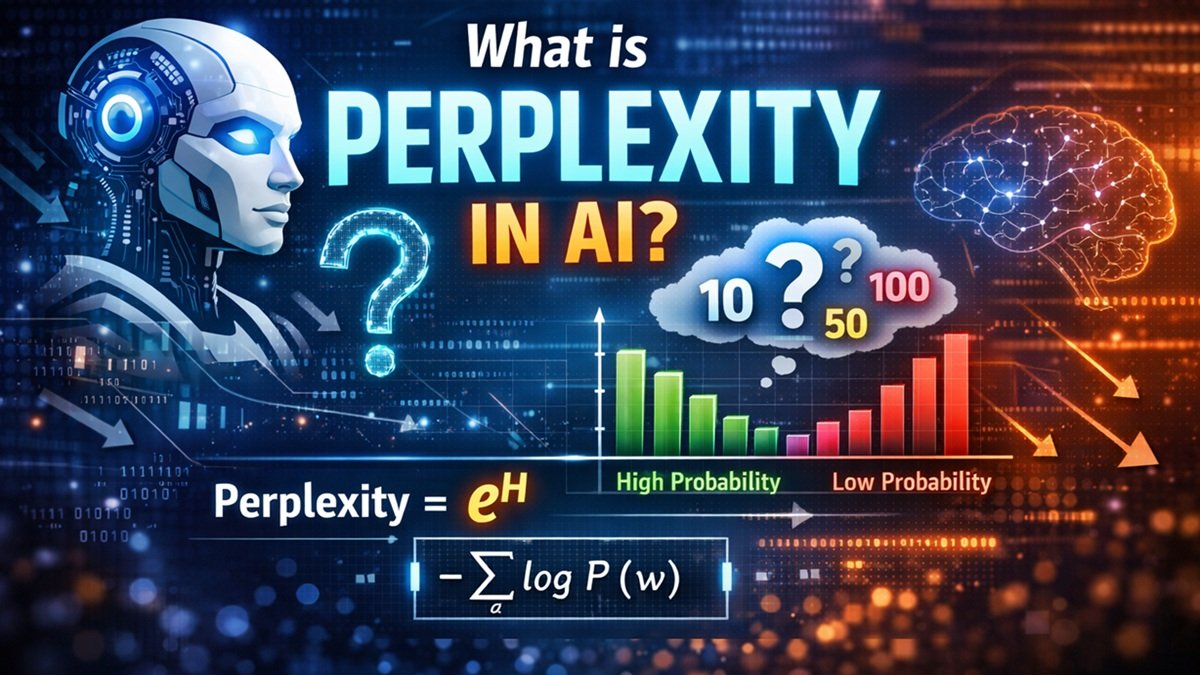
What is Perplexity in AI? (Complete Guide)
Introduction
Perplexity is one of the most important metrics used in Artificial Intelligence (AI)—especially in Natural Language Processing (NLP) and language models like GPT.
In simple terms, perplexity measures how well a probability model predicts a sequence of data.
It answers a key question:
“How surprised is the model when it sees actual data?”
The less surprised (lower perplexity), the better the model.
Simple Intuition (Real-Life Analogy)
Imagine you’re trying to guess the next word in a sentence:
“I drink tea every ___”
- If you guess “day”, you’re confident → good prediction
- If you guess “banana”, you’re confused → bad prediction
Perplexity measures this confusion level.
👉 Low perplexity = confident & accurate predictions
👉 High perplexity = confused & poor predictions
Formal Definition
Perplexity is defined as the exponential of the average negative log-likelihood of a sequence.
Mathematical Formula
[
\text{Perplexity} = \exp\left(-\frac{1}{N} \sum_{i=1}^{N} \log P(w_i)\right)
]
Where:
- (N) = total number of words/tokens
- (P(w_i)) = probability of the (i^{th}) word
Mathematical Insight
\text{Perplexity} = \exp\left(-\frac{1}{N} \sum_{i=1}^{N} \log P(w_i)\right)
This formula shows:
- If the model assigns high probability to correct words → log values are less negative → low perplexity
- If probabilities are low → log values are very negative → high perplexity
Another Interpretation
Perplexity can also be thought of as:
“The effective number of choices the model is confused between.”
Example:
- Perplexity = 10 → model is choosing among ~10 options
- Perplexity = 100 → model is much more uncertain
Relationship with Cross-Entropy
Perplexity is directly related to cross-entropy loss, which is used during training.
[
\text{Perplexity} = e^{\text{Cross-Entropy}}
]
👉 Lower cross-entropy → lower perplexity → better model
Example Calculation
Let’s say a model predicts probabilities for a sentence:
| Word | Probability |
|---|---|
| I | 0.9 |
| love | 0.8 |
| AI | 0.7 |
Steps:
- Take log of probabilities
- Compute average
- Apply exponential
Result → Low perplexity (good model)
Why Perplexity Matters
1. Evaluating Language Models
Used to compare models like:
- GPT
- BERT (for masked tasks)
- LLaMA
👉 Lower perplexity = better language understanding
2. Training Monitoring
During training:
- Perplexity decreases over time
- Indicates learning progress
3. Model Comparison
Example:
| Model | Perplexity |
|---|---|
| Model A | 50 |
| Model B | 20 |
👉 Model B is significantly better
Perplexity vs Accuracy
| Metric | What it Measures |
|---|---|
| Perplexity | Probability quality |
| Accuracy | Correct predictions |
👉 Perplexity is more useful for probabilistic models
Perplexity in Different AI Tasks
1. Language Modeling
Most common use case
Predict next word in a sentence
2. Speech Recognition
Measures how well system predicts spoken words
3. Machine Translation
Evaluates translation fluency
Limitations of Perplexity
Despite being powerful, perplexity has some limitations:
❌ 1. Not Always Human-Meaningful
Low perplexity doesn’t always mean:
- Better creativity
- Better reasoning
❌ 2. Dataset Dependency
Perplexity varies depending on:
- Dataset size
- Vocabulary
❌ 3. Not Comparable Across Tokenizations
Different tokenizers → different perplexity values
Perplexity in Modern LLMs
Large Language Models like:
- GPT
- PaLM
- LLaMA
use perplexity during:
- Pretraining
- Evaluation
However, modern evaluation also includes:
- Human feedback (RLHF)
- Benchmarks (MMLU, etc.)
Practical Insight (For Your Project)
Since you are building models like MiniGPT-350M / 114M, here’s how perplexity helps:
During Training:
- Track
loss → perplexity - Use:
perplexity = torch.exp(loss)
Target Range:
- Beginner models → 50–200
- Good models → < 30
- Strong models → < 20
Key Takeaways
- Perplexity = measure of uncertainty
- Lower perplexity = better predictions
- Closely related to cross-entropy
- Essential for evaluating language models
Read this: Transformers Explained: The Architecture Behind Modern Artificial Intelligence
Final Intuition
Perplexity tells you how “confused” your AI is.
Less confusion = smarter model.


