
What is the Difference Between Flooded and AGM Deep Cycle Batteries?
When selecting deep cycle solar batteries for RVs, marine use or any other application, knowing the differences between AGM (Absorbent Glass Mat) and flood (Absorbent Glass Mat) batteries is vitally important. Both types offer steady power over extended periods; however, they vary in terms of design, quality, maintenance requirements and costs – this article will discuss these main differences so that you can select the most appropriate model for you and your requirements.

Construction and Design Differences
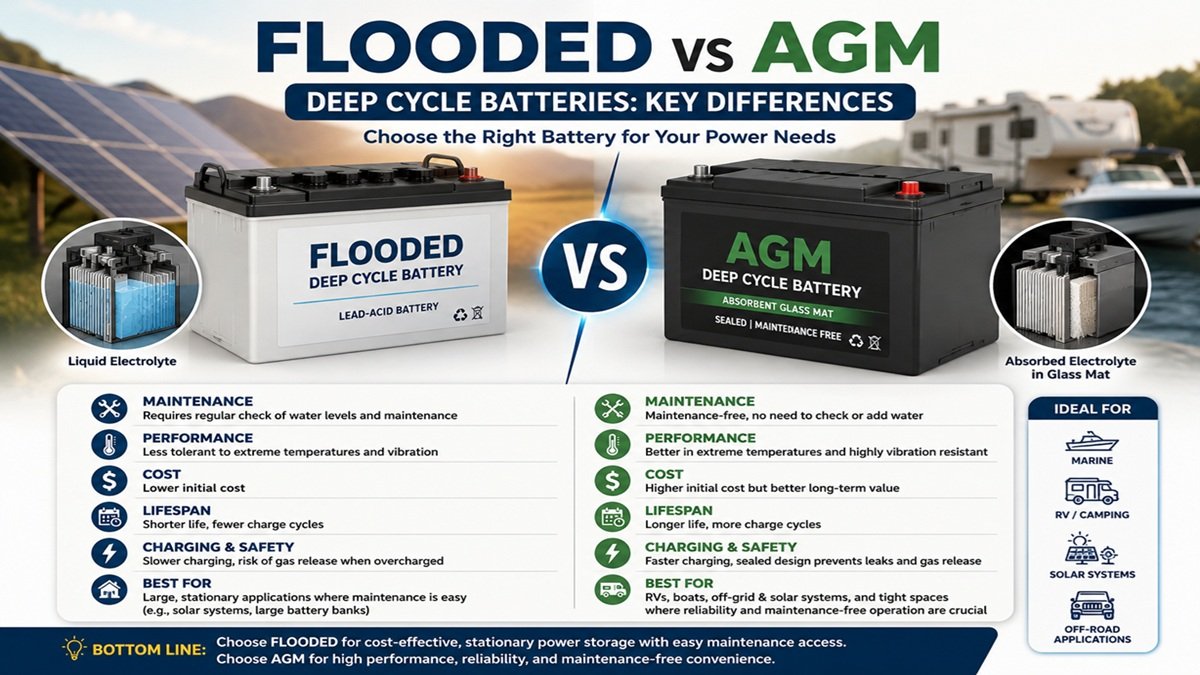
The deep cycle flood battery is the standard type of lead-acid battery. They contain a liquid electrolyte; this is the reason they are known as “flooded” — the electrolyte exists in a liquid state and covers the battery’s internal cells. They rely upon the reaction that takes place between lead plates and electrolytes for the storage of energy before releasing it. The difference is that AGM deep cycle batteries make use of an adsorbent mat to absorb electrolyte and render it inert. This prevents the fluid from spilling out, creating AGM batteries immune to spills and less susceptible to leaks. Internal structure and design are the primary reasons for this. AGM batteries are more advanced, with higher-quality technology and materials that result in greater performance and durability.
Maintenance Requirements
One of the key differences between AGM deep cycle batteries that are flooded and AGM deep cycle batteries lies in their maintenance requirements. Flooded batteries require regular inspection, including monitoring their water levels within each cell. The electrolyte is drained with time, and it is essential in order to refill the batteries with distillate to ensure the condition of the battery and its performance. If the condition is not taken care of, the plates of the battery could become damaged by exposed air, which can lead to the battery’s lifespan being reduced. AGM batteries are, however, classified as “maintenance-free” because the electrolyte is absorbed by the mats made of fiberglass and doesn’t require replenishment. Although AGM batteries still benefited from periodic inspection and cleaning, they don’t need regular maintenance as do filled batteries, making them more convenient for most users.
Performance in Different Environments
AGM batteries generally fare better than flood batteries when faced with extreme conditions like extreme temperatures or low temperatures. Their sealed design of AGM batteries makes them less prone to the environmental elements that affect flooded batteries, like temperature fluctuations. Flooded batteries may experience performance decline in extremely cold temperatures as electrolyte from the liquid may be frozen, making the battery useless. However, AGM batteries have superior cold cranking amps (CCA), which implies that they are able to do better under colder temperatures and are more resistant to failure under extreme conditions. In addition, AGM batteries are more robust to vibration, making them perfect for applications that require lots of moving, such as boats, RVs, as well as off-road cars.
Cost and Longevity
Indeed, the initial price of AGM deep cycle batteries is usually greater than the cost of the flooded batteries. However, the durability and efficiency of AGM batteries could be more than offset by the upfront cost. AGM batteries tend to outlive their counterparts that use flooded cells, providing more charge cycles before needing replacement. While initial investment may be higher, their daily costs of consumption could actually be less. While flooded batteries cost less initially, they could require replacement sooner due to their wear and tear that results from their maintenance needs, and also the risk of being subjected to environmental factors. Therefore, even though they’re an economical alternative for short-term use, AGM batteries might be better suited to last for longer.
Charging Efficiency and Safety
As far as charging efficiency goes, AGM batteries tend to provide greater advantages. They’re faster at charging and can handle greater charges without damage – perfect for fast charging needs in solar power systems and marine applications. Flooded batteries are particularly susceptible to overcharging; their flooding can release harmful hydrogen gas when overcharged too fast or too often – while AGMs’ sealed design mitigates any leakage risks, providing greater security when used in places that are tight, like RVs or home battery storage areas.
Applications and Suitability
Both the flooded as well as AGM deep cycle batteries are suitable for use in similar situations like boats, RVs, as well as solar systems. The difference is that AGM batteries can be ideal for situations that require a lot of maintenance, as well as when space is a problem, for example, in vehicles that have limited space for compartments for batteries. Their compact, sealed design allows them to be placed in a range of places. They can provide an excellent value for certain applications; they are typically more suitable for larger, stationary configurations such as grid-connected solar systems, where they are easily accessible to perform maintenance or top-off levels of water. In addition, they are typically used in situations when cost becomes a key aspect, for instance, in large-scale battery banks that are used for solar energy storage.

Conclusion
In the end, both flooded and AGM deep cycle batteries have benefits and disadvantages. Flooded batteries are affordable and suitable for larger stationary systems, where maintenance is easy. AGM batteries are, however, superior in performance, longer life span and less maintenance, which makes them perfect for applications that require ease of use in reliability, dependability, and superior performance in harsh conditions. Choosing between them is dependent on your particular requirements, budget, as well as the amount of maintenance you’re willing to do.


