
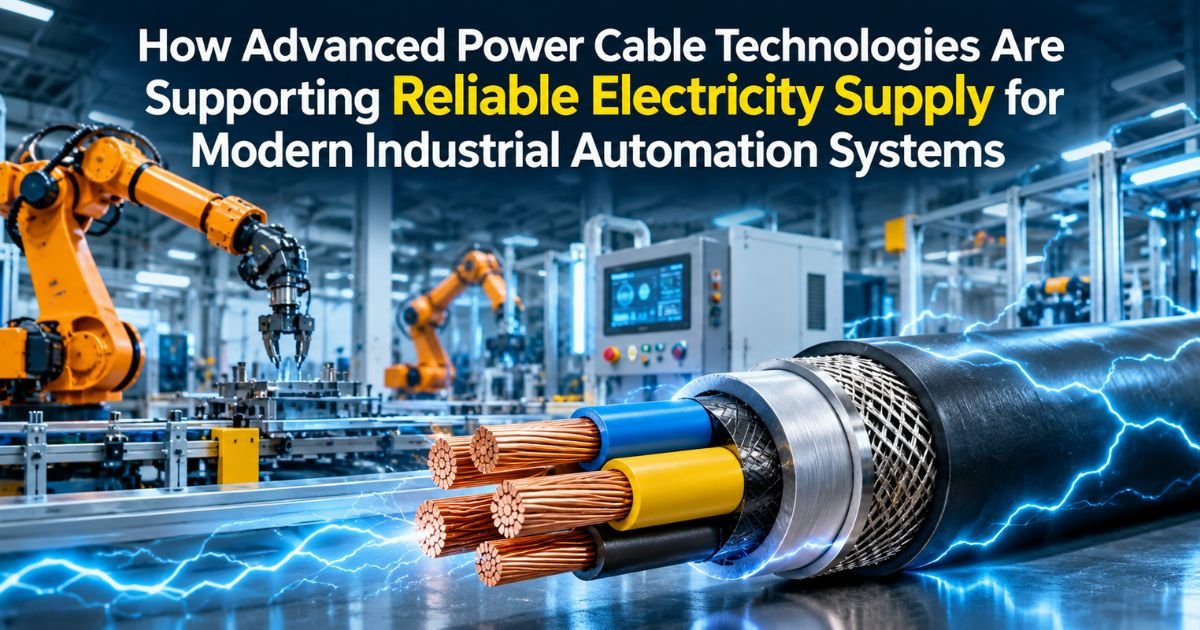
How Advanced Power Cable Technologies Are Supporting Reliable Electricity Supply for Modern Industrial Automation Systems
Modern industries like textile manufacturers and manufacturers have started relying on technological automation to ensure safety and sustainability in their production processes. In this regard, companies must know that modern technologies include different kinds of equipment such as robots, PLCs, VFDs, and conveyors, as well as sensor networks and so on. However, power transmission has always been viewed as a less important part of the entire automation process. In such a way, power cables can serve as the most important element in the automation process. With recent technological development of power cables, as their complexity has increased, it has been possible to adjust these cables to the needs of modern production processes.
The Importance of Electric Power Transmission In Industry Automation
Automated plants are more vulnerable to troubles in the power supply system than the manual processes. A simple cut in voltage, an unplugged connector or a fault in the insulation may result in the stoppage of production, product damage and disruption in safety installations. In sectors such as the automobile or electronics industries or food and drug production, just one minute without production can cost a fortune.
- Cables are key components of reliability.
- They allow control of the amount/level of current flowing through the circuit without overheating.
- They control voltage level across long distances.
- They keep conductors safe from overheating, moisture, wear, and damage.
- They minimize electrical interference, which can hamper precise control and signaling.
The selection of cables involves not only an economic component but also various engineering components that can have serious consequences for safety and service.
Issues With Industrial Power Distribution
The industrial environment is considerably different from domestic or office environments, which is why engineers confront numerous more complicated challenges when designing their automation systems.
- Heating and Constant Load: Motors and drives operate for a longer period of time and under the conditions of significant loading, which implies that electricity passes through the cables continuously, creating a heating effect. If the wires cannot cool down, there will be poor insulation efficiency.
- Electromagnetic Interference: Variable speed drives, together with DC/DC converters, generate signals with very high frequencies, which are behind the failure of different sensors, encoders, and fieldbuses. As the wires do not have shields, it is not possible to prevent failures.
- Mechanical Stress: The wires of robots, gantries, and mobile tool carriers turn, twist, and bend constantly. Ordinary wires that were used in a fixed position can easily become fatigued because this type of movement was not accounted for.
- Chemical Exposure and Environmental Factors: Oils, coolants, cleaning agents, dirt, humidity, and UV rays can be harmful to cable jackets. In addition, food and beverage plants that use their equipment for washdowns put further pressure on cables. In industries such as mining and oil and gas, cables are subjected to rough terrain.
- Fire Safety: In industries lacking basic safety systems, fire could travel through the cable and create toxic fumes in the air. Hence, the companies are responsible for using fire-safe materials.
Technological Innovations in Cables
Cable manufacturers have adapted through improvements made in the areas of materials, design, and testing. The following are some of the most notable advances in manufacturing that users of automated facilities must consider.
- Updated Conductor Design: Due to its excellent conductivity as well as mechanical effectiveness, copper is still the conductor of choice for most applications in industry. Aluminium is also desirable for large feeders due to its weight and cost. Conductors are characterized according to standard IEC 60228. In the case of moving applications, finely stranded conductors (usually of Class 5 or Class 6) are a good choice due to their flexibility.
- Cross-Linked Polyethylene (XLPE) Insulation: XLPE is an insulation medium that has become quite popular for medium- and low-voltage power cables. Its cross-linked molecular structure enables it to withstand higher conductor temperatures than traditional polyvinyl chloride (PVC) and allows it to continuously operate at temperatures up to 90 degrees Celsius. A higher thermal capability allows a cable to carry more current for the same size or carry the same amount of current with more margin of safety. XLPE also exhibits good dielectric properties and moisture resistance, which ensures its efficient performance over several decades.
- Shielding and EMC-Oriented Construction: Power cables supplied with shielded conductors have a copper shield in a wrap around a length of the cable that extends beyond the symmetrical system of conductors. This will reduce the impedance of the power cables for higher-frequency currents and will also reduce noise emissions. Shields that are properly grounded will also reduce control cable interference.
- Stretchable and Twisting-proof features: Exclusive jackets such as thermoplastic elastomer (TPE) or polyurethane (PUR) are mounted on the robot cables and on the drag chains. The shells must provide a certain resistance to wear and to oil – but also, they must be able to be bent hundreds of times (depending on their material). Reliability tests are tests that should qualify the life of the cable before the product goes to market – it must withstand millions of bend cycles.
Remember, the lead to the control could be supplied to hundreds of different spots plus the data and control signal at the same time. This reduces the number of cables winding about the building, boosts support and minimizes the chances of wiring errors. The cable technologies are no longer only hardware. Today, condition monitoring is increasingly applied to power cable systems, in particular for critical installations.
What New Phases Might be Incorporated:
Partial discharge tests measure short discharges within the insulation seen before failure. Distributed temperature sensing describes the ability to use the fiber-optic measurement along the length of the cable route to immediately detect hot spots. Insulation resistance tracking is a method of measuring changes in the level of insulation. With terminals, you can identify loose or overheated connections with a thermal image. By using the information gained from these techniques within the facility’s maintenance system can help the maintenance team transition the maintenance activity of the plant from a reactive maintenance to a predictive maintenance. This would reduce the number of unplanned outages and allow for the replacement during a planned outage rather than having a failure.
Standards and Guarantee of Quality
The performance of a cable is strongly dependent upon the degree of standard compliance. In particular, given the geographical location, the industry associates it with:
- IEC 60502 for extruded insulation power cables, with a rated voltage from 1 kV to 30 kV.
- IEC 60228 for insulated cable conductors.
- IEC 60332 for electric cable testing in a fire.
- Standards of UL and NEC in North America.
- EN and CENELEC standards in Europe.
In addition to the type test, each manufacturer performs routine tests of every length of production, such as voltage and resistance tests. Traceability of the raw material is as important as the process control during design and manufacturing, since small deviations can create difficulties in long-term reliability.
Role of Cables in Industrial Trends
Several wider developments in industry are increasing the importance of high-performance cabling.
- Electrification of Production Processes: Many manufacturers are replacing pneumatic and hydraulic systems with electric drives, and fossil-fuel-based heating with electric alternatives.
- Electricity Generation from Renewable Sources and In-House Production: The modern industrial complex is known for its solar energy stations, energy storage systems, and microgrid technology. New installations allow electricity to move in both directions and would not function properly without installing cables with direct current capabilities that can withstand extreme weather conditions.
- Increase in the Number of Data-Centric Sites: Semiconductor facilities, data centers, and other high-tech manufacturing plants operate under strict requirements for energy quality. Continuous energy supply with no interference may push cable standards higher.
- Reconstruction of Distributed Networks: In many regions, the aging grid and wiring system is being upgraded to keep pace with the changes in the power supply demand and new safety regulations.
- Insight Into the Power Cable Market: The developments noted above are evident in all segments of the power cable market, driven by developments in the grid, industrial development, renewable energy projects, and the upgrade of existing infrastructure.
In addition, the market reacts to the prices of raw materials, such as copper and aluminium, and to the regulatory obligations in the area of safety and sustainability.
According to Pristine Market Insights, the volume of demand for the voltage segments, types of insulation, usage sectors, and geographical demand. This gives direction to the fabricators, engineers, and end customers who are concerned with the technological developments taking place in the market like the replacement of XLPE as an insulator and the choice of halogen-free material.
Some of The Most Important Trends in The Power Cable Industry Include:
- Higher-temperature and more effective insulation systems are becoming more popular.
- There is a greater focus on recycling and lower-carbon manufacturing approaches.
- There is increasing demand for cables compatible with clean energy and electric mobility initiatives.
- There is more emphasis on product traceability, testing, and compliance documentation.
Typical Reasons for Cable-Related Downtime
Common reasons might include:
- Choosing an unsuitable cable type for applications that require a cable to flex continuously.
- Heating caused by undersized conductors, conducting cables packed closely together, etc.
- Cable jackets’ destruction due to sharp edges; lack of protection.
- Moisture getting into terminations and joints.
- Defective cable shielding causing noise.
- Loose connections that cause heating and resistance.
Let us add that many of these problems can be avoided when designed well, installed appropriately, and serviced periodically.
Advanced Cables Powering the Future of Automation
Industrial automation is all about maintenance of supply of power. The transmission is done with a power cable. Conductor design breakthroughs XLPE halogen free insulation screening flexibility and monitoring of cable conditions make cable choices one of the critical parts of the installation specifications, increasing efficiency and safety while reducing the cable’s total cost of ownership. Simultaneously, power cable market growth is driving innovators to new level of innovations and product quality. With automation gaining momentum, power cable technology holds high potential for the future.
Author Bio
Teja Kurane is a research analyst specializing in electrical and electronics technologies, industrial automation, and power infrastructure. Teja focuses on advancements in electrical components, energy transmission, and industrial connectivity. Through research-driven insights, Teja explores how advanced power cable technologies enhance electricity reliability, operational efficiency, and the performance of modern industrial automation systems.


