
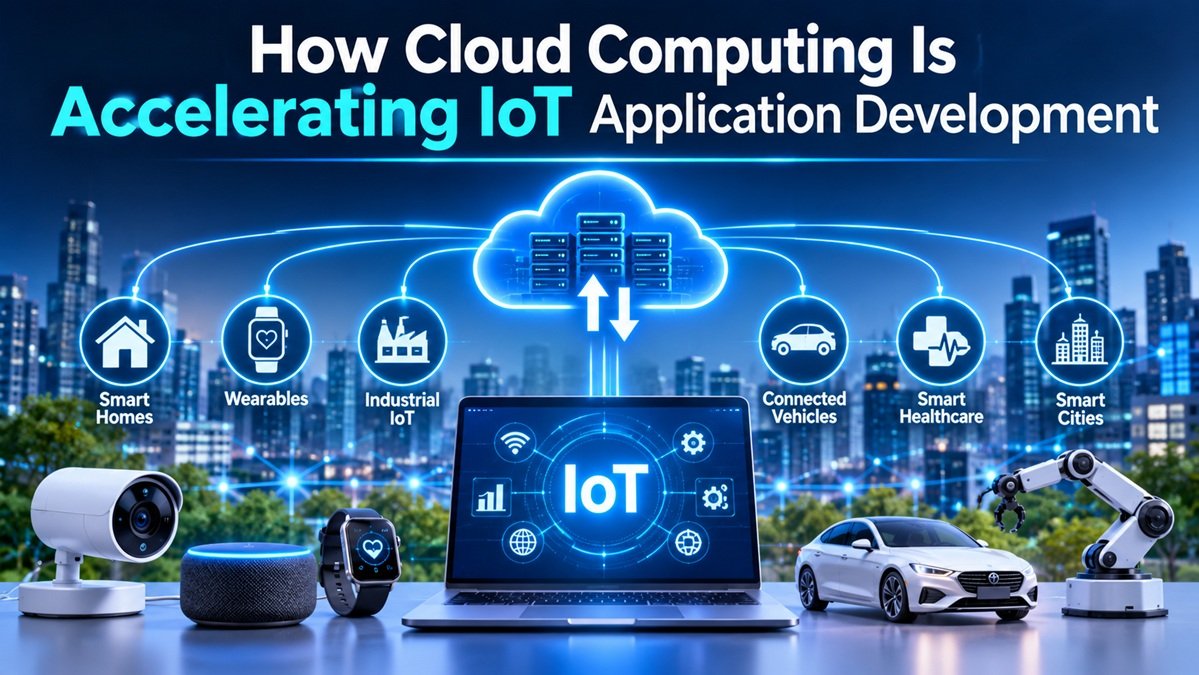
How Cloud Computing Is Accelerating IoT Application Development
IoT projects in the past required making significant investments at the early stage in terms of purchasing servers, storage space, and networking solutions. The development teams were occupied by spending months on creating the necessary infrastructure instead of developing the particular features of the upcoming IoT solution. Cloud computing has completely changed this approach.
Nowadays, cloud computing solutions provide such opportunities as managed data management solutions, infrastructure on demand, pre-integrated analytics solutions and other that allows professionals who work with the Internet of Things to go from an idea to the implementation of the IoT solution in several weeks. The list of data about cloud computing shows that the changes that take place in the field of cloud computing show that many companies that are involved in such spheres as manufacturing, energy, healthcare and logistics are trying to find the ways of implementing solutions faster.
Cloud Technologies Fundamental for IoT Growth
- IoT solutions are composed of four interconnected layers such as the devices, the network connection, the data being processed, and the applications the end-user interacts with. Cloud computing helps support at each level.
- It manages the entire lifecycle of onboarding, auth messaging, and firmware updates. This enables software developers to focus on their products without having to build these fundamental services.
- Elastic computing and storage of interconnected sensors generate data on an endless scale each day. Cloud capacity scales seamlessly during peaks and scales down when the workload diminishes and costs are measured because of this.
- An integration of edge and cloud computing in edge computing as it deals with data very close to the source, making it perfect for use cases with near real-time response requirements.
- Serverless computing and microservices implement event-driven functions that run only when data is coming from the device.
The Way Cloud Fosters the Process of IoT Application Development
Many of those classic examples of IoT applications took so much time to be implemented because each step of that process relied on hardware and the process of its configuration. In this way, the cloud-based platform eliminates all the barriers and offers the development teams more runway. The teams have a chance to check their products through managed services and simulations before actual hardware will appear. Market entry becomes cheaper and more flexible as there is no need in capital investments in hardware and pilot project approval anymore.
Easy APIs/SDKs will assist in minimizing the amount of work required for integration. Cloud development pipeline (this suggests that the software will have the facility for automated testing and over the air updates in the development pipeline of the device, which implies a product that is already deployed) will assist in upgrading the products without going to the physical site of the device. Network in data centers in different locations will assist in deploying the IoT products in two or more sites which are near each other. The product will be modified with ease as modification will not require any changes in the hardware.
Cloud-Enabled IOT In All Industries
Every industry has adopted cloud infrastructure to solve a specific business problem.
- Manufacturing: Production line sensors are collecting vibration, temperature, and cycle data in the factory. This is being sent to an analytics platform in the cloud. This production line data will be used by production line engineers to plan maintenance before failure and monitor the health of equipment across sites.
- Health: Connected monitoring devices transmit patients’ information to secure cloud stores, which allows doctors to check trends from a distance. The products must be created with health data regulations in mind.
- Logistics and Supply Chain: Trucks, containers, and pallets fitted with tracking devices for route tuning and reduction of waste of temperature sensitive goods.
- Energy and Utilities: Remote reading of connected cloud meters and sensors on water usage, and the sharing of the data for improved outage detection and restoration.
- Farming: The soil, weather stations, and water-treatment plant sensors determine needs for watering and treatment; meanwhile, cloud-based analysis works on the data of hundreds of farms at once.
- Cloud aggregates information from lighting, HVAC, and transit to track energy consumption and track public services. Physical sensors gather information and send it to the cloud for analysis, which is then used by an application. The cloud computing market is expanding along this pattern: IoT workloads are the biggest consumers of cloud service data.
Measuring the Acceleration in IoT Development
The success of cloud adoption can be measured in performance metrics and not simply how many services have been acquired. Perform a baseline comparison on these areas:
- Measure the days or weeks between the approval date to the first version in production. Compare the duration for your current project to that of prior projects, which were on-premises.
- Development Productivity: lower release frequency, lower number of bugs, faster adoption of new device types (for any device).
- System Reliability: Uptime, message delivery and response time to incidents indicate if the platform is robust enough to support mission-critical functions.
- Control costs track cost per connected device, data storage and transfer costs and the cost of idle resources. The use of cloud services can get very expensive if you don’t regularly track how you are using it.
- The nature of the data ingested, which is used versus simply stored means you’re paying for storage or deriving value from your investment.
These strategies will always be more effective if they are reviewed on an ongoing basis and compared with the business goals. Running more frequently does nothing for you if it results in buggy applications or runaway costs.
Collaboration and Skills Development
Cloud-based IoT development takes collaboration among what was once separate divisions. The hardware team, software engineers, data scientists, and security teams all need access to a common platform and shared data. They use repositories, consoles, and deployment processes. Organizations must put a new type of knowledge into their hands. Teams need cloud architecture experience and expertise, device management, data engineering, and API design.
Familiarity with Dev Ops techniques like automated testing and infrastructure-as-code is helpful, but even after training and with established best practices, a company can at least cull out some reliance on a few experts. Operations technology workers who are familiar with the installed kit should be included from the outset. Their experience helps improve sensor choice, data definitions and alert rules and ensures that cloud analytics is accurate.
Obstacles To Cloud IoT Development
While cloud IoT projects have obvious merits, they also present some challenges that require early consideration. Here are three groups of challenges.
- Security and Compliance: The greater the connectivity of devices, the greater the opportunities for attack. Data governance brings extra security. Countries and industries have varying regulations on the location and duration of storage of data and requirements for consent; companies need to manage this data.
- Performance and Integration: Safety equipment and applications, which depend on real time feedback, require more than a remote data centre. Edge processing is typically demanded, complicating the architecture. Interoperability is work: each OEM device has its protocols, data formats, leading to a need for integration layers, additional tests (even on mature cloud platforms).
- Commercial Risk: Relying on a sole supplier’s proprietary solutions can be expensive to shift away from, so an open standards and portable architecture should be kept in mind at the outset. And costs have to be strictly controlled. The storage and accessibility of data incur costs, and you won’t be able to realize the full potential of your migration to the cloud if you do not manage the process closely enough.
In the Future: Smart and Scalable IoT
Analytical services powered by the AI; High-performance connectivity and edge computing we use machine learning models that are developed in the cloud to make real-time decisions at the edge in device-to-device communications and bring them back to the data center. Instead of having physical prototypes to design products, we use digital twins. No-code/low-code IoT solutions allow business groups to develop IoT solutions without coding.
Sustainability through Cloud-Based Monitoring in the Cloud will allow you to control waste, the efficiency of devices, and power consumption. According to Pristine Market Insights, industry players should give priority to factors such as cost of technology, workforce skill set, cybersecurity, and integration of these systems to ensure connected operations when they go for a connected enterprise to operate in the cloud computing market in the near term.


