
How Modern Web Technologies Like WebAssembly and JavaScript APIs Enable Powerful Browser Tools
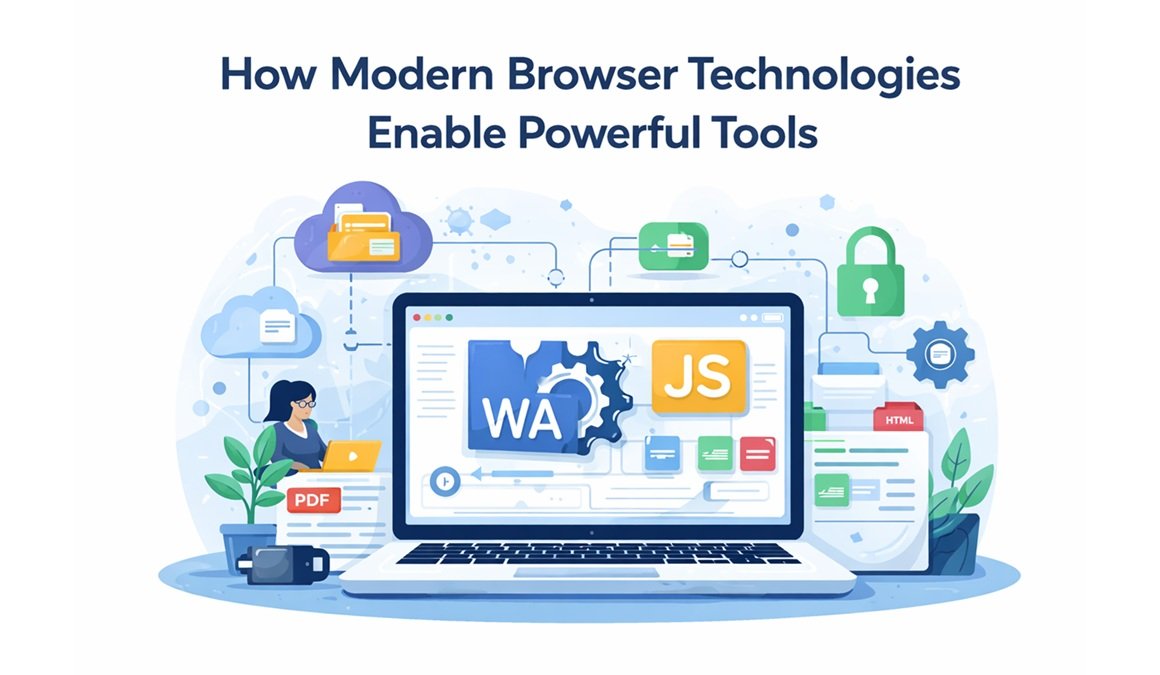
Modern web browsers have evolved far beyond simple website viewers. Today, browsers are capable of running powerful applications directly on your device thanks to technologies such as WebAssembly, advanced JavaScript APIs, and browser-based file systems.
These technologies allow complex tasks like PDF compression, document splitting, financial calculations, image processing, and color conversions to run entirely inside the browser without relying on remote servers.
As a result, modern browser tools are becoming faster, more secure, and privacy-friendly.
WebAssembly: High-Performance Code Inside the Browser
WebAssembly (Wasm) is a powerful technology that allows developers to run near-native performance code inside the browser.
Traditionally, web applications relied entirely on JavaScript. While JavaScript is powerful, some heavy operations such as document processing or image compression require more computational efficiency.
WebAssembly solves this problem by allowing code written in languages like C, C++, and Rust to run directly inside the browser.
This technology enables many modern tools such as PDF compressors and document editors to run efficiently inside the browser, including utilities like
PDF Tools
https://bharatarticles.com/pdf-tools
Because the processing happens locally, users can compress, merge, or split files without uploading documents to external servers.
Advanced JavaScript APIs
Modern browsers provide powerful JavaScript APIs that allow websites to interact with files and perform complex operations.
Some important browser APIs include:
- File API for reading and processing files
- Canvas API for image manipulation
- Streams API for handling large files efficiently
- Compression APIs for file optimization
These APIs enable tools such as image converters and editors to run completely inside the browser.
For example, users can process images locally using
JPEG Image Tools
https://bharatarticles.com/page/jpeg-image-tools
This means images can be converted, resized, or optimized without sending them to external servers.
Browser File Systems and Local Processing
Another powerful advancement is the browser file system and local storage capabilities.
Modern browsers can temporarily store files and data locally while processing them. This allows applications to handle large documents without requiring cloud processing.
Because the files remain on the user’s device, privacy risks are significantly reduced.
This approach is especially useful for document tools, converters, and productivity utilities.
Browser-Based Financial Calculators
Modern browser technologies also power many useful financial and productivity tools that run directly on the user’s device.
For example, users can calculate loan payments using the
EMI Calculator
https://bharatarticles.com/page/emi-calculator
Investors can estimate long-term investment growth using the
SIP Calculator
https://bharatarticles.com/page/sip-calculator
Long-term government savings schemes can be evaluated using the
PPF Calculator
https://bharatarticles.com/page/ppf-calculator
These tools work instantly inside the browser without storing personal financial information anywhere.
Everyday Utilities Powered by Browser Technology
In addition to financial tools, many everyday utilities also run entirely in the browser.
For example:
Users can quickly determine their age using the
Age Calculator
https://bharatarticles.com/page/age-calculator
Designers and developers can convert color codes using the
Color Converter
https://bharatarticles.com/page/color-converter
These tools rely on simple yet powerful JavaScript logic that executes instantly within the browser environment.
Why Browser-Based Tools Are Growing Rapidly
Thanks to modern technologies like WebAssembly and advanced JavaScript APIs, web applications are becoming more powerful than ever.
Advantages of browser-based tools include:
- faster processing speeds
- improved privacy protection
- no file uploads required
- reduced server dependency
- instant results
This shift toward client-side processing is transforming how online tools work.
The Future of Browser Applications
The future of web applications is increasingly moving toward client-side computing, where powerful applications run directly inside the browser.
As browser technology continues to evolve, we can expect to see more advanced tools such as:
- document editors
- media processing software
- financial planning tools
- productivity applications
All running securely inside the browser without needing external servers.
Conclusion
Technologies like WebAssembly, advanced JavaScript APIs, and browser file systems have revolutionized the capabilities of modern web browsers.
These innovations allow websites to run powerful applications directly on users’ devices while improving privacy, speed, and efficiency.
From document tools like
PDF Tools
https://bharatarticles.com/pdf-tools
to financial utilities such as the
SIP Calculator
https://bharatarticles.com/page/sip-calculator
modern browser-based tools demonstrate how far web technology has progressed.
As these technologies continue to develop, browser-based applications will play an increasingly important role in everyday digital workflows.


