
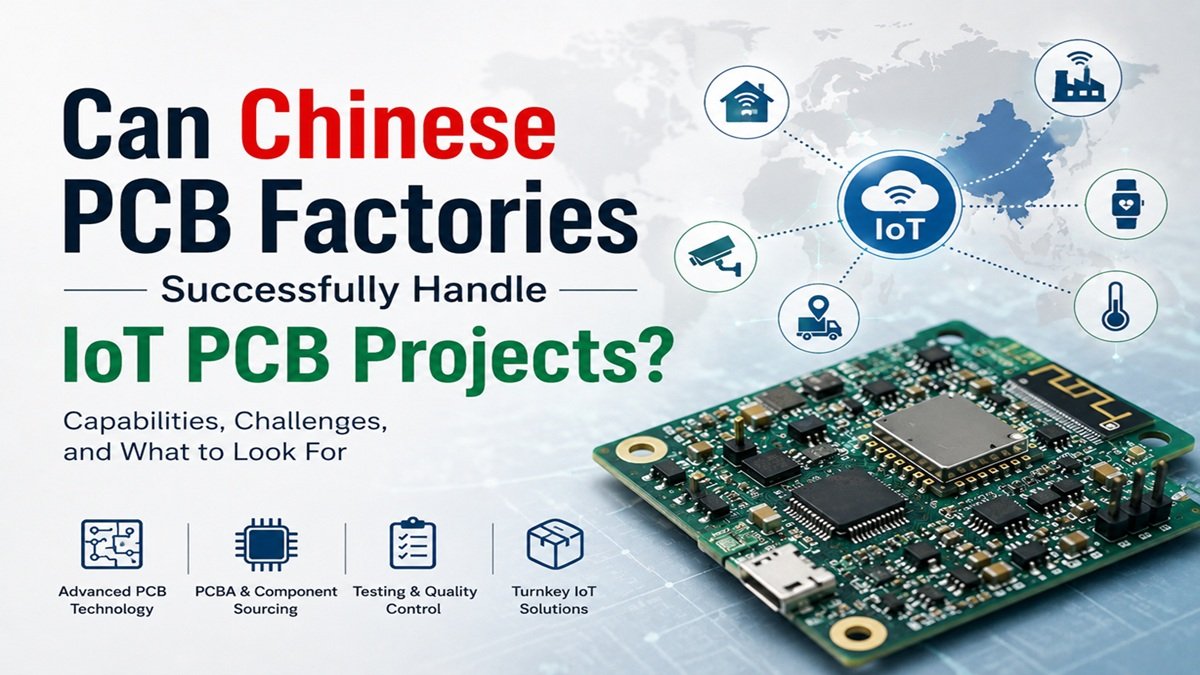
China IoT PCB Manufacturers List for Connected Device Projects
IoT products are not ordinary electronic products. A smart sensor, gateway, wearable device, tracking unit, industrial monitoring module, or smart home controller may look small from the outside, but the PCB inside often carries a complex mix of power management, wireless communication, sensors, memory, antennas, connectors, firmware interfaces, and sometimes battery charging circuits.
This is why choosing an IoT PCB manufacturer is different from choosing a general PCB supplier. For an IoT project, the supplier may need to support PCB fabrication, PCB assembly, component sourcing, wireless-module placement, fine-pitch SMT, testing, firmware loading, enclosure integration, and sometimes full box build assembly.
This article introduces 6 China-based PCB and PCBA companies that may be suitable for IoT projects. The focus is not only on who can make circuit boards, but who can help bring connected hardware closer to a reliable, manufacturable product.
Why IoT PCB Projects Are Difficult
Space Is Usually Limited
Many IoT products need to fit inside a small enclosure. Wearables, sensors, smart locks, tracking devices, smart meters, and compact gateways often require dense layouts, small passive components, fine-pitch ICs, and sometimes flexible or rigid-flex PCBs.
This makes DFM review important. If the layout is too dense or the assembly tolerance is too tight, the product may become difficult to manufacture consistently.
Wireless Performance Depends on PCB Layout
IoT devices often use Wi-Fi, Bluetooth, Zigbee, LoRa, NB-IoT, LTE-M, 4G, 5G, or other wireless communication methods. The PCB layout around antennas, RF traces, ground planes, shielding, and nearby components can directly affect wireless performance.
A weak IoT PCB design may pass basic electrical testing but still perform poorly in real-world communication range, stability, or certification testing.
Low Power Design Is Critical
Many IoT devices run on batteries. In these products, every leakage path, standby current issue, power regulator choice, and firmware wake-up cycle matters.
From a PCB manufacturing and assembly perspective, this means the supplier must control soldering quality, component accuracy, and testing carefully. A small assembly problem can become a battery-life problem in the field.
Component Sourcing Can Be Complicated
IoT products often use wireless modules, sensors, MCUs, memory chips, power ICs, connectors, batteries, and custom cables. Some components may have long lead times or frequent replacement models.
A good IoT PCBA supplier should help review the BOM, identify risky components, and support approved alternatives when needed.
Testing Is More Than Power-On Inspection
For IoT PCB assembly, a board that powers on is not necessarily a good board. Buyers may need firmware programming, wireless communication testing, sensor calibration, functional testing, current-consumption testing, and sometimes enclosure-level testing.
This is why turnkey PCBA and EMS support can be more useful than bare PCB production alone.
PCBCool

PCBCool is the digital brand under PS Electronics and is positioned around PCB manufacturing, PCB assembly, component procurement, program writing, functional testing, and broader PCBA project support. Its website lists services covering PCB manufacturing, component procurement, component mounting, program writing, and functional testing, with support for 1–40 layer PCB manufacturing.
For IoT projects, PCBCool is relevant because many connected products require more than a bare circuit board. A smart home controller, sensor gateway, industrial IoT module, or wearable device often needs PCB fabrication, SMT assembly, BOM sourcing, functional testing, cable integration, and sometimes box build assembly.
PCBCool’s box build service is especially useful for IoT and smart device projects because it covers PCBA installation into enclosures, cable and wire harness integration, power supply or battery-related assembly, mechanical fastening, fit verification, functional testing, final inspection, and packaging support. Its box build page specifically mentions support for IoT and smart devices.
Another important point is fine-pitch assembly. Many IoT products use compact MCUs, wireless chips, memory, and sensor ICs. PCBCool’s BGA assembly page states support for 0.25 mm pitch BGA assembly, SPI, AOI, X-ray inspection, and rework support.
Best fit: IoT product companies that need PCB manufacturing, PCBA, sourcing, testing, firmware-related support, and box build assembly from one manufacturing partner.
Grandtop Group

Grandtop Group is a Shenzhen-based PCB assembly and EMS provider. Its official website describes the company as a PCB assembly manufacturer and electronic manufacturing services provider, specializing in quick-turn prototyping and contract manufacturing PCB assembly services.
Grandtop is relevant to IoT projects because its service positioning is not limited to bare PCB fabrication. It presents itself around PCBA and EMS, which is closer to what many IoT buyers actually need. IoT products often require SMT assembly, DIP or through-hole assembly, component procurement, inspection, final assembly, and sometimes OEM or ODM support.
Public exhibitor information for Shenzhen Grandtop Electronics describes the company as providing PCBA manufacturing, finished product assembly, OEM, ODM, and JDM services for industries including medical, industrial control, automotive, AI, and aerospace.
This makes Grandtop a possible option for IoT buyers whose products overlap with industrial control, smart hardware, automation, or connected electronics.
Best fit: IoT hardware projects that need PCBA manufacturing, EMS support, product assembly, and OEM/ODM-style production services.
XPCB Limited

XPCB Limited is a China-based PCB and PCBA manufacturer located in Shenzhen. Its website states that the company specializes in multilayer flexible circuits, rigid-flex PCB, HDI PCB, and Rogers PCB, with quick-turn PCB prototyping as one of its focuses.
This makes XPCB especially relevant for IoT projects where the board is not a simple rectangular FR4 PCB. Many IoT devices need compact layouts, flexible interconnects, curved mechanical placement, or high-density routing. Examples include wearable devices, smart sensors, handheld terminals, tracking devices, and compact communication modules.
XPCB also has a dedicated IoT devices PCB category, where it again describes itself as a China-based PCB and PCBA manufacturer specializing in multilayer flexible circuits, rigid-flex PCB, HDI PCB, and Rogers PCB.
For IoT projects with space constraints or special mechanical requirements, rigid-flex and HDI capability can be more important than ordinary low-cost PCB production.
Best fit: Wearables, compact IoT sensors, smart modules, flexible PCB designs, rigid-flex IoT products, and HDI-based connected devices.
SYS Technology / SysPCB

SYS Technology, also known as SysPCB, is a China PCB manufacturer founded in 2008. Its website states that it has two Chinese PCB factories, 160 PCB professionals, and 30 employees in its SMT factory. It also says it has experience in PCB manufacturing and PCB assembly, including component assembly and stencil support.
SYS Technology has a dedicated IoT PCB page describing itself as a professional China manufacturer of IoT PCBs. The page states that it has served IoT enterprises in 50 countries and delivered more than one million IoT PCBs. It also mentions low dielectric loss materials, precision laser drilling, and a reported yield figure above 99.2%.
For IoT buyers, this type of supplier may be useful when the project needs both PCB fabrication and SMT assembly support, especially for connected devices where reliability and repeatability matter.
Best fit: IoT PCB production, smart device boards, connected sensor projects, and customers looking for a China-based PCB supplier with IoT-specific positioning.
TopfastPCB

TopfastPCB positions itself as a professional PCB manufacturer providing one-stop PCBA assembly services. Its website lists rigid, flex, rigid-flex, and ceramic PCB fabrication, along with SMT assembly, component sourcing, quality control, and quick-turn services. It also mentions capabilities such as up to 64-layer PCB manufacturing, global parts procurement, BOM cost optimization, wire harness service, and 0201 component assembly.
TopfastPCB also has a dedicated IoT PCB manufacturing and assembly page. It describes its IoT PCB services around industrial IoT, asset tracking, smart cities, connected sensors, low-power design, NB-IoT, LoRa, compact form factors, and 5G-ready products.
This makes TopfastPCB suitable for IoT buyers who care about wireless communication, compact board size, low-power performance, and fast prototype iteration.
For IoT products, TopfastPCB’s stated support for turnkey PCBA, component sourcing, rigid-flex boards, wire harnesses, and small component assembly may be especially useful when the project moves from prototype to pilot production.
Best fit: Industrial IoT, asset tracking, smart city devices, connected sensors, compact wireless products, and low-power IoT boards.
LSTPCB

LSTPCB, operated by Shenzhen LST Technology Co., Ltd., provides PCB design, PCB manufacturing and assembly, electronic component procurement, and electronic finished product assembly. Its website states that the company has automatic printing machines, automatic placement machines, reflow soldering, wave soldering equipment, an 8,000-square-meter factory, and more than 300 employees.
LSTPCB also has a dedicated IoT PCB category, describing IoT PCBs as specialized circuit boards used for communication and data exchange in smart technologies.
Its PCB assembly page states that LSTPCB provides one-stop PCB manufacturing and assembly services for automotive, consumer electronics, AI smart products, medical equipment, industrial control equipment, and smart home products. It also lists component sourcing, SMT, and through-hole assembly as part of its end-to-end service.
For IoT buyers, this makes LSTPCB more relevant when the project needs PCB production, assembly, sourcing, and finished product support rather than only bare boards.
Best fit: Smart home products, consumer IoT devices, industrial control boards, AI smart products, and IoT projects requiring PCB assembly plus component sourcing.
How to Choose a PCB Manufacturer for an IoT Project
A normal PCB price comparison is not enough for IoT projects. Buyers should compare suppliers based on product risk, not only unit cost.
First, check whether the supplier can support the full IoT workflow. This may include PCB fabrication, component procurement, SMT, through-hole assembly, module placement, firmware loading, functional testing, cable assembly, and enclosure integration.
Second, review whether the supplier understands compact and wireless PCB constraints. IoT boards often involve antenna clearance, RF routing, grounding, shielding, impedance control, and noise-sensitive power circuits.
Third, confirm low-power testing requirements. If the device is battery-powered, the supplier should help test sleep current, standby current, charging behavior, and functional current under different operating modes.
Fourth, ask for sample-build discipline. IoT products often need several rounds of design improvement before stable production. A good supplier should give DFM feedback instead of simply producing exactly what is sent.
Finally, confirm traceability. Once an IoT device is deployed in the field, troubleshooting becomes expensive. Batch records, test results, component lot tracking, and inspection data can help reduce long-term risk.
Conclusion
IoT PCB manufacturing is not only about making a small circuit board. It is about building reliable connected hardware that can communicate, save power, survive real-world use, and remain stable after deployment.
PCBCool, Grandtop Group, XPCB Limited, SYS Technology, TopfastPCB, and LSTPCB represent different types of China-based suppliers that may support IoT PCB and PCBA projects. Some are stronger in EMS and box build assembly. Some focus more on flex, rigid-flex, HDI, or quick-turn prototyping. Others position themselves directly around IoT PCB manufacturing and connected device applications.
This China PCB manufacturers list should be used as a starting point, not as a final supplier decision. Before choosing any company, buyers should contact the supplier directly, verify current production capability, review similar project experience, request samples, and confirm whether the supplier can support both prototype development and repeat production.
For IoT projects, the best PCB manufacturer is not simply the one with the lowest board price. It is the partner that can help turn a connected device design into a stable, tested, manufacturable, and scalable product.


