
CPU vs GPU: What’s the Difference and Why It Matters for AI, Gaming, and Everyday Computing
Introduction
If you have ever installed software, played a game, edited video, or tried running an AI model locally, you have seen the terms CPU and GPU. Both are processors inside your computer — but they are designed for completely different types of work.
Understanding the difference is important today because modern tasks like AI models, machine learning, 3D rendering, and video editing rely heavily on the right processor choice.
In simple words:
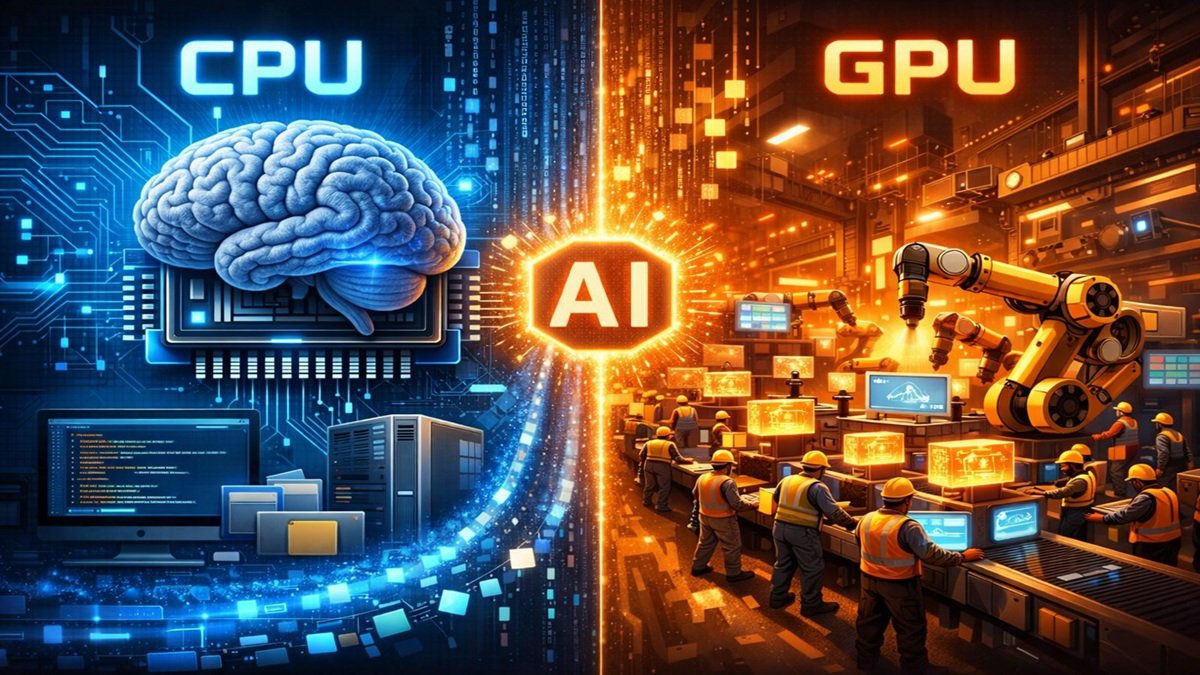
- CPU = Brain (decision making & general tasks)
- GPU = Workforce (mass parallel calculations)
Let’s understand deeply.
Read this: Build Your Own Free Offline AI Chatbot Using Ollama + Open WebUI (Complete Guide)
What is a CPU (Central Processing Unit)?
The CPU is the main processor of the computer. It handles logic, instructions, and coordination of all components.
You can think of it as the manager of the system.
Key Characteristics
- Few powerful cores (4–24 cores common)
- High clock speed
- Handles complex instructions
- Best for sequential operations
What CPU Does in Daily Use
- Running Windows / Linux / macOS
- Opening browser and software
- Coding and compiling programs
- Server operations
- Networking
- File operations
- Operating system control
CPU in AI Workloads
CPU can run AI models but slowly.
It is used for:
- Loading models
- Tokenization
- Small inference tasks
- Background operations
Large language models run, but response generation becomes slow.
What is a GPU (Graphics Processing Unit)?
The GPU was originally designed to render images and graphics. But its real strength is parallel processing — performing thousands of identical calculations simultaneously.
This makes it perfect for Artificial Intelligence.
Instead of a manager, think of GPU as a massive factory workforce.
Key Characteristics
- Hundreds to thousands of cores
- Lower individual core intelligence
- Massive parallel processing power
- Extremely fast matrix math
What GPU Does in Daily Use
- Gaming graphics rendering
- Video editing acceleration
- 3D modeling
- Animation rendering
- AI inference & training
- Image generation
Why AI Needs GPU
AI models mainly perform matrix multiplication repeatedly.
Example:
When a chatbot generates a sentence, it performs billions of mathematical operations per response.
CPU → processes step-by-step
GPU → processes thousands of steps simultaneously
That is why GPUs are used in:
- Chatbots
- Image generation
- Speech recognition
- Machine learning
CPU vs GPU Architecture Difference
| Feature | CPU | GPU |
|---|---|---|
| Purpose | General computing | Parallel computing |
| Core Count | Low | Extremely High |
| Speed per Core | Very Fast | Moderate |
| Parallel Work | Weak | Excellent |
| AI Performance | Slow | Very Fast |
| OS Tasks | Perfect | Not designed |
| Power Efficiency for AI | Low | High |
Real-World Performance Comparison (AI Model Example)
Running a local language model:
| Hardware | Response Speed |
|---|---|
| Only CPU | 1–3 words/sec |
| Entry GPU | 20–40 words/sec |
| Mid-range GPU | 40–80 words/sec |
| High-end GPU | Near real-time conversation |
RAM vs VRAM (Important Concept)
Many users confuse this.
| Type | Used By | Purpose |
|---|---|---|
| RAM | CPU | System memory |
| VRAM | GPU | Model & graphics memory |
AI models load inside VRAM, not normal RAM.
So GPU memory size matters more than system RAM for AI.
When You Need CPU Power
You should prioritize CPU if you do:
- Programming
- Server hosting
- Web browsing
- Office work
- Compiling software
- Databases
When You Need GPU Power
You should prioritize GPU if you do:
- Gaming
- Video editing
- 3D rendering
- AI models (LLMs)
- Stable Diffusion / Image generation
- Machine learning
Simple Analogy
Imagine building a city:
- CPU = Architect planning everything
- GPU = Thousands of workers building simultaneously
Planning requires intelligence → CPU
Construction requires scale → GPU
AI requires scale → GPU wins.
Conclusion
Both CPU and GPU are essential parts of modern computing, but they serve different purposes.
The CPU controls the system and executes logic, while the GPU accelerates massive calculations. With the rise of artificial intelligence, GPUs have become one of the most critical components in a computer.
If your goal is general computing, invest in a better CPU.
If your goal is AI, rendering, or gaming, invest in a powerful GPU.
The future of computing — especially AI — belongs heavily to GPU acceleration, while CPU remains the foundation of system control.


