
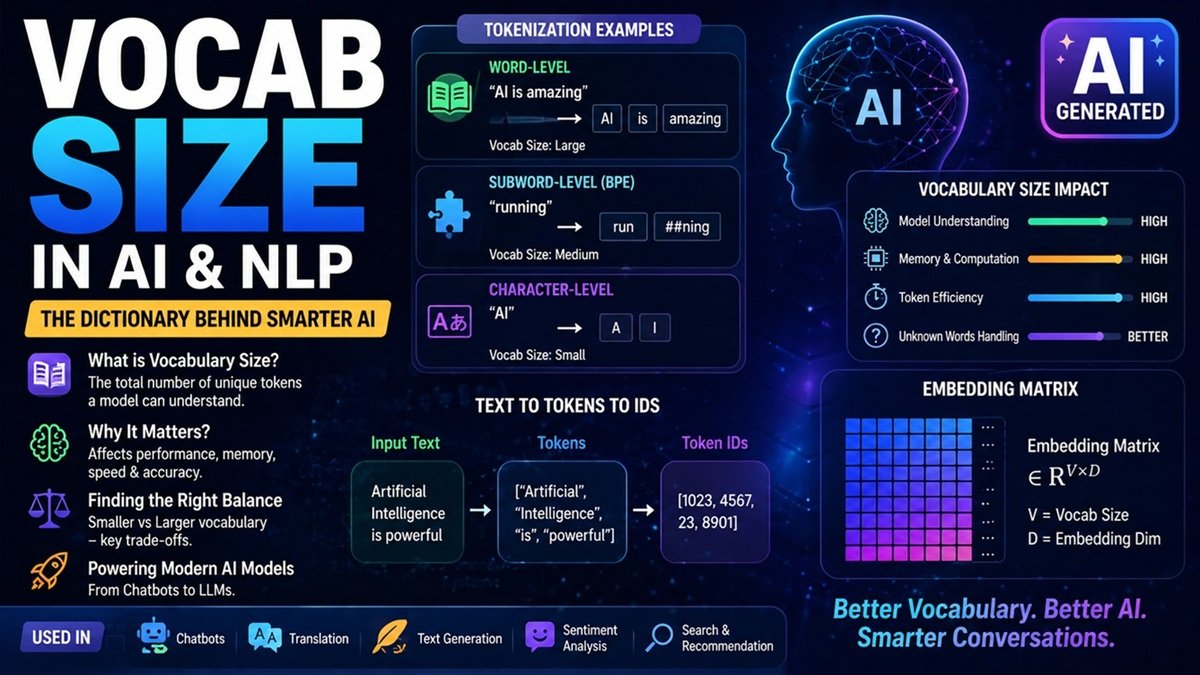
Vocabulary Size in AI: A Complete Guide for NLP and LLMs
Introduction
In Artificial Intelligence, especially Natural Language Processing (NLP), vocabulary size (vocab size) is one of the most critical design choices when building models like chatbots, translators, and large language models.
Modern AI systems such as GPT (Generative Pre-trained Transformer) and BERT depend heavily on how text is converted into tokens—and that’s where vocabulary size comes into play.
Read This: Tensor in AI: A Complete Guide for Beginners to Advanced
What is Vocabulary Size?
Vocabulary size refers to the total number of unique tokens (words, subwords, or characters) that an AI model can recognize.
In simple terms:
It is the dictionary size of an AI model.
Example
If a model has a vocab size of 50,000:
- It knows 50,000 tokens
- Every input word must be converted into one of these tokens
Types of Vocabulary in AI
1. Word-Level Vocabulary
- Each word is a token
- Example: “India is growing” → 3 tokens
- Problem: Huge vocab size, unknown words
2. Subword-Level Vocabulary (Most Used)
- Words are split into smaller units
- Example: “playing” → “play” + “ing”
- Used in modern models
3. Character-Level Vocabulary
- Each character is a token
- Very small vocab
- Slower and less efficient
Why Vocabulary Size Matters
1. Model Understanding
- Larger vocab → Better understanding of rare words
- Smaller vocab → More generalization
2. Memory & Computation
- Larger vocab = more parameters
- Increases:
- Model size
- Training cost
- GPU usage
3. Token Efficiency
- Small vocab → More tokens per sentence
- Large vocab → Fewer tokens
Vocabulary Size in Popular Models
| Model | Approx Vocab Size |
|---|---|
| GPT models | ~50,000+ |
| BERT | ~30,000 |
| T5 | ~32,000 |
These models use subword tokenization techniques like:
- Byte Pair Encoding (BPE)
- WordPiece
- SentencePiece
How Text Becomes Tokens
Example Sentence:
"Artificial Intelligence is powerful"
Tokenization:
["Artificial", "Intelligence", "is", "powerful"]
Token IDs:
[1023, 4567, 23, 8901]
Mathematical View of Vocabulary
Each token is mapped to a vector:

Where:
- (V) = Vocabulary size
- (D) = Embedding dimension
Vocabulary Size vs Embedding Layer
- Larger vocab → Bigger embedding matrix
- Example:
If:
- V = 50,000
- D = 768
Then:
- Parameters = 50,000 × 768 = 38.4M
Trade-offs in Choosing Vocabulary Size
| Factor | Small Vocab | Large Vocab |
|---|---|---|
| Memory | Low | High |
| Speed | Faster | Slower |
| Flexibility | Low | High |
| Unknown words | More | Less |
Real-World Example
In a chatbot:
- User input → Tokenized
- Tokens → Passed to model
- Model → Predicts next token
- Output → Converted back to text
Out-of-Vocabulary (OOV) Problem
When a word is not in vocab:
- Model fails to understand it
- Example: New slang, names
Solution:
- Use subword tokenization
- Use byte-level encoding
Vocabulary Size in Multilingual Models
- Needs larger vocab
- Must handle multiple languages
- Example:
- Hindi + English → Larger token set
Advanced Concepts
1. Dynamic Vocabulary
- Model adapts vocab over time
2. Byte-Level Tokenization
- Works on raw text bytes
- Used in modern LLMs
3. Token Compression
- Reduces token count for efficiency
Code Example
Using Tokenizer (Python)
from transformers import AutoTokenizer

tokenizer = AutoTokenizer.from_pretrained("bert-base-uncased")

tokens = tokenizer.tokenize("AI is amazing")
print(tokens)
Common Mistakes
- Choosing too large vocab unnecessarily
- Ignoring OOV issues
- Not optimizing for multilingual data
- Confusing tokens with words
Explore
Complete Roadmap to Learn AI from Zero to LLMs and Generative AI
Best Free Cloud GPU Platforms in 2026: Google Colab, Kaggle and More
Quantization in AI Models (4-bit, 8-bit, GGUF) — A Clear Detailed Guide
Understanding 7B, 13B, and 70B in AI Models — What “Parameters” Really Mean
Conclusion
Vocabulary size is a core factor in NLP model performance. It directly impacts:
- Model accuracy
- Speed
- Memory usage
Modern AI models strike a balance by using subword tokenization and optimized vocab sizes.
Understanding vocab size properly will help you:
- Build efficient AI systems
- Optimize LLM training
- Improve NLP performance


