
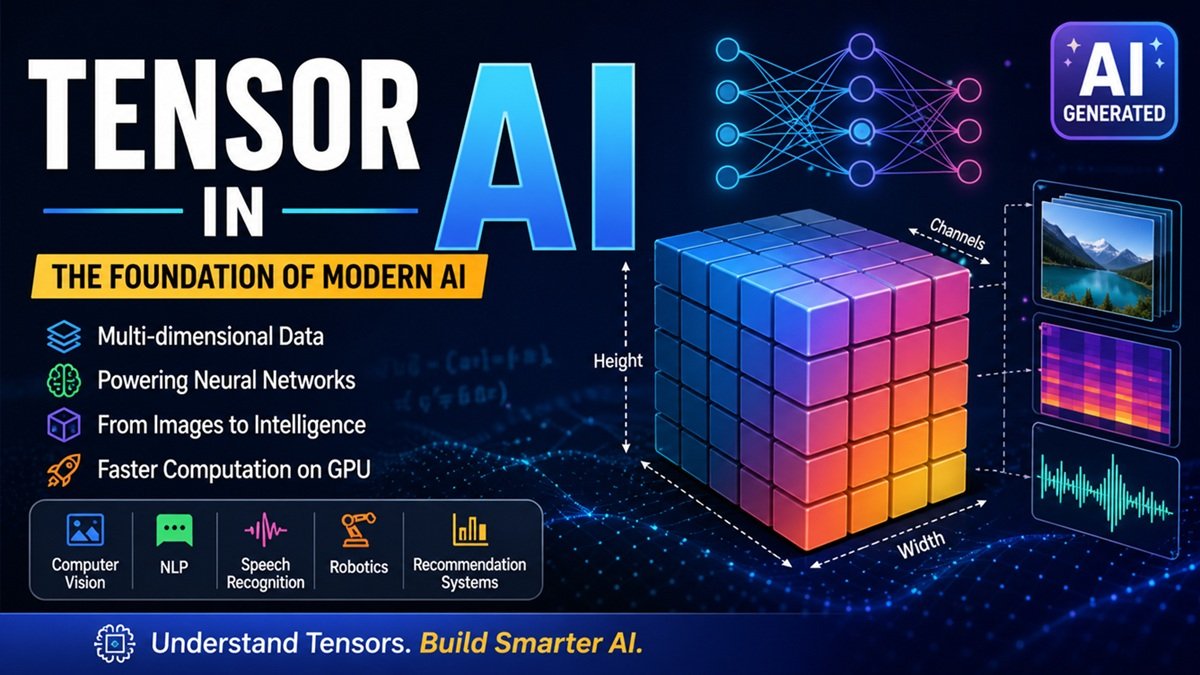
Tensor in AI: A Complete Guide for Beginners to Advanced
Introduction
In modern Artificial Intelligence (AI), especially in deep learning, the term tensor is everywhere. Whether you’re working with neural networks, computer vision, or NLP models, tensors are the fundamental building blocks behind all computations.
Libraries like TensorFlow and PyTorch rely heavily on tensors to process and transform data efficiently on CPUs and GPUs.
This article provides a deep, structured, and SEO-optimized explanation of tensors in AI—from basic concepts to real-world applications.
What is a Tensor?
A tensor is a mathematical object used to represent data in multiple dimensions. Simply put:
A tensor is a generalization of scalars, vectors, and matrices to higher dimensions.
Types of Tensors (By Dimension)
| Type | Dimensions | Example |
|---|---|---|
| Scalar | 0D | 5 |
| Vector | 1D | [1, 2, 3] |
| Matrix | 2D | [[1,2],[3,4]] |
| Tensor | 3D+ | [[[…]]] |
Why Tensors Are Important in AI
Tensors are essential because:
- They allow efficient computation on large datasets
- They enable parallel processing on GPUs
- They store complex data like images, text, and audio
- They are optimized for linear algebra operations
Real-Life Examples
- Image → 3D tensor (Height × Width × Channels)
- Video → 4D tensor (Frames × Height × Width × Channels)
- Text embeddings → 2D tensor
- Audio spectrogram → 2D tensor
Tensor Representation in AI Models
In deep learning models:
- Input data → Tensor
- Weights → Tensor
- Output → Tensor
For example, in a neural network:
Input Tensor → Hidden Layers → Output Tensor
Mathematical Perspective of Tensors
A tensor can be represented as:

Where:
- (d_1, d_2, …, d_n) represent dimensions
- (n) is called the rank or order of the tensor
Tensor Operations in AI
Common operations include:
- Addition
- Multiplication
- Dot product
- Matrix multiplication
- Reshaping
- Broadcasting
Example (Matrix Multiplication)
C=A×B
This operation is fundamental in neural networks where weights interact with inputs.
Tensor vs Matrix vs Vector
| Feature | Vector | Matrix | Tensor |
|---|---|---|---|
| Dimensions | 1D | 2D | nD |
| Complexity | Low | Medium | High |
| Usage | Simple data | Tabular | Complex data |
Tensors in Popular AI Frameworks
TensorFlow
- Uses static and dynamic graphs
- Optimized for production
- Developed by Google
PyTorch
- Dynamic computation graph
- Easier debugging
- Preferred in research
- Developed by Meta
Tensor Shape and Rank
- Shape: Size in each dimension
Example: (3, 224, 224) - Rank: Number of dimensions
Example: Rank = 3
Tensor in Deep Learning Workflow
- Data collection
- Convert data → tensor
- Feed into model
- Perform operations
- Get output tensor
GPU Acceleration and Tensors
Tensors are optimized for parallel processing using:
- CUDA-enabled GPUs
- TPUs (Tensor Processing Units)
This allows AI models to train faster.
Applications of Tensors in AI
- Computer Vision
- Natural Language Processing
- Speech Recognition
- Recommendation Systems
- Robotics
Advanced Concepts
1. Sparse Tensors
Used when most values are zero (memory efficient)
2. Dense Tensors
Regular tensors with all values stored
3. Tensor Decomposition
Breaking tensors into smaller components
Tensor Example in Code
PyTorch Example
import torch

tensor = torch.tensor([[1, 2], [3, 4]])
print(tensor)
TensorFlow Example
import tensorflow as tf

tensor = tf.constant([[1, 2], [3, 4]])
print(tensor)
Common Mistakes Beginners Make
- Confusing shape vs rank
- Mixing matrix and tensor concepts
- Ignoring broadcasting rules
- Not understanding GPU optimization
Explore
Complete Roadmap to Learn AI from Zero to LLMs and Generative AI
Best Free Cloud GPU Platforms in 2026: Google Colab, Kaggle and More
Quantization in AI Models (4-bit, 8-bit, GGUF) — A Clear Detailed Guide
Understanding 7B, 13B, and 70B in AI Models — What “Parameters” Really Mean
Conclusion
Tensors are the core foundation of AI and deep learning. Every modern AI system—from chatbots to self-driving cars—relies on tensors for data representation and computation.
Understanding tensors deeply will help you:
- Build better AI models
- Optimize performance
- Work efficiently with frameworks like TensorFlow and PyTorch


