
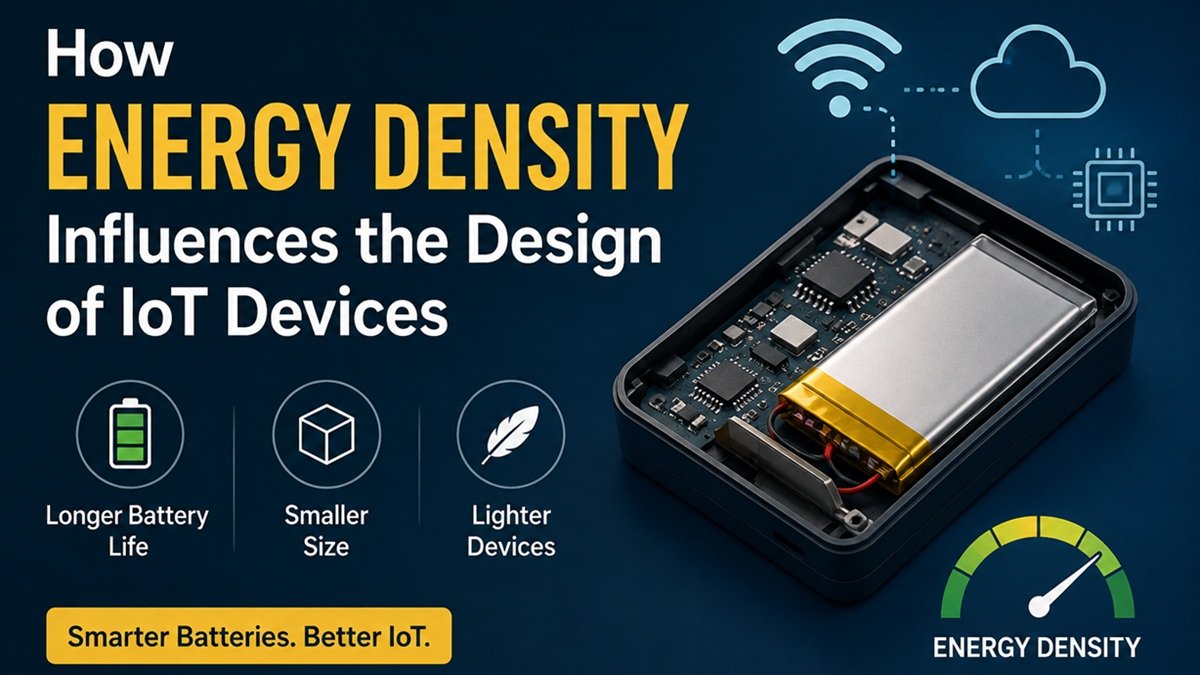
How Energy Density Influences the Design of IoT Devices
As IoT devices become smaller and lighter, the battery is no longer just a power source. It has become a key component that can affect the overall product design. For smart wearables, medical devices, smart glasses, industrial sensors, and drones, the battery’s size, weight, capacity, power output, and safety can all affect battery life, mechanical design, and the use of internal space.
Among these factors, energy density is especially important. Higher energy density does not simply mean more energy in the battery. It can also provide longer battery life in the same space, or allow the battery to be made smaller and lighter while providing the same battery life.
For IoT hardware engineers, energy density is therefore more than just a battery performance metric. It can directly affect the device’s size, internal space, mechanical design, and power system.

What Is Battery Energy Density?
Battery energy density simply describes how much energy a battery can store for a given weight or volume. In engineering, there are two common ways to measure it: gravimetric energy density and volumetric energy density.
Gravimetric Energy Density
Gravimetric energy density is usually measured in Wh/kg. The calculation is straightforward:
Gravimetric Energy Density = Stored Energy ÷ Battery Weight
This value is especially important for products where weight matters, such as drones, robots, and wearable devices. If two batteries can provide the same amount of energy, the battery with higher energy density can usually deliver that energy with less weight.
This is especially useful for wearable products. Smart glasses and smart rings may be worn for many hours, so even a few grams of weight reduction can improve overall weight balance and wearing comfort.
Volumetric Energy Density
Volumetric energy density is usually measured in Wh/L:
Volumetric Energy Density = Stored Energy ÷ Battery Volume
When internal space is limited, this metric can be even more important than simply looking at battery capacity.
Take smart glasses as an example. The battery may need to fit inside a narrow temple arm. In this case, the real engineering question is not simply, “Can we fit a larger battery?”
It is how can we get more usable energy from the same limited space?
That is why both gravimetric and volumetric energy density matter for compact IoT devices. When space is the main constraint, however, volumetric energy density can become the more critical factor.
Why Does Energy Density Affect IoT Device Design?
The most direct impact of energy density is that it changes what engineers can achieve when they are working within strict space and weight limits.
1. Energy Density Affects Device Size
Suppose an IoT device needs about 1.85 Wh of battery energy. With different levels of volumetric energy density, the theoretical battery volume would be:
| Volumetric Energy Density | Theoretical Volume Needed for 1.85 Wh |
| 400 Wh/L | ~4.63 cm³ |
| 600 Wh/L | ~3.08 cm³ |
| 800 Wh/L | ~2.31 cm³ |
This is only a theoretical example to show the relationship between energy density and battery volume. In a real battery design, engineers also need to consider packaging, tabs, protection structures, operating voltage, usable capacity, safety margins, and other factors.
Still, the example highlights an important point:
When the energy requirement stays the same, higher volumetric energy density can reduce the space needed to store that energy.
For space-constrained IoT products, this can give engineers several options:
- Make the overall device smaller.
- Keep the device size the same and increase battery life.
So, higher energy density does not necessarily mean the device has to become smaller. Its bigger value is higher energy density creates more design freedom.
2. Energy Density Affects Battery Life
Battery energy has a direct relationship with operating time.
Under ideal conditions, the basic calculation is:
Operating Time ≈ Battery Energy ÷ Average Power Consumption
For example, if a battery provides about 1.85 Wh of usable energy and the device consumes an average of 200 mW, the theoretical operating time would be:
1.85 Wh ÷ 0.2 W = 9.25 hours
If a higher-energy-density battery provides 2.5 Wh of energy in the same physical space, the theoretical operating time could increase to:
2.5 Wh ÷ 0.2 W = 12.5 hours
This shows how higher energy density can extend operating time without increasing the device size.
In real IoT products, however, battery life is not simply equal to “battery energy ÷ average power consumption.” Other factors also affect actual runtime. Therefore, engineers should use a system-level power model when estimating battery life rather than looking only at the battery’s rated capacity.
3. Energy Density Affects Device Weight
For portable and wearable IoT devices, weight can be just as important as size.
Take smart glasses as an example. The battery is often placed inside the temple arms. If the battery is too heavy, it can shift the device’s center of gravity and increase pressure on the nose and ears.
Similar challenges can be found in smart rings, smartwatches, medical patches. In these applications, higher gravimetric energy density can help engineers reduce battery weight while providing the same amount of energy.
Why Doesn’t Higher Energy Density Always Mean a Better Battery?
Higher energy density does not always mean a battery is the best choice for an IoT product.
If engineers focus only on Wh/kg or Wh/L, they may face issues such as voltage drop, heat, short cycle life, or system restarts during actual use.
Battery selection should also consider these key factors.
1. Power Capability and C-rate
Energy density tells us how much energy a battery can store.
C-rate tells us how quickly it can deliver current.
For example, if a 200 mAh battery needs to supply 600 mA during a peak load:
600 mA ÷ 200 mAh = 3C
The battery therefore needs to support about 3C peak discharge.
A battery with high energy density is not a good fit if it cannot meet the device’s peak current demand. This matters for Wi-Fi, cellular, cameras, robot motors, and AI devices.
2. Internal Resistance and IR Drop
When the device suddenly needs more power, current rises quickly. Higher battery resistance usually means a larger voltage drop:
Vdrop = I × R
If the voltage falls below the UVLO (Under-Voltage Lockout) threshold of the PMIC or SoC, the device may restart, lose communication, or enter protection mode.
For high-power IoT devices, low internal resistance and stable discharge performance are therefore also important.
3. Cycle Life
IoT devices have different charging patterns. Some may be charged every few months, while wearables may be charged every day.
For devices that cycle every day, battery cycle life can directly affect the product’s usable lifetime.
So engineers should ask not only:
“How many Wh/L does the battery provide?”
but also:
“How much capacity can it retain under real operating conditions?”
4. Safety and Thermal Management
Higher energy density means more energy is stored in the same space, making safety and thermal management more important.
For wearable and medical devices, engineers should consider:
- Operating and charging temperature
- Battery swelling
- Mechanical pressure
- Overcharge, over-discharge, and short-circuit protection
- Thermal management
- Certification requirements
In the end, battery selection is a trade-off between multiple factors.
The best battery is not necessarily the one with the highest energy density. It should provide the right balance of energy, power, cycle life, size, weight, and safety for the application.
Battery Requirements Vary by IoT Application
Different IoT products have different battery requirements.
Smart wearables such as smart glasses, smart rings, and smartwatches need to balance energy density, size, weight, thickness, and peak power. In products like smart glasses, the battery is also part of the overall mechanical and industrial design.
Medical IoT devices usually focus on energy density, reliability, safety, and cycle life, while also considering weight, temperature, and user comfort.
Industrial IoT sensors may operate in hard-to-reach locations. Higher energy density can extend operating time and reduce battery replacement and maintenance.
Drones and robots need both high energy density and high power capability. The battery must provide enough energy for longer operation while handling high current demands during motor startup and acceleration.
A Simple Battery Selection Process
Battery selection for wearable IoT Devices can be simplified into four key steps:
- Define runtime — Determine how long the device needs to operate.
- Calculate energy needs — Use average power and operating time to estimate the required energy, then add system losses and design margin.
- Check space and peak power — Consider battery dimensions, available space, peak current, C-rate, internal resistance, and voltage drop.
- Check environment and safety — Evaluate temperature, vibration, mechanical stress, and required certifications such as IEC 62133-2, UN 38.3, UL 1642, and RoHS.
The key is to select the battery together with the product design. The best battery is not necessarily the one with the highest energy density, but the one that best matches the device’s size, power, runtime, safety, and lifecycle requirements.
Conclusion: Energy Density Is a System-Level Design Parameter
As IoT devices become smaller and more powerful, energy density is becoming increasingly important.
Higher energy density can provide more energy in the same space, helping engineers improve battery life, device size, weight, and internal space utilization.
But higher energy density does not always mean a better battery. Engineers also need to consider:
Energy Density + Power Capability + Cycle Life + Safety + Form Factor + Thermal Performance
The battery should not be treated as the last component added to a finished product. Its size, shape, energy, power, and thermal requirements should be considered from the early design stage.
The best battery is not necessarily the one with the highest energy density, but the one that provides the right balance of performance, size, safety, and reliability for the application.
That is the real impact of energy density on IoT device design.


