
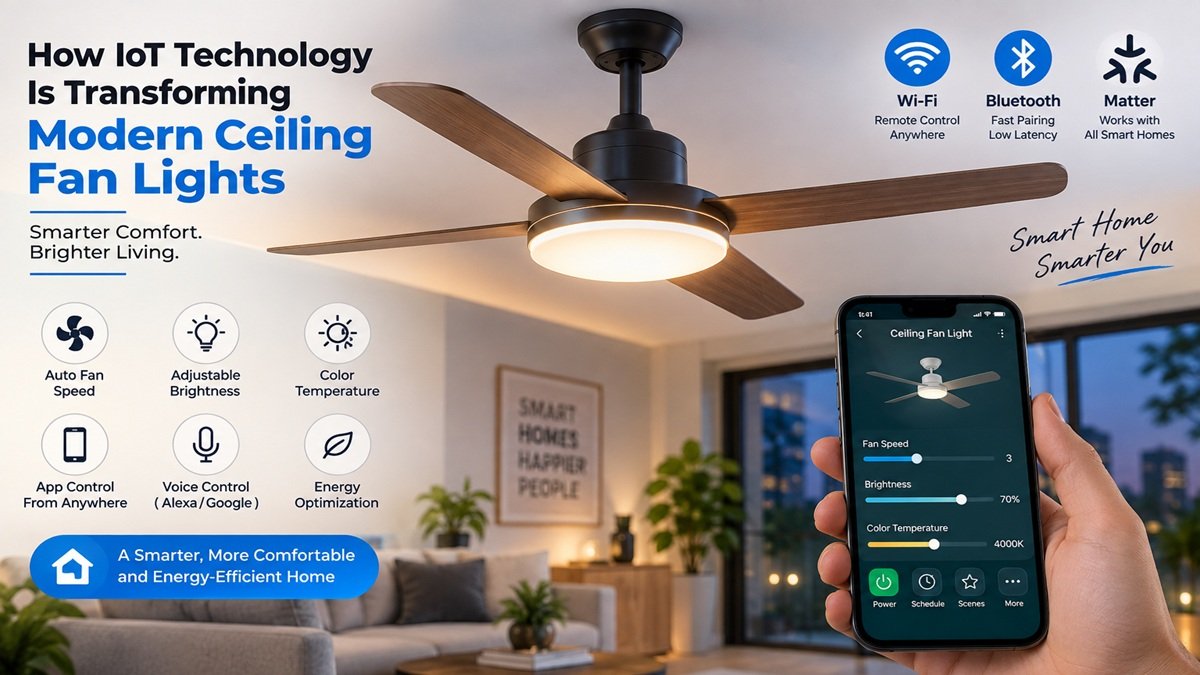
How IoT Technology Is Transforming Modern Ceiling Fan Lights

Traditional ceiling fan lights are mainly a combination of a fan and a lighting system, with separate and limited functions. Users still need to manually adjust the fan speed and lighting, while the device cannot automatically respond to environmental changes or connect with modern smart home systems.
With the development of Internet of Things(IoT) technology, modern ceiling fan lights are evolving from simple appliances into intelligent home devices. By combining sensors, wireless communication, smart algorithms, and control systems, IoT-enabled ceiling fan lights can sense environmental changes, respond to user needs, and automatically adjust airflow, brightness, and color temperature. They also support remote app control, voice interaction, smart scenes, and energy optimization, creating a more comfortable and efficient home environment.
1. Understanding the IoT Architecture Behind Smart Ceiling Fan Lights
1.1 The Evolution from Traditional Control to Smart Connectivity
Traditional ceiling fan lights rely on a hardware-based control system, where operating parameters are fixed during production with limited customization options.
The integration of IoT connectivity and advanced control chips has transformed the underlying control architecture, upgrading standalone hardware systems into a distributed smart framework of “device + cloud + algorithms.” This enables network connectivity, remote control, and continuous feature updates throughout the product lifecycle.
1.2 The Core Logic of IoT: Data, Decision, and Action
Smart ceiling fan lights powered by IoT technology create a closed-loop system of “sensing–data transmission–decision-making–execution–feedback.”
Through multiple sensors, the device continuously collects real-time indoor data and sends it to gateways or cloud platforms through IoT protocols. Based on built-in algorithms and smart scene models, the system automatically adjusts fan speed, rotation direction, and lighting settings. The device then executes these commands and feeds back operating status, enabling autonomous and intelligent operation with minimal user intervention.
1.3 Why IoT Fits the Future Development of Ceiling Fan Lights
IoT technology enables faster device integration without major hardware changes, connects products across smart ecosystems, and adds new features through software updates. With OTA upgrades, intelligent scheduling, and multi-device interaction, IoT helps reduce product similarity and drives innovation in ceiling fan light development.
Traditional Ceiling Fan Lights vs. IoT-Enabled Smart Ceiling Fan Lights
2.1 Limitations of Traditional Ceiling Fan Light
Traditional ceiling fan lights only support local control, making remote shutdown impossible and potentially leading to unnecessary energy use and safety concerns. Fixed speed levels and lighting settings also limit adjustment, preventing the system from adapting to temperature changes, occupancy, or different scenarios such as sleep and comfort modes.
2.2 How IoT Technology Upgrades Ceiling Fan Light Functions
IoT-enabled smart ceiling fan lights combine control chips, sensors, and wireless connectivity to deliver smarter operation. It can lower fan speed and brightness during sleep, increase airflow when room temperature rises, and shut down remotely when users leave home to reduce energy waste. It can also connect with smart home systems for device coordination and receive continuous improvements through OTA updates.
2.3 Wireless Technologies: Wi-Fi, Bluetooth, and Matter Protocol Applications
Smart ceiling fan lights rely on three key communication protocols — Wi-Fi, Bluetooth, and Matter — to achieve efficient and reliable connectivity. Wi-Fi enables long-range cloud access and remote control, Bluetooth supports fast local pairing and low-latency offline operation, while Matter serves as a universal connectivity standard .

3. Core IoT Architecture of Smart Ceiling Fan Lights
3.1 App-Based Remote Control
Remote app control creates a closed-loop process of “status upload → cloud synchronization → command delivery → execution feedback.” IoT architecture removes the limits of local control by sending real-time motor and lighting data to the cloud. Users can access device status through mobile apps and remotely control power, fan speed, and lighting from anywhere. After execution, the device automatically updates its status, enabling real-time two-way communication and control.
3.2 Voice Control and Smart Home Integration
Voice interaction creates a complete response process of “voice capture → semantic analysis → command processing → device execution.” Connected through IoT gateways, smart ceiling fan lights can integrate with whole-home ecosystems and accurately recognize voice commands for fan and lighting control. With Matter’s cross-device compatibility, they can work seamlessly with other smart home devices, moving beyond standalone operation toward faster interaction and coordinated smart scenes.
3.3 Scheduling and Smart Scene Automation
Scene automation creates a workflow of “parameter preset → schedule storage → one-click activation → dynamic adjustment.” The system can save customized modes such as home arrival, sleep, and movie settings, with matching fan speed and lighting parameters for each scenario.
4. How IoT Improves Smart Ceiling Fan Light Performance
4.1 IoT-Based BLDC Motor Control for Smooth, Quiet, and Efficient Operation
IoT-enabled BLDC motors use real-time algorithms to dynamically adjust torque and current based on airflow resistance and load changes, enabling smooth and stepless speed control. This helps reduce vibration and low-frequency noise while optimizing power output, minimizing idle and overload energy consumption, and balancing airflow performance, quiet operation, and energy efficiency.
4.2 Smart Lighting Adjustment for Brightness and Color Temperature
IoT-enabled lighting uses PWM technology for smooth brightness and color temperature adjustment. By combining ambient light data and usage scenarios, it automatically switches between warm and cool lighting, creating a more comfortable all-day lighting experience.
4.3 Natural Wind Simulation and Intelligent Fan Direction Control
IoT algorithms simulate natural airflow to reduce direct wind discomfort. Smart rotation control adjusts airflow direction by season, improving cooling efficiency in summer and heat circulation in winter.
5. IoT-Driven Airflow and Lighting Enhancements
5.1 Sensor-Based Automatic Control
Multi-sensor fusion enables smart ceiling fan lights to overcome delayed manual control and inaccurate operation matching. By integrating occupancy, temperature, and humidity sensors, the system detects real-time indoor conditions and uses edge computing for instant decisions and adjustments. This allows the device to automatically start, stop, and adjust speed based on actual needs, reducing unnecessary energy use and achieving more precise environment-based control.
5.2 Smart Home Scenes Modes
IoT connectivity eliminates the limitations of standalone ceiling fan lights by enabling integration with whole-home smart ecosystems. Through universal smart home protocols, the device can work with sensors, security systems, and lighting devices for coordinated operation. Users can create customized scenes by combining fan speed, brightness, and color temperature settings for scenarios such as sleep, home arrival, movie mode, and away mode.
5.3 Energy Monitoring and Intelligent Power
IoT-based energy monitoring and dynamic load control help overcome the limitations of traditional ceiling fan lights, such as poor energy visibility and inefficient operation. Equipped with power sensing units, the system tracks real-time consumption, load changes, and standby losses to build an energy usage model. Smart algorithms identify inefficient operating conditions and optimize motor and lighting output, enabling accurate monitoring, analysis, and adaptive energy management while reducing overall power consumption.
6. Future Trends and Challenges of IoT Smart Ceiling Fan Lights
6.1 Compatibility, Connectivity, and Security
Smart ceiling fan lights still face three key challenges in large-scale adoption. At the ecosystem level, fragmented proprietary protocols limit cross-brand compatibility and create isolated smart devices. At the network level, wireless interference can cause control delays, connection drops, and unstable operation. At the security level, cloud communication and remote access may introduce risks such as data exposure and unauthorized control, limiting wider market adoption.
| Key Challenge | Specific Issues | Technical Root Cause |
| Compatibility Barriers | Cross-brand device integration failures | Inconsistent communication protocols and fragmented smart home ecosystems |
| Network Instability | Signal delays and frequent device disconnections | Limited interference resistance of wireless communication |
| Data Security Risks | Privacy leaks and unauthorized device access | Weak cloud encryption and access control mechanisms |
6.2 OTA Updates
Traditional ceiling fan lights have fixed hardware functions with limited upgrade potential after production. OTA updates enable software-based improvements without replacing hardware, allowing remote updates for algorithm optimization, protocol compatibility, new features, and security patches. This helps improve performance, extend product lifespan, and maintain long-term value.
6.3 Future Trends:AI-Based Control
The future of smart ceiling fan lights will be driven by the combination of IoT connectivity and AI-based control.
Instead of simply responding to commands, future ceiling fan lights will learn user habits, understand environmental changes, and automatically adjust airflow, brightness, and color temperature.
Author Bio:
I’m Arrebol Su, focusing on smart lighting solutions, IoT applications, and connected home technologies. Through my work with NEBOLA, I explore how product innovation, intelligent control systems, and emerging technologies are shaping the future of modern ceiling fan lights.I regularly share insights on smart home trends, product development, and industry experiences through my LinkedIn updates. I’m always happy to discuss new possibilities.


