
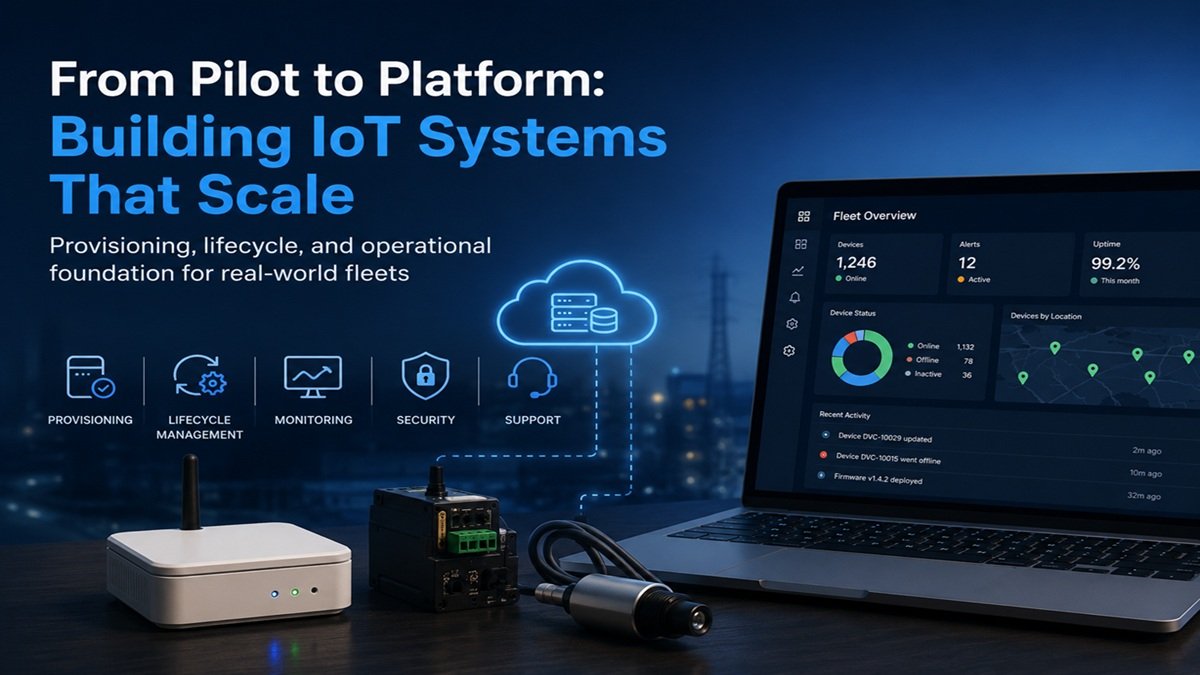
From Devices to IoT Platform: Provisioning & Lifecycle Management
A small IoT project can look almost too clean at the beginning. A few devices send telemetry, a dashboard shows current values, and someone on the team still knows which box is installed where. If something behaves strangely, the engineer who set it up probably remembers the workaround.
That stage is useful. It proves that the hardware can talk to the cloud and that the data has value. What it does not prove is that the system is ready to scale.
Most IoT projects do not become painful because one big architectural decision was obviously wrong. They become painful because small decisions remain informal for too long: device IDs live in a spreadsheet, provisioning depends on one developer’s script, firmware versions are known “more or less”, and the dashboard shows values without enough operational context.
At pilot scale, this is manageable. At fleet scale, it becomes the work. The real shift happens when the team no longer asks, “Can we connect the device?” but starts asking, “Can we connect, update, replace, monitor, support, and explain this device repeatedly without turning every case into manual engineering?”
Why early IoT projects often look simpler than they are
Early IoT systems often hide their complexity because the first version is built around a narrow path: one hardware type, one communication pattern, one dashboard, and one person who understands the firmware well enough to fix exceptions manually. In that setting, even a rough architecture can feel practical.
Things change when the project gets a little more real. A second device model is added. Installers need a predictable onboarding flow. Support needs device history without asking engineering. Customers ask why one unit reports a value differently from another. None of this sounds dramatic, but together these requests expose whether the project has a platform foundation or only a connected-device demo with extra parts attached.
This is where the dashboard starts to show its limits. A dashboard can show temperature, voltage, location, alerts, or status. It cannot, by itself, answer who owns a device, which configuration it should have, when it was last updated, what asset it is tied to, or whether its telemetry means the same thing as the rest of the fleet.
A pilot can survive with tribal knowledge. A platform cannot. Once devices move into the field, every missing rule becomes somebody’s task: installers improvise, support waits for engineering, reports need manual cleanup, and each new integration starts from uncertainty again.
The practical point is not to build a huge platform before the product works. It is to identify early what will repeat: device identity, provisioning, lifecycle state, telemetry structure, monitoring, access, and support visibility. If these stay outside the foundation, each new deployment becomes harder to operate.
Provisioning: the first scaling problem teams usually feel
Provisioning is often treated as a setup task, something that happens before the “real” system begins to work. In a small project, a developer can flash firmware, add credentials, register a device, check that telemetry appears in the dashboard, and move on.
The problem is that provisioning does not stay small for long. Once devices leave the lab, the process has to work for installers, service teams, partners, customers, or support staff — people who cannot rely on internal scripts, credential files, or undocumented backend fields.
To me, this is where an IoT team first feels the difference between “we connected a device” and “we can operate a fleet.” A connected device only needs to send data once. A provisioned device has to enter the system with a clear identity, ownership, configuration, permissions, and expected behavior. It should be obvious which site, asset, customer, or user it belongs to. It should also be possible to understand who added it, when it was activated, and whether the activation actually finished.
When this process is informal, small errors become expensive. A device is shipped with the wrong credentials. Two units appear under similar names. A field technician pairs hardware to the wrong customer account. Support sees an “offline” device but cannot tell whether it failed, was never activated, was moved, or was retired without anyone updating the platform.
A good provisioning flow does not have to be fancy. It has to be repeatable. Device identity should be created in a controlled way. Credentials should not be passed around manually if the process can avoid it. The link between device, asset, site, and user should be part of the platform model rather than a note in a spreadsheet. Activation should leave an audit trail, not just a successful test message in a log.
It also helps to treat provisioning as the start of the device lifecycle. Onboarding data will later support monitoring, updates, replacements, diagnostics, access control, and sometimes billing or reporting. If that information is weak, every later process inherits the weakness.
This is why provisioning exposes scaling pains early. It forces the team to answer questions a pilot can avoid: who may add devices, how ownership is assigned, how configuration is verified, how mistakes are corrected, and how much of the process can happen without calling the original engineer. Once those questions appear, the project is already moving toward a platform problem.
Lifecycle management: updates, replacements, support, and retirement
The device lifecycle begins earlier than many teams admit. It starts at provisioning, because the way a device enters the system defines how it will be monitored, updated, replaced, supported, and eventually removed from service.
In early projects, lifecycle management often lives as a set of habits, not as a process. Someone knows which firmware version is installed, which batch used a different configuration, or why two units report the same state differently. This works only while the people involved are still close to the project.
Once the fleet grows, memory stops being infrastructure. Support needs to know what happened to a device without opening five tools or asking the engineer who configured it six months ago. Operations need to see whether a unit is active, inactive, under maintenance, replaced, or retired. Product teams need to understand whether strange behavior comes from firmware, configuration, connectivity, hardware revision, or field conditions. If the system cannot answer these questions, every investigation starts from scratch.
Firmware updates are usually the most visible part of the problem. A small team can update devices manually and fix failures case by case. At scale, updates need rollout rules, compatibility checks, failure handling, and some recovery path. Otherwise, every update becomes a small release crisis: nobody is fully sure which devices received it, which failed, and which are now running in a half-known state.
Replacements create a similar kind of mess. In a clean lifecycle model, replacing a device should preserve the operational meaning around it: the asset, location, customer, service history, permissions, and reporting context. Without that model, replacement often becomes manual surgery. The new device is added, the old one is half-disabled, historical data is split, and support has to remember that two records actually describe one real-world unit over time.
Retirement is another boring detail, until it is ignored. Devices that are no longer in use should not remain active in access rules, automation scenarios, reports, alerting flows, or credentials. Good lifecycle management simply makes device state explicit: when a unit was onboarded, what configuration it uses, which firmware it runs, which asset it represents, and why it moved from one state to another.
This is where IoT operations become less about individual devices and more about continuity. The system has to remember what people cannot reliably remember. Without that, growth adds not only devices, but uncertainty.
Data model consistency: the quiet problem behind unreliable platforms
Data model consistency rarely looks urgent at the beginning. One device sends temperature as temp, another as temperature, a third reports the same value in Fahrenheit because that is what the sensor library used by default. Someone fixes the dashboard, adds a mapping rule, and the project moves on. Fair enough, at that stage.
But these small differences do not disappear. They settle into the system. After a few more device types, firmware revisions, and customer-specific integrations, the platform may still show values on the screen, but the meaning behind those values becomes less stable. One device state means “offline because no heartbeat arrived”. Another means “offline because the gateway disconnected”. A third has no real offline state at all, only a missing timestamp.
Many unreliable platforms start there: not with broken infrastructure, but with unclear meaning. If the same concept is represented in three different ways, every part of the system has to compensate. Dashboards need special cases. Alerts become harder to trust. Reports require cleanup logic. APIs expose inconsistent fields. Support teams start asking engineering what a value actually means, which is rarely a good sign.
The problem becomes even more visible when devices are connected to assets. A device is a technical unit; an asset is something the business actually cares about — a machine, room, vehicle, charger, production line, building, or site. If the platform does not clearly separate these concepts, data becomes harder to use. A replacement device may accidentally look like a new asset. Historical reports may split one real-world object into several records. Automation may trigger against the wrong level of the model.
Inconsistent telemetry also weakens automation. If temperature, status, battery level, fault codes, and operating modes are not normalized, every scenario needs extra defensive logic. Across a growing fleet, that turns into a pile of exceptions nobody wants to touch before a release.
A consistent data model does not require every device to be identical. That would be unrealistic, especially in industrial and B2B environments where hardware diversity is normal. The point is to define common structures: how devices are identified, how telemetry is named, how units are handled, how states are represented, how assets relate to devices, and where metadata belongs.
It is unglamorous work, but it decides whether the system can scale cleanly. Without data model consistency, every new device type brings not only new capabilities, but another layer of interpretation. Eventually, the platform may collect plenty of data while becoming less sure what that data actually says.
From scripts and dashboards to reusable architecture
Most IoT teams do not start with bad architecture on purpose. They start with practical fixes: a script imports devices from a CSV file, another normalizes a payload from one hardware model, a dashboard widget hides a messy state value, and a support engineer keeps a checklist for devices that need special handling. Each decision makes sense in the moment.
The problem is that these fixes slowly become hidden infrastructure. Nobody planned them as the platform foundation, but the platform starts depending on them anyway. When a new customer, site, device type, or workflow appears, the team has to remember which workaround applies where. At some point, the work is no longer about building new IoT functionality. It is about keeping old improvisations from breaking the next release.
Dashboards have a similar limit. They can show that a device is offline, but they cannot explain whether it was never provisioned correctly, lost connectivity, failed after a firmware update, was replaced in the field, or belongs to a retired asset. For that, the system needs a more reliable foundation behind the screen.
Once provisioning, lifecycle management, and data model consistency become recurring problems, the team is no longer dealing with a simple device project. It needs reusable architecture: device management, remote monitoring, and integration mechanics that are not built from scratch for each new deployment. A modular framework such as the 2Smart framework makes sense in this context: the common IoT foundation can rely on reusable building blocks while project-specific workflows, roles, interfaces, and business logic remain customizable.
I would keep one caveat here. A reusable architecture is not the same as forcing every project into the same template. It does not mean every device behaves identically, every customer workflow is standardized, or every integration is reduced to a generic connector. Real IoT projects rarely work like that. Hardware differs, networks differ, field conditions differ, and business rules often contain details that only make sense in one domain.
In practice, the line is simple: separate what should be common from what should stay specific. Provisioning flows, device identity, lifecycle states, telemetry conventions, access logic, monitoring, and integration patterns usually belong in the common layer. They are repeated too often to be reinvented each time. Domain workflows, customer-facing dashboards, automation rules, reporting views, partner permissions, and business-specific integrations can then be built on top without disturbing the foundation.
It changes the role of customization too. Custom work should not be wasted on rebuilding device onboarding, basic fleet visibility, or another version of the same status model. It should go into the parts that actually make the solution different: how a service team handles alerts, how an installer activates equipment, how a customer sees asset health, how operations staff approve changes, or how data moves into a third-party business system.
A platform built this way is still flexible, but it is less fragile. Adding a device type does not require inventing a new lifecycle process. Adding a customer does not require a separate support model. Adding an integration does not mean creating another isolated script that only one engineer understands. The reusable layer absorbs the standard mechanics, while the project-specific layer stays free to reflect the real use case.
What to standardize before the fleet grows
Standardization in IoT does not mean freezing the product too early. A young project still needs room to learn from real deployments, field conditions, customer requests, and unexpected hardware behavior. The better question is narrower: which parts become expensive if every team solves them differently?
Device identity is usually the first answer. Each device should have a clear identity, owner, location, asset relationship, and lifecycle state. It should not depend on someone remembering how it was added or which spreadsheet still contains the correct mapping.
Provisioning should be repeatable as well. The team needs a clear flow for adding devices, assigning credentials, linking them to users or assets, and verifying that activation is complete. A “successful first message” is useful, but it is not always enough to prove that the device is ready for normal operation.
Lifecycle states also need a shared language. Active, inactive, maintenance, replaced, retired — the exact terms can vary, but the system should not leave support, operations, and engineering to describe the same device in different ways.
Firmware, configuration, and telemetry conventions should be visible before they become urgent. The platform should show which version is running, which configuration is expected, how units and states are represented, and how new hardware fits into the existing data model.
Finally, monitoring and integrations should be treated as repeatable interfaces rather than isolated bridges. Remote monitoring needs enough context to act: recent changes, connectivity history, alerts, ownership, and configuration. Integrations need stable APIs, event structures, and data conventions, not a new one-off script every time another business system appears.
The goal is not to standardize everything. Workflows, dashboards, service logic, domain rules, and customer-specific integrations should stay flexible. But the mechanics that repeat across every deployment should not remain improvised. If they do, the fleet may grow, but the operating model will not grow with it.
Conclusion
IoT projects rarely cross the line from simple to complex in one dramatic moment. More often, the signs are ordinary: a device takes too long to activate, a support ticket needs engineering help again, firmware updates become stressful, or nobody is fully sure whether a device is offline, retired, misconfigured, or never properly provisioned.
These are not just operational annoyances. They are early signals that the project has become a platform problem.
That does not mean every team should design a heavy platform before the first device is useful. Over-engineering is still waste. But provisioning, lifecycle management, data model consistency, monitoring, and integration patterns are not decorative architecture topics. They decide whether the system can keep growing without making every new deployment feel like a rescue job.
The practical lesson is simple enough: do not build more platform than you need, but do not ignore the parts that will clearly repeat. In IoT, they usually arrive earlier than expected.
This is contributed article.


