
What is the Difference Between a Battery Isolator and a Battery Separator?
When dealing with multiple batteries in motor vehicles, RVs or boats, most individuals encounter the terms battery isolator and battery separator. Although they are almost the same phonemically and are aimed at preserving batteries unnecessarily drained, they do not have a similar design or performance. It is worth knowing their distinctions since the wrong device in your installation may cause inefficiency, a short battery life, or even a breakdown of vital systems. Two things make the comparison of the two very clear, which enable you to decide which is more suitable for your electrical system and power requirements.

What is a Battery Isolator?
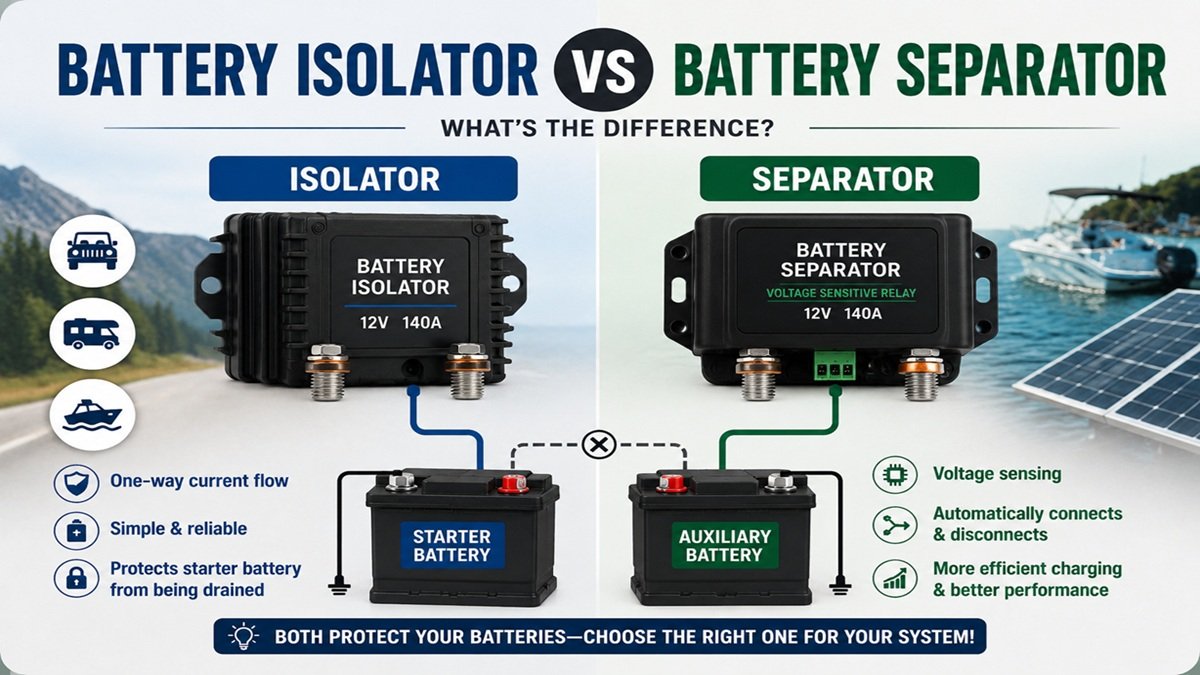
A battery isolator is a gadget that does not allow current to pass through two or more batteries. It is primarily done to be able to use your auxiliary or house battery to power other non-essential items like lights, fridges or inverters and not impact the starter battery. This makes sure that the starter battery is charged to the fullness to serve the engine when the time comes. Isolators can be either diode-based or relay-based, both types being built with the aim of physically and electrically isolating batteries whilst retaining the ability to charge the battery at the same time as the alternator is operating.
What is a Battery Separator?
A battery separator takes a more dynamic approach compared to an isolator. Instead of permanently preventing current flow between batteries, a separator uses voltage-sensing technology to determine when batteries should be connected or disconnected. At a predetermined voltage limit, when the alternator or charging source increases the system voltage to exceed the predetermined limit, the separator connects the batteries in a way that allows both batteries to be charged. When the voltage falls to a lower limit, it breaks them apart so that the one does not discharge into the other. This smart functionality allows greater flexibility and efficiency in power management.
Key Operational Difference
The fundamental difference between an isolator and a separator is the division of the flow of current. An isolator is a passive (usually diode-based) device that only permits the movement of charging current in one direction. It is simple, reliable, but it can cause a slight voltage drop. In contrast, a separator is an active, voltage-sensitive switch that automatically decides when to link or unlink batteries. This makes separators more efficient, as they reduce unnecessary voltage loss and allow charging systems to operate closer to their intended capacity, especially in modern vehicles with sensitive electronics.
Advantages of Battery Isolators
The simplicity and reliability of a battery isolator is the greatest strength of the battery isolator. Because it acts as a physical barrier to current flow between the batteries, it is unlikely that there can be any accidental draining of the starter battery. They are tough, need little maintenance and can be used in a system where efficiency is not a major issue. An example of this is that a battery isolator gives peace of mind in older vehicles, marine applications or RVs where the main concern is keeping the starter battery safe. Also, isolators are able to withstand severe environments, and therefore, they are highly suited to off-road or marine environments where resistance is paramount.
Advantages of Battery Separators
Battery separators, on the other hand, excel in the realms where efficiency and intelligent charging matter. Separators reduce the loss of voltage, since they monitor the voltage and only connect a battery when required by the load, which is why they are well-suited to modern alternators and electrical systems. They may also be bi-directionally charged, i.e., a solar panel or shore power charger can be connected to an auxiliary battery, and the starter battery can also be charged when required, should the voltage become sufficiently high. This is what makes separators particularly attractive in an RV, boat or off-grid situation, that is a combination of multiple sources of charging that may be alternators, solar panels, or generators.

Which One Should You Choose?
Whether to use a battery isolator or a battery separator is a question of the priorities of your system. An isolator might be a good option in case you want 100 percent dependability and can afford a slight sacrifice in efficiency. This is particularly so in rough applications such as off-road trucks or older boats. But when you need the best efficiency and more intelligent power control, especially in a system with more than one charging input, a separator is preferable. In modern alternator-powered RV or marine applications, the separator is usually more versatile and more practical.
Conclusion
In a nutshell, although both gadgets are supposed to safeguard your starter battery and control auxiliary loads, they do it in quite different ways. A more basic, more rugged device, a battery isolator permanently separates the batteries to eliminate undesirable discharge. A battery separator, by comparison, is a dynamically-controlled, voltage-sensing-based technology to switch batteries in or out to maximize efficiency and flexibility. With this understanding, you can make a good decision that will ensure that your electrical system can perform comfortably, keep your batteries in proper shape, and provide you with reliable power when you are on the road, at sea or off-the-grid.


