
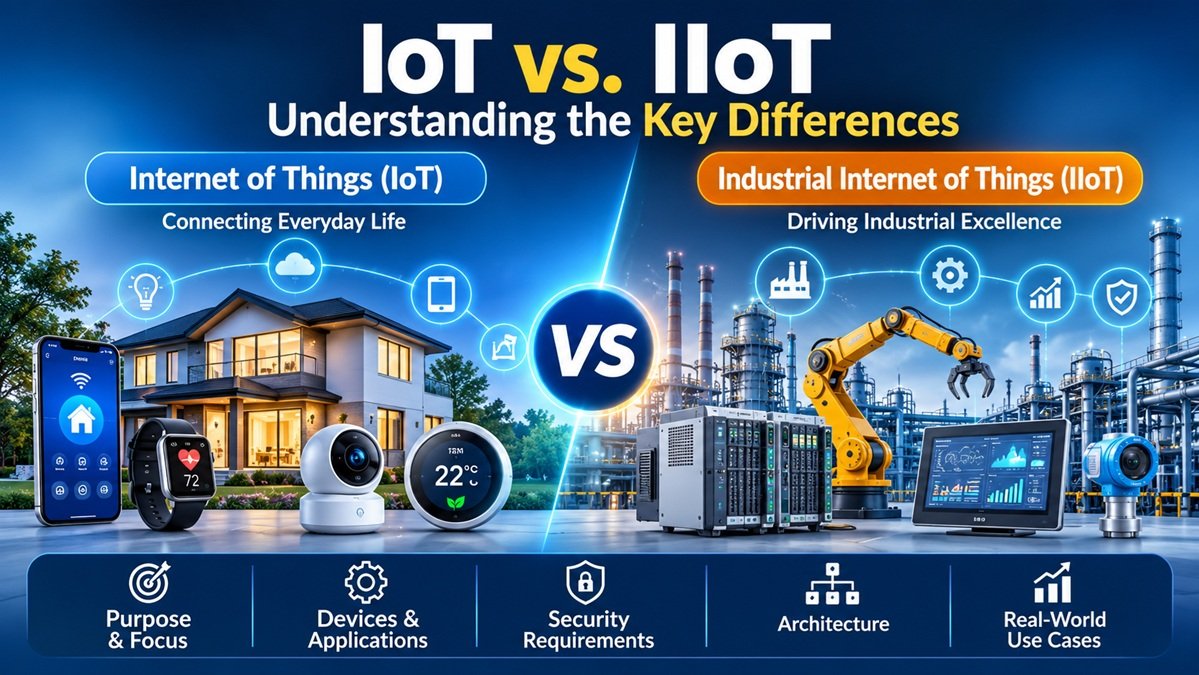
IoT vs. IIoT: Understanding the Key Differences, Technologies, Architecture, and Applications
The Internet of Things (IoT) and the Industrial Internet of Things (IIoT) are transforming how devices, machines, and systems interact with the digital world. From smart home appliances and connected vehicles to automated manufacturing facilities and intelligent power grids, connected technologies are creating new possibilities for collecting data, improving efficiency, and making informed decisions.
Although IoT and IIoT share many underlying technologies, they serve different purposes and operate under different requirements. Consumer IoT primarily focuses on convenience, connectivity, and improving everyday experiences. IIoT, on the other hand, applies connected technologies to industrial environments, where reliability, operational continuity, safety, and real-time data processing are critical.
Understanding the distinction between these two concepts is important for businesses, engineers, system integrators, and technology professionals evaluating connected solutions.
This article explores IoT and IIoT in detail, including their architecture, communication technologies, applications, security requirements, challenges, and the factors that influence their implementation.
1. What Is the Internet of Things (IoT)?
The Internet of Things (IoT) refers to a network of physical objects equipped with sensors, software, communication interfaces, and processing capabilities that allow them to collect and exchange data over a network.
These connected objects can communicate with cloud platforms, mobile applications, gateways, and other devices to perform automated tasks or provide useful information to users.
IoT systems are commonly found in homes, offices, healthcare environments, transportation, agriculture, and consumer electronics.
For example, a smart thermostat can monitor room temperature, compare it with a predefined setting, and automatically adjust an air conditioning system. Similarly, a connected security camera can detect movement and send notifications to a smartphone.
Key Components of an IoT System
An IoT implementation typically consists of several interconnected components:
1. Sensors and Devices
Sensors collect information from the physical environment. Depending on the application, they may measure temperature, humidity, motion, pressure, light intensity, location, or energy consumption.
2. Connectivity
Communication technologies allow devices to transmit collected information. Common options include Wi-Fi, Bluetooth Low Energy (BLE), Zigbee, Thread, LoRaWAN, and cellular connectivity.
3. IoT Gateways
Gateways connect devices to wider networks and may perform protocol conversion, local processing, filtering, and secure communication with cloud services.
4. Cloud and Data Platforms
Cloud platforms store, process, and analyze information received from connected devices. They can also manage device identities, configurations, updates, and application services.
5. Applications and User Interfaces
Mobile applications, web dashboards, and automation systems allow users to monitor devices, receive notifications, and control connected equipment remotely.
Common Applications of IoT
- Smart homes: Automated lighting, smart locks, thermostats, security cameras, and connected appliances.
- Wearable technology: Smartwatches and fitness trackers that monitor activity, heart rate, and other measurements.
- Connected transportation: Vehicle tracking, navigation, remote diagnostics, and fleet monitoring.
- Smart agriculture: Soil moisture monitoring, automated irrigation, and environmental sensing.
- Healthcare: Connected medical devices and remote patient monitoring systems.
The primary objective of consumer IoT is to make everyday activities more convenient, efficient, and accessible through connected technology.
2. What Is the Industrial Internet of Things (IIoT)?
The Industrial Internet of Things (IIoT) is the application of connected devices, industrial sensors, intelligent controllers, communication networks, and data analytics within industrial and commercial operations.
It extends IoT concepts into environments such as manufacturing plants, energy facilities, water treatment systems, oil and gas installations, logistics operations, and industrial infrastructure.
Unlike typical consumer IoT applications, IIoT systems frequently interact with machinery and processes that require continuous monitoring and predictable operation.
For example, a manufacturing facility may install vibration and temperature sensors on industrial motors. These sensors continuously collect operational data, allowing engineers to identify unusual patterns and detect potential equipment failures before they result in unexpected downtime.
Key Components of an IIoT System
1. Industrial Sensors and Instrumentation
Industrial sensors measure parameters such as temperature, pressure, vibration, flow rate, humidity, motor speed, and electrical current.
These measurements help operators understand equipment conditions and production processes.
2. Programmable Logic Controllers (PLCs)
PLCs are industrial controllers responsible for executing control logic and managing machinery, sensors, actuators, and production equipment.
They are widely used in automated manufacturing and process control systems.
3. Supervisory Control and Data Acquisition (SCADA)
SCADA systems provide centralized monitoring and supervisory control of industrial processes. They collect information from remote equipment, display operational conditions, and allow authorized operators to interact with industrial systems.
4. Industrial Gateways and Edge Computing
Industrial gateways connect operational technology (OT) networks with higher-level applications and information technology (IT) systems.
Edge computing allows data to be processed close to the equipment, reducing communication delays and minimizing unnecessary cloud traffic.
5. Industrial Data Platforms and Analytics
IIoT platforms collect operational information from multiple machines and facilities. Analytics applications use this information to identify inefficiencies, detect abnormal conditions, and support maintenance decisions.
Common Applications of IIoT
- Predictive maintenance: Identifying equipment degradation through vibration, temperature, and operational data.
- Smart manufacturing: Monitoring production lines, machine performance, and production quality.
- Energy management: Measuring electricity consumption and improving energy efficiency.
- Remote equipment monitoring: Observing industrial machines across geographically distributed facilities.
- Supply chain optimization: Tracking industrial assets, inventory, and transportation operations.
- Water and wastewater management: Monitoring pumps, pipelines, pressure levels, and treatment processes.
The primary objective of IIoT is to improve industrial productivity, reliability, operational visibility, and safety through connected systems and data-driven decisions.
3. IoT vs. IIoT: Key Differences
IoT and IIoT share connectivity and data collection principles, but their implementation requirements can vary significantly.
The following comparison highlights their major differences.
| Parameter | IoT | IIoT |
|---|---|---|
| Primary focus | Consumer and everyday applications | Industrial and business operations |
| Main objective | Convenience and automation | Productivity, reliability, and safety |
| Devices | Smart appliances, wearables, cameras | PLCs, industrial sensors, motors, robots |
| Environment | Homes, offices, and public spaces | Factories, plants, and industrial facilities |
| Reliability | Depends on application requirements | Often requires high availability |
| Communication | Wi-Fi, BLE, Zigbee, Thread | Industrial Ethernet, OPC UA, Modbus, cellular |
| Data processing | Cloud and device-level processing | Edge, on-premises, and cloud processing |
| Response requirements | Application-dependent | May require deterministic, low-latency control |
| Security | Privacy and device protection | OT security and operational continuity |
| Maintenance | Consumer-oriented servicing | Planned industrial maintenance |
| Scalability | Homes and consumer ecosystems | Multiple facilities and large industrial networks |
3.1 Purpose and Operational Requirements
Consumer IoT systems are generally designed to improve convenience and automate routine activities.
For example, a connected lighting system may automatically switch lights on when someone enters a room.
IIoT systems have more demanding operational objectives. A sensor installed on an industrial compressor may monitor vibration continuously to identify mechanical abnormalities.
An incorrect reading or delayed response in a consumer application may cause inconvenience. In an industrial environment, similar problems could contribute to equipment damage, production interruptions, or safety incidents.
3.2 Devices and Hardware
IoT commonly uses compact, low-power microcontrollers, wireless sensors, smart appliances, and consumer-grade communication modules.
IIoT deployments frequently involve industrial-grade sensors, PLCs, distributed control systems (DCS), variable frequency drives (VFDs), industrial robots, and specialized gateways.
Industrial hardware is typically selected according to environmental conditions, electrical requirements, equipment compatibility, and operational reliability.
3.3 Communication Protocols and Networking
IoT devices commonly communicate through Wi-Fi, Bluetooth, Zigbee, Thread, and cellular networks.
Industrial environments may use a combination of industrial Ethernet, Modbus TCP, Modbus RTU, PROFINET, EtherNet/IP, CAN-based networks, and OPC UA.
MQTT is also widely used for lightweight messaging between industrial gateways, applications, and data platforms.
The selection of a communication protocol depends on factors such as latency, interoperability, network topology, reliability, and the type of information being exchanged.
3.4 Data Criticality and Real-Time Processing
IoT data is often used for monitoring, notifications, automation, and user-facing services.
IIoT data can directly influence industrial decision-making and operational processes.
For example, a connected home temperature sensor may update a cloud dashboard every few minutes. An industrial pressure monitoring system may need to communicate measurements much more frequently, depending on the process requirements.
It is important to distinguish monitoring and analytics from real-time control. Safety-critical and time-sensitive control functions generally remain within appropriately engineered local control systems rather than depending entirely on cloud connectivity.
3.5 Security Requirements
Both IoT and IIoT require strong cybersecurity protections, but their threat models and potential consequences differ.
Consumer IoT security focuses heavily on protecting personal information, preventing unauthorized device access, and securing connected applications.
IIoT security must also protect industrial control networks, production processes, operational data, and physical infrastructure.
Security measures may include:
- Device authentication and access control.
- Network segmentation.
- Encrypted communication.
- Secure firmware updates.
- Continuous monitoring and logging.
- Vulnerability management.
- Backup and recovery procedures.
- OT-specific incident response planning.
In industrial environments, security improvements must be carefully implemented to avoid disrupting critical processes.
4. Understanding IoT and IIoT Architecture
Architecture is one of the most important differences between consumer IoT and industrial IoT implementations.
Although both may use sensors, gateways, communication networks, and cloud platforms, their system structures are designed around different operational requirements.
4.1 Typical IoT Architecture
A typical consumer IoT architecture can be divided into four layers:
Perception Layer: Sensors and connected devices collect information from the physical environment.
Network Layer: Wi-Fi, Bluetooth, Zigbee, or cellular connectivity transfers information between devices, gateways, and cloud services.
Processing Layer: Edge devices or cloud platforms process collected data and execute application logic.
Application Layer: Mobile applications and web dashboards provide monitoring, automation, and device management.
For example, a smart home system may collect temperature measurements, transmit them through a Wi-Fi network, process them using a cloud service, and display the results in a mobile application.
4.2 Typical IIoT Architecture
An industrial IoT architecture generally includes several interconnected operational and information technology components:
Field Level: Industrial sensors, actuators, motors, and instrumentation interact with physical processes.
Control Level: PLCs, DCS controllers, and other automation systems execute control logic and manage industrial equipment.
Supervisory Level: SCADA systems and human-machine interfaces (HMIs) provide process visualization, alarms, historical information, and supervisory control.
Edge and Gateway Level: Industrial gateways collect information from operational equipment, perform protocol conversion, and process selected data locally.
Platform and Application Level: Industrial analytics platforms, historians, cloud services, and enterprise applications use operational data for monitoring and optimization.
This layered architecture helps separate time-sensitive operational control from higher-level monitoring, analytics, and business applications.
4.3 IIoT and SCADA: Understanding Their Relationship
SCADA and IIoT are closely related, but they are not interchangeable technologies.
SCADA systems traditionally focus on supervisory monitoring, alarm management, data acquisition, and operator control. IIoT expands industrial connectivity by connecting operational equipment and data sources with edge computing, analytics platforms, and enterprise applications.
For a deeper technical comparison of their system structures, communication approaches, and operational roles, explore this guide on IIoT vs SCADA architecture.
In many modern industrial deployments, SCADA and IIoT work together rather than replacing one another. SCADA continues to support industrial monitoring and supervisory functions, while IIoT technologies extend data accessibility, analytics, and remote visibility.
5. Technologies Powering IoT and IIoT
Several technologies support both IoT and IIoT deployments. However, their selection and configuration depend on the operating environment.
5.1 Sensors and Actuators
Sensors convert physical measurements into electrical or digital signals that connected systems can process.
Common sensor types include:
- Temperature sensors.
- Pressure transducers.
- Proximity sensors.
- Accelerometers and vibration sensors.
- Humidity sensors.
- Flow meters.
- Current and voltage sensors.
Actuators perform physical actions based on control signals. Examples include motors, valves, relays, and pneumatic cylinders.
5.2 Edge Computing
Edge computing processes information close to the source rather than sending every measurement to a remote cloud platform.
In IoT applications, edge processing can reduce latency and support local automation.
In IIoT applications, edge computing can filter high-volume sensor data, perform local analytics, detect abnormal operating conditions, and maintain selected functions when cloud connectivity is unavailable.
5.3 Cloud Computing
Cloud platforms provide scalable computing resources, centralized storage, remote device management, and analytics capabilities.
They are particularly useful for applications involving multiple locations, historical data analysis, and centralized reporting.
However, cloud connectivity should not be treated as a substitute for local industrial control and safety systems.
5.4 Artificial Intelligence and Machine Learning
AI and machine learning can analyze large datasets to identify patterns that are difficult to detect through conventional monitoring.
Industrial applications include predictive maintenance, quality inspection, process optimization, and anomaly detection.
For example, machine learning models can analyze historical vibration measurements to identify patterns associated with bearing degradation.
5.5 Digital Twins
A digital twin is a digital representation of a physical asset, process, or system.
It can combine sensor measurements, engineering information, operational data, and simulation models to help engineers understand equipment behavior.
Digital twins are increasingly useful in industrial design, maintenance planning, and process optimization.
6. Real-World Applications of IoT and IIoT
6.1 Smart Homes and Building Automation
Consumer IoT enables homeowners and building operators to control lighting, air conditioning, access systems, and security equipment through connected applications.
Sensors can monitor occupancy, temperature, humidity, and energy consumption to support automated building management.
6.2 Industrial Manufacturing
IIoT allows manufacturing facilities to monitor machine performance, production output, energy usage, and equipment health.
Connected sensors can provide continuous information about production equipment, helping maintenance teams identify abnormal operating conditions.
6.3 Energy and Power Management
IoT technologies support smart meters, connected energy monitors, and building-level energy management.
IIoT extends these capabilities to power generation facilities, electrical substations, industrial distribution systems, and large-scale energy infrastructure.
6.4 Transportation and Logistics
Connected vehicles and tracking devices help monitor vehicle locations, fuel consumption, and transportation conditions.
In industrial logistics, IIoT can support warehouse automation, asset tracking, equipment monitoring, and supply chain visibility.
6.5 Agriculture and Environmental Monitoring
IoT sensors can measure soil moisture, temperature, humidity, and weather conditions to support precision agriculture.
Industrial applications can extend to automated irrigation infrastructure, water distribution systems, and large-scale environmental monitoring.
7. Security Challenges in IoT and IIoT
Security is a fundamental requirement for any connected system.
As the number of connected devices increases, organizations must address vulnerabilities involving device firmware, communication networks, authentication, data storage, and remote access.
IoT Security Challenges
Common consumer IoT security concerns include:
- Weak or default device passwords.
- Unsecured wireless communication.
- Outdated firmware.
- Inadequate authentication.
- Exposure of personal information.
- Vulnerable third-party applications.
Manufacturers and users should prioritize secure configurations, regular firmware updates, unique credentials, and encrypted communication.
IIoT Security Challenges
Industrial environments introduce additional complexities because operational technology often includes legacy equipment and systems designed before modern cybersecurity requirements became standard.
Common challenges include:
- Legacy PLCs and industrial controllers.
- Limited patching opportunities.
- Unprotected OT network segments.
- Unauthorized remote access.
- Insecure industrial gateways.
- IT and OT network convergence.
- Potential disruption of critical operations.
A layered security strategy should include network segmentation, controlled remote access, asset discovery, monitoring, access restrictions, and incident response planning.
Standards and guidance such as IEC 62443 and the NIST Cybersecurity Framework can help organizations develop structured industrial cybersecurity programs.
8. Challenges in Implementing IoT and IIoT
Despite their advantages, connected systems introduce technical, financial, and operational challenges.
IoT Implementation Challenges
Interoperability: Devices from different manufacturers may use incompatible communication protocols or application interfaces.
Privacy: Connected devices may collect personal or behavioral information that requires appropriate protection.
Connectivity: Wireless interference, limited coverage, and unstable internet connections can affect device performance.
Power Consumption: Battery-powered sensors require efficient communication and power management.
Device Management: Managing firmware updates, security configurations, and large numbers of connected devices can become complicated.
IIoT Implementation Challenges
Legacy System Integration: Existing industrial equipment may use older communication protocols or proprietary interfaces.
High Deployment Costs: Industrial sensors, gateways, networking infrastructure, engineering, and maintenance can require significant investment.
Operational Reliability: Industrial systems must be designed to maintain required performance even during network failures or equipment disruptions.
Data Management: Large industrial installations can generate substantial volumes of time-series data that require efficient storage, filtering, and analysis.
Workforce Skills: Successful IIoT deployment requires knowledge of industrial automation, networking, software integration, and cybersecurity.
9. How to Choose Between IoT and IIoT
Choosing between IoT and IIoT depends primarily on the application, operating environment, and required system capabilities.
IoT is generally appropriate when the objective is to connect consumer devices, automate everyday activities, or improve user convenience.
IIoT is more suitable when connected technologies must support industrial machinery, manufacturing processes, operational monitoring, or large-scale infrastructure.
Consider the following factors before selecting an implementation:
- Application requirements: Identify whether the system is intended for consumer use or industrial operations.
- Reliability requirements: Determine the availability, response time, and continuity requirements.
- Communication infrastructure: Evaluate network coverage, bandwidth, latency, and protocol compatibility.
- Security requirements: Identify potential cybersecurity threats and operational consequences.
- Scalability: Consider how the solution will expand as additional devices, machines, or facilities are connected.
- Integration: Check compatibility with existing equipment, software platforms, and enterprise systems.
- Total cost of ownership: Evaluate hardware, deployment, maintenance, connectivity, and long-term operational expenses.
In some projects, IoT and IIoT technologies may coexist. A connected industrial facility, for example, could use consumer-style IoT technologies for employee-facing applications while relying on industrial automation and IIoT infrastructure for production operations.
10. The Future of IoT and IIoT
The future of connected technology will increasingly involve intelligent automation, advanced analytics, edge computing, and improved interoperability.
Several developments are expected to influence both IoT and IIoT.
5G and Advanced Connectivity: Improved wireless infrastructure can support connected devices, mobile industrial equipment, and applications requiring higher bandwidth or lower latency.
AI-Powered Automation: Artificial intelligence can help identify patterns, detect abnormalities, and optimize processes using real-time and historical information.
Industrial Edge Intelligence: More processing will take place near industrial equipment, enabling faster analysis and reducing dependence on centralized cloud platforms.
Digital Twin Integration: Digital twins will continue to connect engineering models with actual operational data, helping organizations improve maintenance and system performance.
Stronger Cybersecurity: Secure device identities, network segmentation, zero-trust principles, and improved OT monitoring will become increasingly important.
Interoperability: Open standards and standardized interfaces will help connect equipment and applications from different manufacturers.
As these technologies mature, the distinction between traditional IT infrastructure and industrial operational systems will continue to evolve.
Conclusion
IoT and IIoT are closely connected technological concepts, but their objectives, architectures, and operational requirements are different.
IoT primarily focuses on connecting everyday devices to improve convenience, automation, and user experiences. IIoT extends connected technologies into industrial environments, where equipment monitoring, operational reliability, process optimization, and safety are essential.
Both technologies rely on sensors, communication networks, data processing, and intelligent applications. However, industrial deployments require additional consideration of control systems, legacy equipment, network reliability, and OT cybersecurity.
Understanding these differences helps businesses and technology professionals select appropriate architectures, communication protocols, and security strategies for their projects.
As edge computing, artificial intelligence, 5G, and digital twins continue to develop, IoT and IIoT will play an increasingly important role in building connected homes, intelligent infrastructure, and more efficient industrial operations.


