
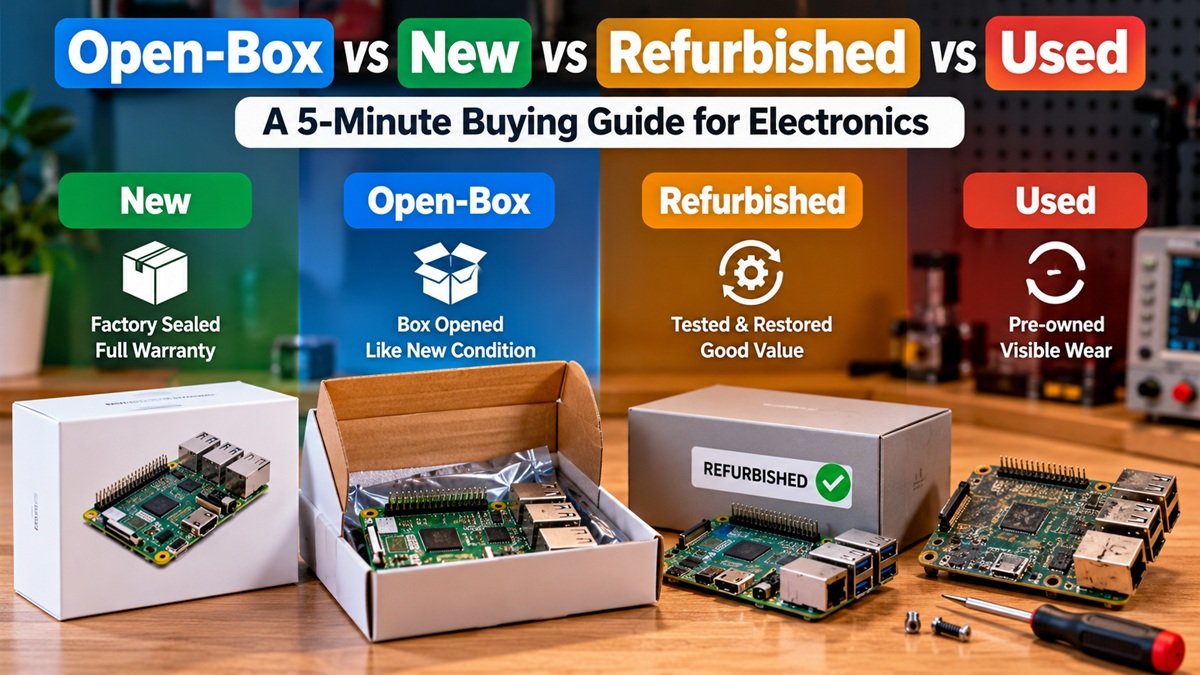
Open-Box Hardware for Makers: What the Label Does and Does Not Tell You
Development boards, sensors, single-board computers, bench power supplies, USB analysers and the occasional oscilloscope all pass through retail returns at a steady rate. A board gets ordered for a project that changes direction. A power supply turns out to lack the current the build needs. A kit arrives, the carton is opened, and the buyer realises the pinout is not the one the tutorial assumed. None of these units is defective, and all of them lose the word “new” the moment the tape is cut.
For engineers and hobbyists, that creates a supply of hardware at prices well below retail. It also creates a labelling problem, because “open-box” describes the carton and says nothing about the device.
The definition behind the label
Retail convention is strict: a product is new only while sealed. Once opened, it cannot be sold as new again regardless of whether it was powered, flashed or even removed from its anti-static bag. The board returned unopened-but-unsealed and the board that ran for three weeks as a prototype are both “open-box” to a retailer.
What separates them is a condition grade, and the grade is only useful if it was assigned to the specific unit after inspection, not inherited from the product line.
Grades, translated for electronics
Graded sellers generally use a short scale. For hardware it is worth mapping each grade to a measurable state:
- Like new, opened box. Carton opened, item complete, no evidence of use. For a board, this should mean header pins unsoldered if shipped that way, no flux residue, no bent pins, and firmware at factory state.
- Used, good. Evidence of handling. Headers may be soldered, a few pins may show insertion wear, firmware may have been flashed. Fully functional.
- Used, fair. Visible wear named on the listing: a scuffed enclosure, a missing standoff, a scratched display.
- As-is. Faulty, incomplete or untested. Kept in a separate section by any seller grading honestly.
An opened carton is never “new”. A listing that uses both words is describing the lower state.
What to verify before relying on a graded unit
The advantage of opened hardware is that it can be tested in ways a sealed box cannot. Insist on these checks, either in the listing or on arrival within the return window:
Firmware and bootloader state. A board that was flashed with a custom bootloader may not accept the vendor’s tooling until restored. Confirm the listing states firmware condition or restore it yourself before judging the hardware.
Power rails and regulators. On a bench supply, verify output against a known load, not just the display. On a single-board computer, check the 3.3 V and 5 V rails under load; a regulator stressed by a previous owner’s project will show droop.
I/O integrity. Walk every GPIO with a simple loopback. Bent or bridged pins are the most common damage on returned boards and the easiest to miss in a photograph.
Accessories and documentation. Antennas, ribbon cables, heatsinks, programmers and the correct power brick. A missing proprietary cable turns a bargain into a sourcing exercise. Good listings name what is absent.
Battery-backed parts. Real-time clocks, backup cells and lithium packs degrade without regard to whether the carton was opened. Treat any battery as unknown and test capacity.
Sealed components. Anything moisture-sensitive that ships in a dry pack, such as bare modules, should stay sealed. Do not buy those opened.
Categories where graded purchases make sense
Strong: single-board computers, development kits, bench instruments, power supplies, programmers and debuggers, displays with standard interfaces, mechanical hardware such as enclosures and mounts.
Weak: anything calibrated where the calibration history is unknown, anything with a sealed battery that cannot be measured, consumables, and safety-rated equipment such as isolation transformers where the test record matters.
The seller test
Before the hardware, evaluate the seller. Grades must be assigned per unit by hand. The listing must name what is missing. Faulty stock must live in its own section. There must be a return window long enough to actually bring the device up and run it, not just power it on; thirty days of returns and free exchanges is the sensible standard. And shipping must be known before checkout, because on a twelve-dollar sensor it decides whether the discount exists.
A note on terminology
The condition vocabulary used by graded sellers is not standardised across retailers, and the same word can describe different states on different sites. For a plain-language breakdown of how the common labels differ in practice, this guide to what open-box electronics labels mean sets out each term against what a buyer can actually verify. It is written for a Canadian audience, but the definitions travel.
Bottom line
For hardware, open-box is a statement about packaging. Condition is in the grade, the firmware state, the rail measurements and the pin walk, and every one of those is something the buyer can check. Buy from sellers who make that checking possible, and the label stops being a risk and becomes a discount.


