
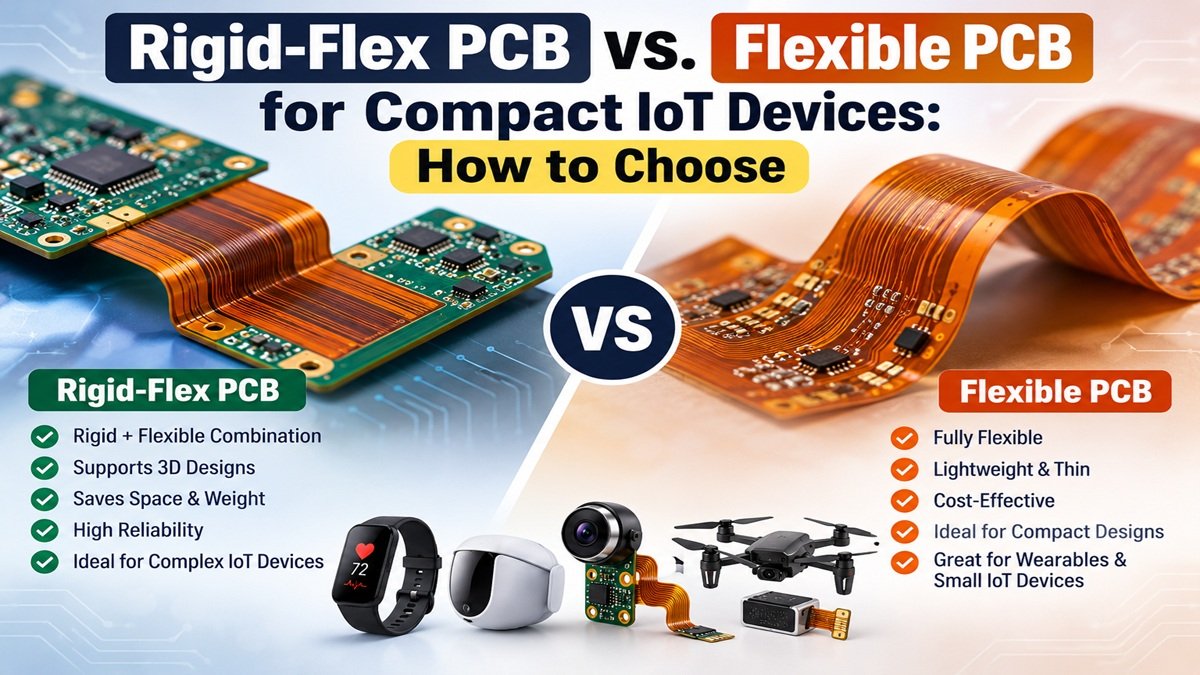
Rigid-Flex PCB vs. Flexible PCB for Compact IoT Devices: How to Choose
The Internet of Things (IoT) landscape is undergoing a relentless shift toward extreme miniaturization. From smart wearables and medical patches to ruggedized industrial sensors and asset trackers, today’s connected devices must pack extensive processing power, wireless transceivers, and complex sensor arrays into tight, irregular enclosures.
As traditional flat, rigid circuit boards run out of space, hardware design engineers frequently turn to advanced substrate technologies. Among these, flexible PCBs and offer the ultimate spatial freedom. However, choosing between a pure flexible circuit and a hybrid rigid-flex architecture is one of the most consequential decisions in an IoT hardware project. Making the right choice impacts long-term reliability, assembly yields, thermal performance, and total bill-of-materials (BOM) cost.
Understanding the Contenders
To evaluate which technology fits a compact IoT application, it is essential to look at how each board type is constructed and how it behaves mechanically.
Flexible PCBs (Flex PCBs)
Flexible printed circuit boards consist entirely of flexible dielectric base films—most commonly polyimide (PI) or polyester—laminated with conductive copper traces. Protected by a flexible polymer coverlay, a pure flex circuit can bend, twist, and fold into complex 3D shapes.
- Key Advantages: Exceptionally lightweight, ultra-thin (often down to 0.1 mm), and capable of enduring dynamic, repetitive flexing without trace fracture.
- Primary Limitation: Because the entire board is pliable, mounting heavy components, dense ball grid arrays (BGAs), or external connectors can induce mechanical stress, often requiring localized stiffeners.
Rigid-Flex PCBs
Rigid-flex boards combine the best of both worlds. They integrate multiple layers of rigid FR4 or polyimide substrates with flexible polyimide routing zones into a single, unified, multilayer circuit board. The Rigid-Flex PCB rigid sections act as stable platforms for heavy ICs, microcontrollers, power management units, and connectors, while the flexible sections serve as seamless internal wiring harnesses.
- Key Advantages: Eliminates inter-board wiring connectors and cables, offers robust mechanical mounting for heavy components, and dramatically improves vibration resistance.
- Primary Limitation: Involves complex multi-stage lamination processes and tighter quality controls, resulting in a higher initial unit cost than standard rigid or pure flex boards.
Core Comparison Dimensions for IoT Hardware
| Performance Metric | Flexible PCB | Rigid-Flex PCB |
| Space & Weight Optimization | Exceptional; maximum adaptability in constrained 3D spaces. | High; folds to fit tight housings while keeping critical sections flat. |
| Component Mounting Stability | Low to moderate; requires stiffeners under heavy components. | Excellent; rigid zones securely host dense ICs and BGAs. |
| Connector Elimination | Moderate; still requires interface headers if splitting modules. | High; replaces multiple boards and cables with a single integrated circuit. |
| Dynamic Bending Endurance | Superior; engineered for continuous, repeated movement. | Moderate; flex zones are typically folded once during assembly, not flexed continuously. |
| Manufacturing Complexity | Moderate; handling thin PI layers requires precision. | High; requires sequential lamination and thermal mismatch management. |
Key Decision Factors for IoT Designs
When architecting a compact IoT device, consider the following engineering criteria to guide your selection.
1. Spatial Constraints and Enclosure Geometry
If your IoT device requires the circuit board to bend around corners, wrap tightly inside a cylindrical casing, or conform to an ergonomic curved contour (such as a smart ring or fitness band), a pure flexible PCB is often the natural choice.
Conversely, if your device features multiple distinct compartments—such as a main processing deck, a battery compartment, and an external antenna port—a rigid-flex board allows you to place rigid islands in each compartment connected by a seamless, custom-folded flex bridge.
2. Mechanical Flexing: Static vs. Dynamic
- Static Flexing: If the circuit bends once or twice during manufacturing or final enclosure assembly to fit a tight space and then remains stationary, either a flex PCB with stiffeners or a rigid-flex PCB works exceptionally well.
- Dynamic Flexing: If the IoT device undergoes continuous mechanical movement during operation—such as a hinge mechanism in a foldable tracker, a robotic joint sensor, or a vibrating industrial probe—a pure flexible PCB utilizing rolled-annealed (RA) copper is mandatory to withstand metal fatigue.
3. Component Density and Connector Reliability
In high-density IoT designs, inter-board connectors are frequent points of failure under shock, drop testing, and vibration. By fusing multiple rigid sections into a single continuous rigid-flex structure, engineers eliminate vulnerable cabling, reducing assembly time and boosting field reliability. However, if your circuit is relatively simple and can fit on a single small flex board with minimal surface-mounted components, a pure flex option avoids the higher fabrication costs associated with rigid-flex lamination.
4. Cost and Volume Trade-offs
Unit economics heavily influence IoT production scaling. Pure flex circuits and rigid-flex boards both carry higher initial tooling and fabrication costs than standard FR4 rigid boards due to specialized polyimide materials and complex chemical etching processes.
However, rigid-flex can offset its higher per-board price in high-reliability applications by eliminating manual hand-soldering of internal wiring harnesses, lowering scrap rates, and drastically reducing final box-build assembly time.
Conclusion
Choosing between a flexible PCB and a rigid-flex PCB comes down to a careful balancing act between mechanical movement, spatial limits, component density, and budget. For dynamic, lightweight wearables and single-plane curved sensors, pure flex circuits offer unmatched adaptability. For complex, multi-plane industrial IoT devices that demand rigid component stability without the risk of loose internal connectors, rigid-flex architecture provides a robust, professional-grade solution. Evaluating these factors early in the schematic and layout phases ensures your connected device achieves optimal performance, durability, and commercial viability.


