
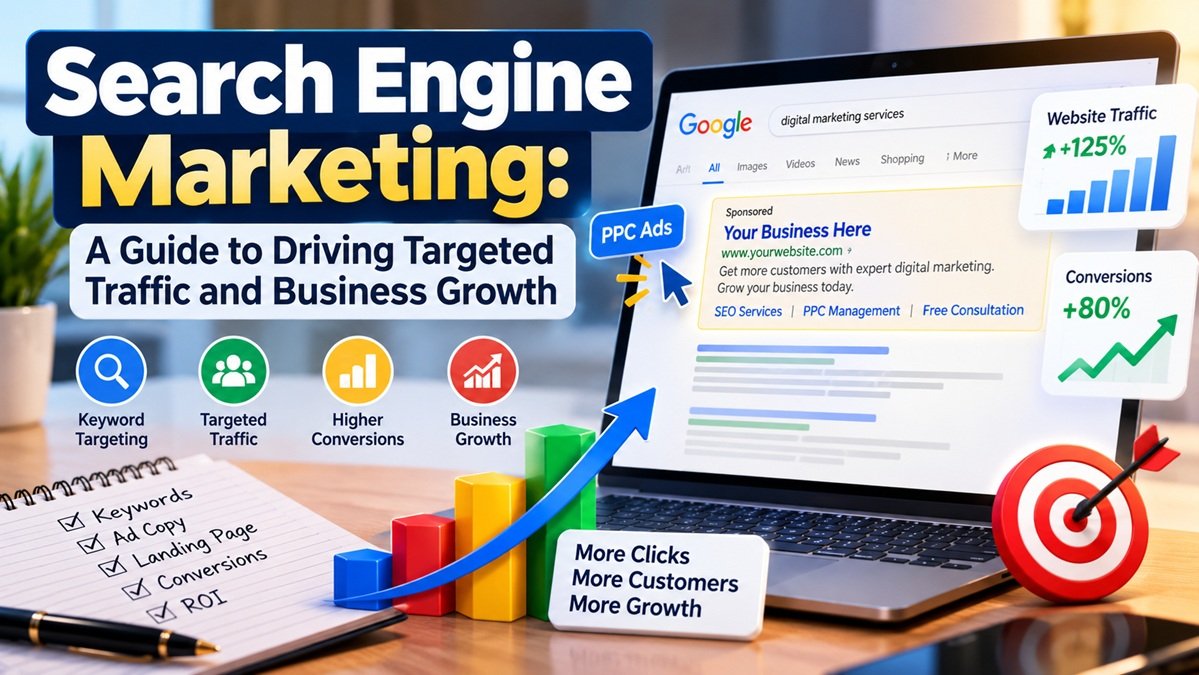
Search Engine Marketing: A Guide to Driving Targeted Traffic and Business Growth
Search engine marketing is one of the most powerful digital marketing strategies available to businesses seeking greater online visibility, high-intent website traffic, and measurable growth. By using paid advertisements on search engines such as Google and Bing, businesses can position their products or services in front of people who are actively searching for relevant solutions.
Unlike marketing channels that attempt to create demand among passive audiences, search engine marketing connects businesses with potential customers at the moment they express a need. Someone searching for a local service, a particular product, or an answer to a commercial problem may already be considering a purchase. This makes search traffic especially valuable.
A well-planned search engine marketing campaign can help a business generate enquiries, increase online sales, promote a new offer, or enter a competitive market. However, successful campaigns involve much more than selecting a few keywords and setting a daily budget. Advertisers must understand user intent, create relevant advertisements, build effective landing pages, and continuously analyse campaign performance.
This guide explores the fundamentals of search engine marketing, its main benefits, and the best practices businesses can use to build more effective paid search campaigns.
What Is Search Engine Marketing?
Search engine marketing, commonly shortened to SEM, is a digital marketing strategy that uses paid advertisements to increase a business’s visibility on search engine results pages, also known as SERPs.
These advertisements may appear above or below organic search results when users enter relevant queries. Their placement gives advertisers an opportunity to attract attention in highly visible areas of the results page, particularly for competitive keywords where achieving a strong organic ranking may take considerable time.
Advertisers typically bid on keywords connected to their products or services. When a user searches for one of those keywords, the advertising platform runs an automated auction to determine which advertisements may appear and in what order.
The highest bid does not always guarantee the best position. Search engines may also consider factors such as:
- The relevance of the advertisement to the search query
- The expected likelihood that users will click the advertisement
- The quality and usefulness of the landing page
- The advertiser’s bid and campaign settings
- The expected effect of ad assets or extensions
- The overall user experience
This system encourages advertisers to create useful and closely targeted campaigns rather than relying entirely on large advertising budgets.
SEM is sometimes used as a broad term covering both paid search advertising and search engine optimisation. In everyday digital marketing practice, however, it most commonly refers to paid search campaigns. SEO focuses on improving unpaid or organic visibility, while SEM allows businesses to purchase advertising placements for selected searches.
The two strategies can work together. SEO can support long-term organic growth, while paid search can provide more immediate visibility, keyword insights, and campaign data.
How Search Engine Marketing Works
A typical search engine marketing campaign begins with identifying the products, services, or offers a business wants to promote. The advertiser then researches the phrases potential customers may use when searching for those solutions.
Relevant keywords are organised into focused campaign structures, and advertisements are written to match the likely intent behind each search. When users click an advertisement, they are directed to a landing page where they can complete a desired action.
Depending on the business, that action may include:
- Purchasing a product
- Submitting an enquiry
- Calling the business
- Requesting a quote
- Booking an appointment
- Registering for an event
- Downloading a resource
- Signing up for a service
The advertiser generally pays when a user clicks the advertisement, which is why paid search is often described as pay-per-click advertising, or PPC. The actual amount paid can vary depending on competition, bid strategy, advertisement quality, and other auction conditions.
Key Benefits of Search Engine Marketing
Consumers frequently turn to search engines when they are ready to make a purchase, compare providers, or solve a specific problem. This creates several important advantages for businesses investing in SEM.
Immediate Search Visibility
SEO can deliver valuable and sustainable results, but establishing strong organic rankings may take time. New websites and businesses entering competitive industries may find it particularly difficult to appear prominently for valuable search terms.
Search engine marketing can provide visibility much sooner. Once an eligible campaign is active, advertisements may begin appearing for relevant searches without waiting for organic rankings to develop.
This makes SEM useful when a business is:
- Launching a new product or service
- Entering a new geographic market
- Promoting a limited-time offer
- Building awareness for a new brand
- Supporting an event or seasonal campaign
- Competing for commercially valuable keywords
Immediate visibility does not remove the need for careful optimisation. It simply gives businesses a faster opportunity to reach users and begin collecting meaningful performance data.
Highly Targeted Traffic
One of the greatest strengths of search engine marketing is its targeting precision. Rather than presenting the same message to a broad audience, advertisers can create campaigns for specific searches and customer groups.
Campaigns may be targeted based on factors such as:
- Keywords and search themes
- Geographic location
- Device type
- Language
- Demographic signals
- Time of day or day of the week
- Previous website interactions
- Audience behaviour and interests
A local service provider, for example, may focus advertising on users searching within its service area. An online retailer may adjust campaigns for mobile shoppers or target people who previously visited a product page without completing a purchase.
This level of control helps businesses attract visitors who are more likely to find the offer relevant. Better targeting can also reduce unnecessary advertising expenditure by limiting exposure to audiences unlikely to become customers.
Access to High-Intent Audiences
Search advertising reaches people based on what they are actively requesting. This is different from interruptive forms of advertising that appear while someone is consuming unrelated content.
Searches such as “request an accounting quote”, “emergency plumber near me”, or “buy office furniture online” suggest a clearer commercial need than broad informational queries. By identifying these differences, advertisers can decide which searches deserve higher bids, more persuasive advertisements, or dedicated landing pages.
Not every visitor will be ready to purchase immediately. However, aligning campaign messaging with the user’s stage in the buying journey can improve the quality and relevance of the experience.
Measurable Campaign Results
Search engine marketing provides detailed performance data that businesses can use to evaluate campaign effectiveness. Instead of relying only on impressions or general brand visibility, advertisers can track actions throughout the customer journey.
Common paid search metrics include:
- Impressions
- Click-through rate
- Average cost per click
- Conversion rate
- Cost per acquisition
- Impression share
- Total conversion value
- Return on ad spend
Click-through rate, or CTR, indicates how frequently users click an advertisement after seeing it. Conversion rate shows the percentage of visitors who complete a desired action. Cost per acquisition, or CPA, helps advertisers understand how much they are spending to generate each conversion.
Return on ad spend, commonly called ROAS, compares the revenue attributed to advertising with the amount spent on the campaign. However, businesses should select metrics that reflect their actual objectives. An e-commerce business may prioritise revenue and ROAS, while a professional services business may focus on qualified enquiries and client acquisition costs.
Greater Control Over Marketing Expenditure
Paid search platforms allow advertisers to set budgets, bids, targeting rules, and campaign schedules. This provides greater control over where and how advertising funds are used.
Businesses can shift budget towards better-performing campaigns, pause keywords that produce poor-quality traffic, and test new opportunities without committing the entire marketing budget to one approach.
Campaign budget should still be managed carefully. A poorly structured campaign can spend money quickly without generating meaningful results. Clear conversion tracking and regular analysis are essential for distinguishing valuable activity from wasted clicks.
Increased Brand Awareness
Search engine marketing can also support brand awareness. Even when users do not click an advertisement, seeing the business name repeatedly for relevant searches may improve familiarity.
Over time, this visibility can help potential customers associate the brand with a particular service, product category, or solution. Paid search may be especially useful for newer businesses competing against established brands with stronger organic recognition.
Brand awareness should not be measured through impressions alone. Advertisers should consider whether campaigns are reaching the right searches and presenting a clear, consistent message.
Search Engine Marketing Tips to Remember
Generating sustainable results from SEM requires ongoing refinement. The following practices can help businesses improve campaign relevance and efficiency.
Focus on User Intent
Keyword selection should be based on what users want to accomplish, not simply on search volume. A keyword may attract thousands of searches but still produce weak results if it does not align with the business’s offer.
Consider whether each query is informational, navigational, comparative, or transactional. High-intent searches often indicate that a user is evaluating providers, requesting a quote, or preparing to buy.
Campaigns should group closely related keywords together so that advertisements can directly address the user’s need.
Use Negative Keywords
Negative keywords prevent advertisements from appearing for searches that are irrelevant to the business. They can reduce wasted spending and improve the overall quality of campaign traffic.
For example, a business selling premium software may want to exclude searches containing terms such as “free” if it does not offer a free product. A company providing services only to businesses may need to exclude searches related to personal or consumer use.
Search term reports should be reviewed regularly to identify irrelevant queries that need to be excluded.
Write Clear and Compelling Ad Copy
Effective advertisements should communicate relevance quickly. Headlines and descriptions need to explain what the business provides, why the offer matters, and what the user should do next.
Strong ad copy may include:
- A relevant product or service
- A clear point of difference
- A specific customer benefit
- Trust-building information
- A direct call to action
Advertisers should test different headlines, descriptions, calls to action, and ad assets. Continuous testing makes it possible to learn which messages attract qualified users rather than merely generating more clicks.
Improve the Landing Page Experience
The landing page should continue the promise made in the advertisement. If an ad promotes a particular service, users should arrive on a page specifically addressing that service rather than a general homepage.
A strong landing page should be:
- Relevant to the advertisement and keyword
- Easy to navigate
- Fast-loading
- Mobile-friendly
- Clear about the next action
- Supported by useful trust signals
- Free from unnecessary distractions
Important information and calls to action should be easy to locate. Advertisers should also test forms, telephone links, and purchase processes to ensure that technical problems are not preventing conversions.
A more relevant landing page may support stronger campaign performance while providing users with a better overall experience.
Monitor the Right Performance Metrics
Campaign optimisation should be connected to business outcomes. High traffic does not necessarily mean strong performance if visitors do not enquire, purchase, or complete another valuable action.
Advertisers should regularly review metrics such as:
- Conversion volume
- Conversion rate
- Cost per acquisition
- Search impression share
- Search terms
- Revenue or lead value
- Return on ad spend
- Performance by device and location
The purpose of reporting is not simply to collect data. It is to identify practical decisions, such as reallocating budget, changing bids, excluding irrelevant searches, or improving a landing page.
Track Meaningful Conversions
Accurate conversion tracking is essential. Without it, a business may optimise for clicks rather than results.
The campaign should measure actions that contribute to commercial objectives, such as purchases, qualified form submissions, calls, bookings, or completed registrations. Where possible, businesses should distinguish between low-value and high-value actions.
For lead-generation campaigns, the process should extend beyond counting form submissions. Reviewing lead quality and eventual customer outcomes can reveal whether the campaign is producing genuine business opportunities.
Review and Optimise Campaigns Regularly
Search behaviour, competition, costs, and customer expectations can change. SEM should therefore be treated as an ongoing process rather than a one-time setup.
Regular campaign reviews may include:
- Analysing search terms
- Updating negative keyword lists
- Testing new advertisements
- Adjusting bids and budgets
- Reviewing geographic performance
- Checking conversion tracking
- Improving landing pages
- Pausing inefficient keywords
- Expanding successful campaign themes
Making changes without enough evidence can create instability, so optimisation should be guided by reliable performance data and clear business objectives.
Combining SEM With a Broader Digital Strategy
Search engine marketing can be highly effective on its own, but it often performs best as part of an integrated digital strategy.
SEO can build long-term organic visibility. Content marketing can answer customer questions and support users during the research process. Remarketing can reconnect with people who visited a website but did not convert. Email marketing can nurture existing leads and customers over time.
Paid search data may also reveal useful information for other channels. Search terms can highlight customer language, common needs, and emerging demand. High-performing advertisement messages may help shape website copy, content topics, and future offers.
Businesses should avoid treating SEM as an isolated source of traffic. The complete customer journey may involve several campaigns and interactions before a conversion occurs.
Invest in Search Engine Marketing Today
Search engine marketing remains one of the most effective ways to reach customers at the moment they are searching for relevant products or services. Its combination of immediate visibility, detailed targeting, high-intent traffic, and measurable performance makes it valuable for businesses of many sizes and industries.
However, successful SEM requires more than paying for clicks. Strong results depend on strategic keyword selection, persuasive advertisements, accurate conversion tracking, relevant landing pages, and continuous performance analysis.
Whether a business is launching its first paid search campaign or improving an established account, the focus should remain on relevance and commercial value. Every keyword, advertisement, landing page, and bid should contribute to a clear customer journey.
With a structured strategy and ongoing optimisation, search engine marketing can generate qualified traffic, support customer acquisition, increase revenue, and contribute to sustainable business growth.


