
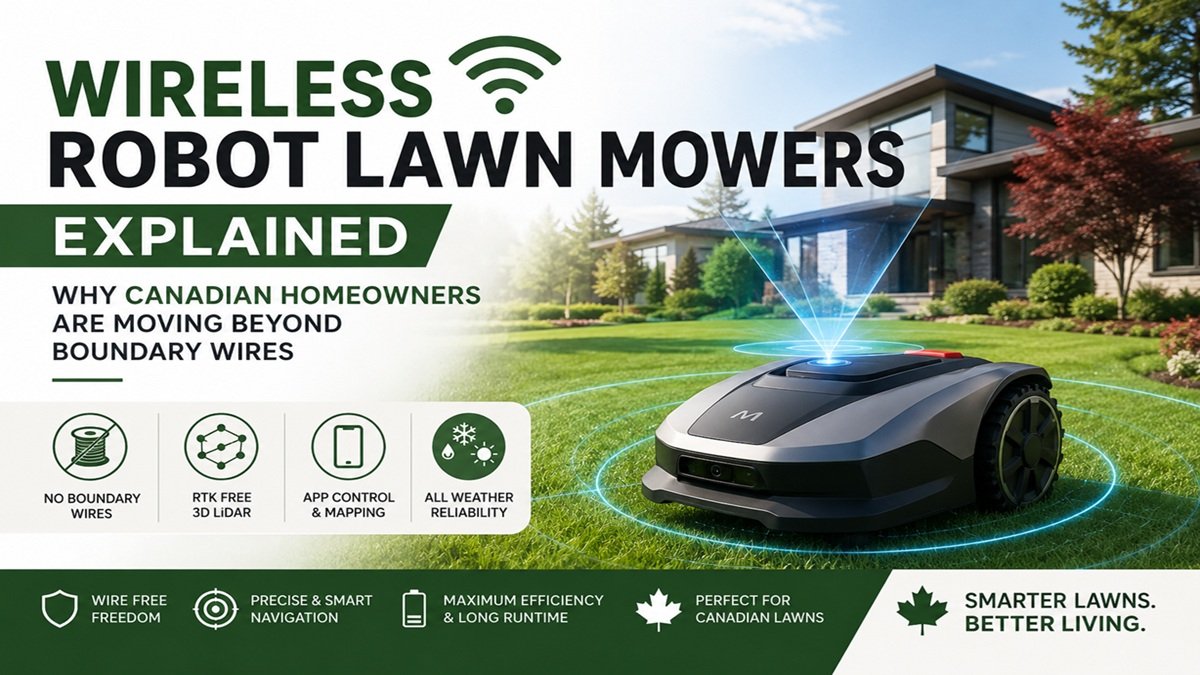
Wireless Robot Lawn Mowers Explained: Why Canadian Homeowners Are Moving Beyond Boundary Wires
Managing a healthy lawn across Canada presents unique geographical challenges. Between sudden spring thaws, short intense growing seasons, and varying lawn terrain, keeping residential turf neatly manicured requires considerable time and effort.
For years, automated outdoor care relied heavily on first generation robotic equipment. However, standard perimeter wire mowers often created as many headaches as they solved. Canadian homeowners are increasingly shifting away from delicate physical boundaries toward intelligent, wire free technology.
The Hidden Frustrations of Traditional Boundary Wires
Traditional automated mowers rely on low voltage physical wires buried around property edges and garden beds. While functional in theory, real world outdoor conditions quickly expose the weaknesses of this setup:
- Susceptibility to Frost Heave: In colder climates across Ontario, Alberta, and Quebec, deep winter freezing and spring thawing shift the topsoil. Soil expansion frequently snaps buried lines or pushes wires back above ground, leading to frustrating signal loss.
- Accidental Damage: Simple yard maintenance, aerating, flowerbed edging, or pets digging can accidentally sever underground boundaries. Locating a hidden wire break often requires specialized signal detection tools or hours of tedious troubleshooting.
- Rigid Yard Layouts: Any change to your landscape, such as planting a new tree, building a patio, or expanding a garden, requires digging up and re-laying physical wire.
- Labor Intensive Installation: Setting up traditional boundaries across complex multi zone yards can take an entire weekend of physical labor, trenching, and manual testing.
Key Difference: Traditional boundary wires require labor intensive trenching and remain prone to winter frost damage. Modern RTK Free 3D LiDAR systems replace physical wires with app assisted virtual mapping and weatherproof optical sensors for instant updates.
Navigation Evolution: Satellite RTK vs. RTK Free 3D LiDAR
To eliminate physical wire setup, early wireless solutions introduced Real Time Kinematic (RTK) satellite positioning. While RTK removed physical cables, it introduced new environmental dependencies:
| Technology | Navigation Method | Signal Dependencies | Performance Under Dense Canopies |
| Boundary Wire | Low voltage signal loop | Physical continuous wire loop | Unaffected by sky, prone to physical breaks |
| Satellite RTK | GNSS / GPS satellite signals | Clear line of sight to sky & base station | Prone to signal drift under trees or near walls |
| RTK Free 3D LiDAR | 360° 3D LiDAR + AI Vision | Self contained onboard optical sensors | Unaffected by trees, structures, or lighting conditions |
Satellite RTK mowers require an unobstructed view of the open sky. Dense evergreen trees, overhanging roof eaves, narrow side yards, or tall neighboring fences frequently block satellite reception. When satellite tracking drops, RTK units stall or drift off course.
In contrast, an RTK Free 3D LiDAR navigation system acts independently of orbital satellites. By emitting millions of invisible laser pulses per second, onboard sensors continuously bounce signals off physical surroundings to construct a real time, centimeter accurate 3D point cloud map. Combined with high definition AI vision, the mower navigates dark areas under dense tree canopies, tight side alleys, and varied light conditions without losing positioning accuracy.
Selecting the Right Smart Mower for Your Property
Properties vary significantly in scale, incline, and layout complexity. When evaluating a modern wire free robot lawn mower, choosing hardware matched to your specific acreage ensures optimal battery runtime and cutting performance:
Compact Residential Lawns: MOVA LiDAX Pro 800
- Property Size: Ideal for smaller residential lots up to 0.2 acres (~800 m²).
- Terrain Handling: Tackles lawn slopes up to 45% (24°) with high traction rear wheel drive systems.
- Key Features: Uses UltraView 2.0 technology combining 360° 3D LiDAR and AI visual sensors for instant, RTK free app auto mapping. Handles disconnected front and back yards effortlessly through multi zone management.
Mid Sized Suburban Properties: MOVA LiDAX Ultra 1000
- Property Size: Engineered for yards up to 0.25 acres (~1,000 m²).
- Terrain Handling: Crosses obstacle heights up to 1.6 inches and handles uneven ground contours.
- Key Features: Features integrated UltraTrim edge cutting technology with a movable floating cutter disk, cutting within 2 inches of perimeter walls and fences to eliminate manual string trimming. A fast charging battery system reduces downtime between cutting sessions.
Large Estates and Complex Turf: MOVA LiDAX Ultra 2000
- Property Size: Built for expansive properties up to 0.5 acres (~2,000 m²).
- Terrain Handling: Easily navigates steep slopes up to 45%, narrow passages down to 23.6 inches, and tough outdoor obstacles.
- Key Features: Features extended long range AI visual detection that identifies over 300 types of lawn obstacles, including outdoor furniture, garden tools, and resting pets. Includes 4G connectivity options, TrueGuard garden security monitoring, and dual map multi zone scheduling controlled via the smartphone app.
Core Practical Benefits for Canadian Homeowners
Transitioning to an advanced robot mower without perimeter wire changes weekly outdoor maintenance into an automated background process:
- Effortless Setup and Mapping: Physical setup time drops significantly. Simply position the low profile charging base, launch the companion application, and guide the mower along your yard perimeter to store virtual boundaries instantly.
- Dynamic Boundary Customization: Adding a fresh flowerbed, fire pit, or temporary pool requires no wire modifications. Users can adjust boundaries, establish virtual keep out zones, or fine tune pathways directly through app controls.
- Smart Obstacle Recognition: Real time 3D perception detects garden hoses, fallen branches, toys, and small animals. Instead of bumping blindly into items, the mower smoothly routes around hazards.
- Structured Cutting Routes: Rather than moving in random bouncing patterns, modern units utilize systematic U shaped parallel, chequerboard, or crisscross cutting paths. This yields efficient coverage, professional lawn striping, and healthy turf density.
Path Comparison:
• Systematic U Shaped Route (3D LiDAR): Provides even coverage, maximum battery efficiency, and clean lawn striping.
• Random Bounce Route (Legacy Mowers): Leaves uneven patches, causes repetitive tire wear, and drains battery life rapidly.
Upgrade to Smarter Lawn Care Today
Upgrading your outdoor equipment to wire free, satellite independent technology protects your landscape from invasive trenching and eliminates wire repair chores. Whether managing a suburban lot with the MOVA LiDAX Pro 800, mid sized yards with the MOVA LiDAX Ultra 1000, or sprawling acreage with the MOVA LiDAX Ultra 2000, RTK Free 3D LiDAR delivers consistent cutting precision all season long.


