
How to Choose the Right Sensors for Reliable IoT Monitoring
IoT monitoring systems are often judged by their dashboards, connectivity, and automation features. In practice, however, the quality of the entire system depends heavily on something much simpler: the sensor collecting the original measurement.
A reliable sensor can provide stable data for years. A poorly selected one can create false alarms, missed events, calibration problems, and unnecessary maintenance. For industrial and remote IoT applications, sensor choice should therefore be treated as a system-design decision rather than a last-minute hardware purchase.
Start With the Measurement, Not the Device
The first step is to define exactly what needs to be measured.
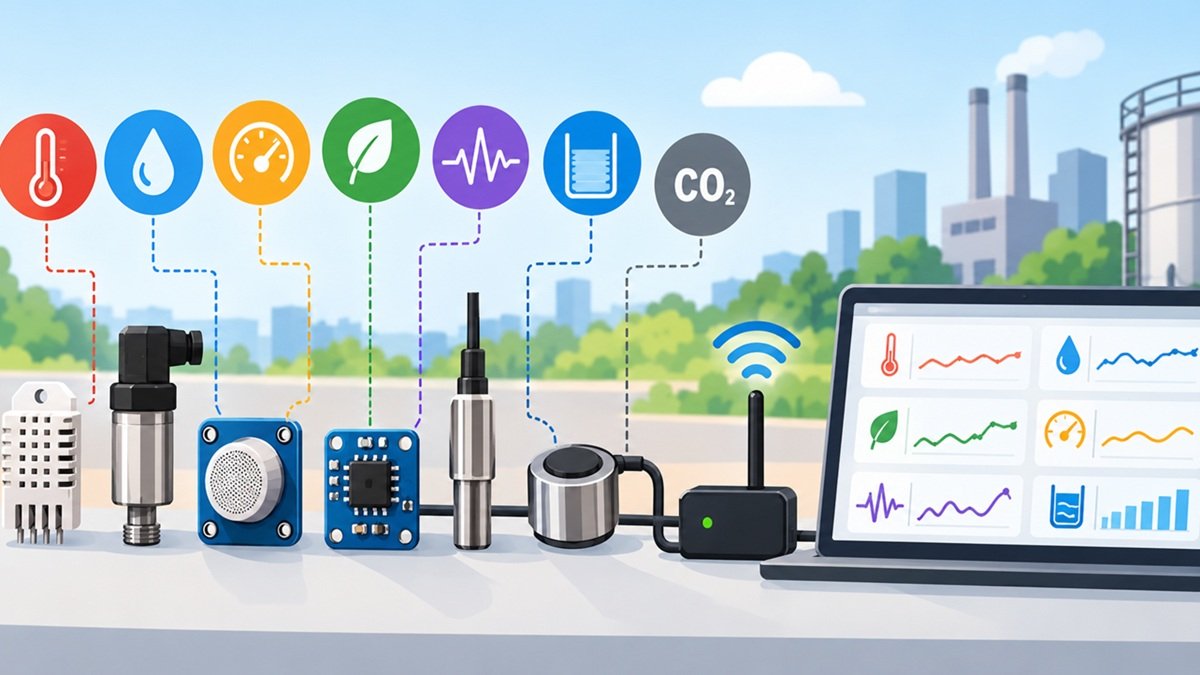
Temperature, pressure, humidity, vibration, flow, liquid level, gas concentration, and electrical parameters may all require different sensing technologies. Even within one category, operating requirements can vary significantly.
For example, a temperature sensor used inside an office building faces very different conditions from one installed near a boiler, inside a refrigeration system, or outdoors in direct sunlight.
Before selecting hardware, define:
- expected measurement range;
- required accuracy;
- acceptable response time;
- environmental conditions;
- installation location;
- expected operating life.
This prevents one of the most common mistakes in IoT projects: choosing a popular sensor first and then trying to adapt the application around its limitations.
Measurement Range Should Include a Safety Margin
A sensor should comfortably cover the normal operating range of the system.
Selecting a device that operates too close to its maximum or minimum limit can reduce accuracy and reliability. Industrial environments can also experience short-term conditions outside the expected range, including temperature spikes, pressure surges, or vibration events.
A reasonable safety margin helps the sensor continue working during these situations.
At the same time, a range that is excessively wide may reduce useful measurement resolution. The goal is not simply to select the sensor with the largest possible range, but to match the sensor closely to real operating conditions.
Accuracy and Resolution Are Not the Same
Accuracy describes how close a measurement is to the actual value. Resolution describes the smallest change the sensor can detect.
A device may display many decimal places without being highly accurate.
For basic environmental monitoring, extremely high accuracy may not be necessary. Industrial process control, laboratory equipment, energy systems, or safety-related monitoring can require much tighter tolerances.
The required accuracy should be established before comparing sensors because higher precision often increases cost and may also introduce additional calibration requirements.
Consider the Environment
Environmental conditions are one of the main reasons sensors fail prematurely.
A sensor may perform perfectly on a workbench but behave very differently after installation in a factory, agricultural field, mechanical enclosure, or outdoor monitoring station.
Important factors include:
- temperature extremes;
- moisture and condensation;
- dust;
- chemical exposure;
- vibration;
- mechanical shock;
- electromagnetic interference.
Outdoor and industrial installations may also require appropriate enclosure protection and durable connectors.
A useful industrial sensor selection process should therefore consider not only measurement specifications but also the physical environment, signal requirements, installation method, and long-term maintenance needs.
Choose the Right Output and Interface
The sensor must communicate correctly with the rest of the monitoring system.
Common outputs include analog voltage, current loops, resistance-based signals, pulse outputs, and digital interfaces.
IoT devices may use protocols such as:
- I2C;
- SPI;
- UART;
- RS-485;
- Modbus;
- CAN.
For longer cable runs and industrial environments, interfaces designed for noise resistance are often preferable to low-voltage signals intended for short PCB connections.
The interface should also match the available controller or gateway. Adding converters or interface boards later increases complexity and introduces additional points of failure.
Power Consumption Matters in Remote IoT Systems
Power requirements can become critical when sensors are connected to battery-powered or solar-powered IoT nodes.
Some sensors operate continuously, while others can enter low-power sleep modes between measurements.
A device that consumes only a small amount of additional current may not matter in a mains-powered system. In a remote installation expected to operate for months or years without maintenance, the same difference can significantly affect battery life.
When evaluating a sensor, consider both average current consumption and peak current during measurement or communication.
Response Time Should Match the Application
Not every monitoring application needs instant measurements.
Slow environmental changes such as room temperature may be monitored at relatively long intervals. Vibration, pressure changes, machine conditions, or safety-related events may require much faster response.
A sensor with very high sampling speed provides little benefit if the monitored process changes slowly. Conversely, a slow sensor can miss important events in dynamic systems.
The required response time should therefore be based on the physical process being monitored rather than on the maximum performance offered by the device.
Calibration and Long-Term Stability
Initial accuracy is only part of the sensor’s performance.
Some sensors drift gradually over time because of aging, contamination, mechanical stress, or environmental exposure.
For long-term IoT monitoring, check whether the sensor requires periodic calibration and how difficult that process will be after installation.
A low-cost sensor that requires frequent manual calibration may eventually cost more to operate than a more stable device.
Remote installations make this particularly important because maintenance visits can be expensive.
Installation Can Affect Measurement Quality
Even the correct sensor can produce poor data when installed incorrectly.
Temperature sensors may be affected by nearby heat sources. Pressure sensors can be influenced by unsuitable tubing. Humidity sensors may suffer from condensation. Vibration sensors require proper mechanical mounting.
Cable routing also matters. Signal wires running near motors, power electronics, or high-current cables may pick up electrical noise.
Installation requirements should therefore be considered during sensor selection, not after the hardware has already been purchased.
Reliability Is More Valuable Than Extra Features
IoT projects often focus on advanced features such as wireless connectivity, cloud integration, machine learning, and automated alerts.
None of these features can compensate for unreliable measurements.
For most monitoring systems, the best sensor is not necessarily the newest or most sophisticated one. It is the device that provides consistent data under real operating conditions, works with the available interface, requires reasonable maintenance, and remains stable over the expected lifetime of the system.
Final Considerations
Reliable IoT monitoring begins at the measurement point.
Before choosing a sensor, define the required range, accuracy, response time, environmental protection, interface, power consumption, installation method, and calibration needs.
Evaluating these factors together helps prevent costly redesigns and improves the quality of the data collected by the entire IoT system.
A well-selected sensor may be one of the smallest components in an IoT installation, but it often has one of the largest effects on overall system reliability.


