
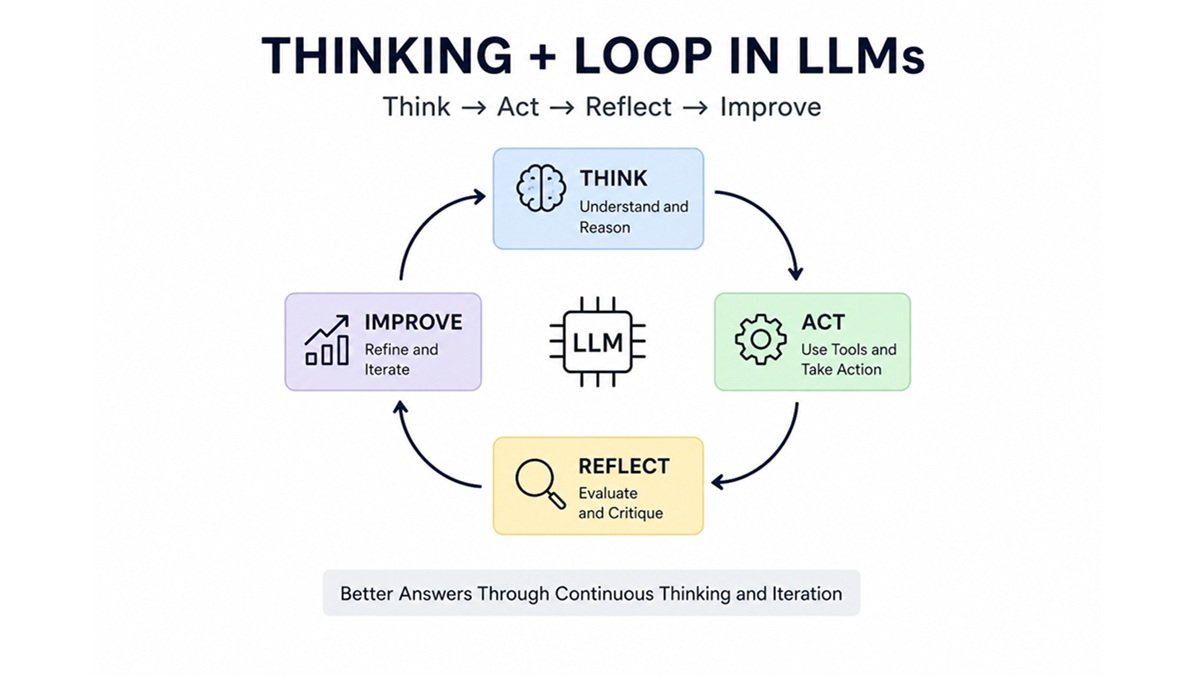
Thinking + Loop in LLMs: A Deep Dive into Reasoning, Iteration, and Agentic Intelligence
Introduction
Large Language Models (LLMs) like GPT-4, LLaMA, and Mistral are no longer just next-token predictors. Modern systems are designed to simulate thinking, iterate through problems, use tools, and refine outputs over multiple passes.
Two foundational ideas enable this:
- Thinking (Reasoning) → structured, step-by-step internal processing
- Loops (Iteration cycles) → repeated passes to improve, verify, or act
Together, they power agentic AI systems, autonomous workflows, and high-accuracy reasoning engines.
Read this: Head Dimension in AI: Complete Guide for Transformers
Understanding “Thinking” in LLMs
What Does “Thinking” Mean?
In LLMs, “thinking” refers to explicit or implicit reasoning before producing an answer. Instead of jumping directly to output, the model:
- Interprets the problem
- Breaks it into steps
- Applies logic or learned patterns
- Produces a structured response
Chain-of-Thought (CoT)
Chain-of-Thought prompting forces step-by-step reasoning:
Problem → Intermediate Steps → Final Answer
This improves:
- Mathematical reasoning
- Logical consistency
- Transparency
Types of Thinking
1. Fast Thinking (System 1)
- Immediate response
- Pattern recognition
- Low latency, lower accuracy
2. Slow Thinking (System 2)
- Step-by-step reasoning
- Higher compute
- Better correctness
3. Reflective Thinking
- Self-evaluation
- Error correction
- Iterative refinement
What is a Loop in LLM Systems?
A loop is when the model does not stop at one pass. Instead, it cycles through reasoning, action, and evaluation multiple times.
Basic transformation:
Single-pass:
Input → Output

Loop-based:
Input → Think → Act → Evaluate → Repeat → Final Output
Loops convert LLMs into dynamic problem solvers.
Types of Loops in LLM Architectures
1. Self-Reflection Loop
Concept
The model critiques and improves its own output.
Flow
Generate → Critique → Revise → Finalize
Use Case
- Essay improvement
- Code debugging
- Logical correction
Strength
- Reduces hallucination
- Improves coherence
2. Iterative Refinement Loop
Concept
Output is improved incrementally across iterations.
Flow
Draft → Improve → Improve → Improve → Final
Example
- Summarization refinement
- Translation polishing
3. ReAct Loop (Reason + Act)
Used in frameworks like LangChain.
Flow
Thought → Action → Observation → Thought → Action → Final Answer
Key Idea
The model:
- Thinks
- Uses tools
- Observes results
- Continues reasoning
4. Tool-Use Loop
Concept
LLM integrates external systems.
Flow
Query → LLM → Tool Call → Result → LLM → Answer
Tools
- Search APIs
- Databases
- Code execution
5. Planning Loop (Agent Loop)
Concept
Breaks a goal into sub-tasks.
Flow
Goal → Plan → Execute Step → Check → Next Step → Final
Used In
- Autonomous agents
- Task automation
Example frameworks:
- AutoGPT
6. Memory Loop
Concept
LLM uses past information to improve decisions.
Types
- Short-term (context window)
- Long-term (vector DB)
Flow
Input → Retrieve Memory → Reason → Update Memory → Output
7. Verification Loop
Concept
Check correctness before final output.
Flow
Answer → Verify → If wrong → Fix → Final
Example
- Math validation
- Fact checking
8. Debate Loop (Multi-Agent Loop)
Concept
Multiple agents argue and refine answers.
Flow
Agent A → Agent B → Critique → Defense → Judge → Final
Benefits
- Better reasoning
- Reduced bias
9. Tree of Thoughts (ToT) Loop
Concept
Multiple reasoning paths explored simultaneously.
Flow
Problem
 ├── Path A
 ├── Path B
 ├── Path C
 ↓
Evaluate → Select Best Path
Advantage
- Handles complex reasoning
- Avoids local mistakes
10. Recursive Loop
Concept
The model calls itself with refined prompts.
Flow
Task → Solve → Subtask → Solve → Combine → Final
11. Human-in-the-Loop (HITL)
Concept
Human feedback improves output.
Flow
LLM Output → Human Feedback → Improve → Final
12. Continuous Learning Loop
Concept
System improves over time via feedback.
Flow
Data → Train → Deploy → Feedback → Retrain
Combined Thinking + Loop Architecture
Unified Flow
User Input
   ↓
Thinking (Reasoning)
   ↓
Initial Output
   ↓
Loop System:
   - Reflection
   - Tool Use
   - Verification
   - Memory Update
   ↓
Final Output
Pseudocode Example
while not done:
    thought = model.reason(input)

    if need_tool:
        result = call_tool()
        update_context(result)

    if need_reflection:
        thought = model.reflect()

    if verified:
        done = True

return final_answer
Real-World Systems Using Loops
1. AI Coding Assistants
- Multi-step reasoning
- Debugging loops
- Code refinement
2. Research Agents
- Search → Analyze → Refine
3. Autonomous AI Systems
- Plan → Execute → Monitor
Benefits of Loop-Based Thinking
Accuracy
Multiple passes reduce errors
Robustness
Handles complex problems
Adaptability
Can adjust strategy dynamically
Autonomy
Enables self-operating systems
Challenges
1. Latency
More loops = slower responses
2. Cost
Higher compute usage
3. Loop Instability
Infinite or unnecessary loops
4. Error Amplification
Wrong reasoning repeated
Future of Thinking + Loops
- On-device reasoning (TinyLLMs + IoT)
- Real-time adaptive loops
- Multi-agent ecosystems
- Hybrid symbolic + neural reasoning
Conclusion
Thinking + Loop transforms LLMs from:
👉 Static text generators
➡️ Into dynamic reasoning systems
Modern AI systems:
- Think step-by-step
- Act using tools
- Reflect on outputs
- Iterate until optimal
This paradigm is the backbone of:
- AI agents
- Autonomous workflows
- Future AGI systems


