
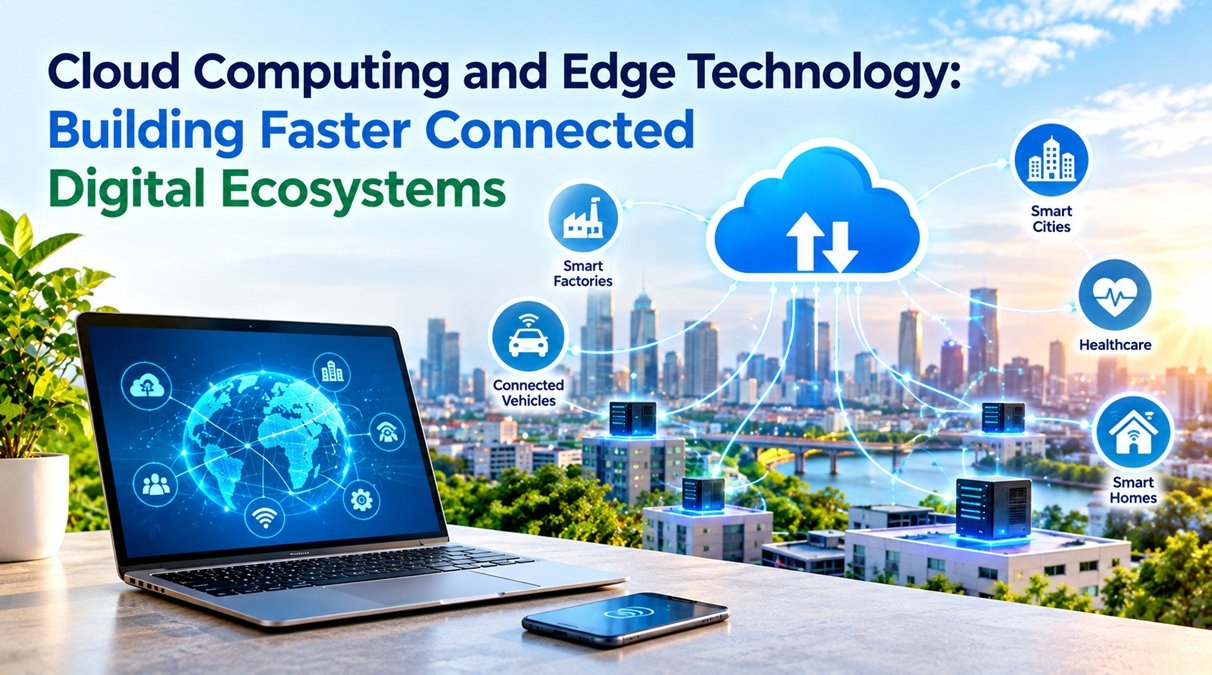
Cloud Computing and Edge Technology: Building Faster Connected Digital Ecosystems
The era of digital transformation does not mean merely the ability to be online. Contemporary companies construct digital ecosystems, in which apps, devices, data centers, artificial intelligence (AI), and automation operate all at once. Cloud computing and edge technology are two interconnected notions that constitute the very essence of the digital transformation. With the help of cloud computing, organizations can use scalable computing infrastructure via centralized storage, software, servers, and computing resources without having to possess numerous devices. Edge technology is an extended version of cloud computing, because it brings computing power closer to where the data is generated.
Cloud and edge technologies make digital ecosystems even faster and smarter. The growing popularity of the cloud computing market proves the increasing interest in this technology among enterprises. At the moment, cloud computing is required for businesses, government agencies, healthcare providers, manufacturing, and financial services to store large amounts of data and implement innovative technologies, including AI, machine learning, and IoT.
Evolution of Cloud Computing in Digital Infrastructure
The conventional IT infrastructure was highly dependent on physical servers located at the premises of enterprises. This method had the disadvantages of high cost of installation, maintenance, and a lengthy deployment period. The cloud computing system is quite different because it offers on-demand use of computing resources through a central facility. The main benefit offered by the cloud computing system is that of scalability. An organization can either reduce or increase its computing capacity based on demand without having to make any capital investment in hardware.
Cloud Computing Services and Can Be Classified Mainly into Three Categories as Follows:
- Infrastructure as a Service (IaaS): It provides virtualized infrastructure services such as computational processing, storage, networking, thereby helping organizations to create and manage their own applications and platforms.
- Platform as a Service (PaaS): The service that provides a platform for developing, testing, and deploying applications without the need to deal with hardware and infrastructure management.
- Software as a Service (SaaS): The solution that provides pre-built software applications and thus allows people to use the service without having to install and maintain software.
These models have enabled different sized organizations to embrace modern-day technology much more effectively. Smaller companies can now avail enterprise level computing capabilities with minimal investments required initially, whereas larger companies can operate efficiently globally through distributed clouds.
Emerging Need for Edge Computing Technology
Whereas cloud computing has been revolutionizing data processing, more data is being produced due to the ever-growing connectivity. Sensors, autonomous applications, industry machines, intelligent cars, and interconnected consumer devices continuously produce vast quantities of information that must be immediately processed. Edge computing helps to solve this problem by processing data near its source instead of sending all data points to centralized cloud servers. This helps eliminate delays, increases the responsiveness and reduces the required bandwidth.
For instance, an autonomous car cannot rely on a remote cloud server in order to make driving decisions right away. It needs to have local processing power that would be able to process information obtained by the sensors right away. In addition, manufacturing robots that work in plants should be able to respond in time for safety and efficiency. Cloud plus edge provides a distributed computing model where various tasks will be executed depending on their type and needs. Immediate operations can take place at the edge, whereas large-scale processing can be executed in cloud.
Cloud and Edge Integration: Creating Connected Digital Ecosystems
The future of digital infrastructure will not revolve around either cloud or edge technology. Rather, firms are developing architectures that integrate centralized cloud technologies with decentralized edge technologies. This collaborative framework enhances efficiency since the technologies can handle different functions effectively. While cloud technologies offer computing capacity, global availability, and massive data storage, edge technologies ensure fast local computing and low latency.
Key Advantages of Cloud-Edge Integration Include:
- Efficient Data Processing: Edge devices conduct analysis of essential information locally, while cloud conducts complex data analysis.
- Efficient Operation: Companies can avoid unnecessary transmission of data and transfer information that is necessary for processing to centralized systems.
- Increased Reliability: Distributed computing ensures that companies are less reliant on a single processing location and thus increase reliability.
- Efficient Data Management: Firms are able to process data at the appropriate location as per security, cost, and performance considerations.
As per initiatives by the technology policy in Europe, cloud computing and edge computing are increasingly being regarded as components of a computing continuum environment where computing resources can switch between centralized and localized environments depending on requirements.
Role of Artificial Intelligence and Internet of Things
As a result of AI and IoT development, more need will arise for advanced cloud and edge architectures. The use of AI implies high computational power to train algorithms, analyze data, and make predictions. The cloud provides the required infrastructure for these actions. Edge systems are needed to let AI applications work closer to users and devices. In production, the edge AI system can detect equipment malfunction and prevent equipment breakdown. Sensors installed on devices process the data, analyze the patterns, and send the important information to cloud platforms. In the healthcare industry, the connected medical devices can track patients’ states and warn about their condition. The information is processed instantly thanks to the edge computing, but the cloud is needed to manage the medical data and conduct research.
Retailers can use edge technology to provide customers with personalized experience through the analysis of customer behavior, goods movements, and automatic payments systems. These examples show that the cloud and edge technologies become the key elements of intelligent digital ecosystem.
Industries Changing via Cloud and Edge Computing
- Manufacturing: The manufacturing industry is considered among the front-runners in implementing the cloud-edge architecture. There are smart manufacturing plants that have connected machines, robotic and automated production lines which need constant interaction. The edge computing helps machines to react faster to changes, while the cloud allows centralized visibility of several manufacturing plants.
- Healthcare: Hospitals and other healthcare companies are actively using the cloud-based infrastructure in order to monitor their patients, store their medical records, conduct imaging diagnostics, as well as make a diagnostic using AI.
- Telecommunications: The telecommunication networks are becoming one of the essential components of edge computing because they help to ensure the connectivity for distributed digital services. The development of 5G networks helps to implement the systems that need to work fast and with low latency, such as autonomous systems, smart cities, industrial automation.
- Financial Services: Cloud and edge solutions are used by banks and financial companies for fraud detection, digital banking platforms, risk analysis, and customer personalization. Real-time transaction monitoring is one of the processes that need edge computing because suspicious transactions can be detected instantly.
Challenges in Cloud and Edge Ecosystem Development
however, some difficulties arise due to the use of cloud and edge computing despite their many benefits.
- Data Security and Privacy: With distributed computing, there arise new concerns regarding data security since data is processed from different places. There is a need for secure encryption, identity management, and cybersecurity systems.
- Infrastructure Complexity: Distributed computing infrastructures require high coordination between the network, application, device, and security levels. Companies have to employ specialists who will be able to operate distributed computing systems.
- Energy Consumption: The increased need for computer processing power puts pressure on data centers and network infrastructure. Efficient hardware, the use of renewables, and effective cooling system technologies become increasingly important for creating sustainable digital environment.
- Regulatory Requirements: Data sovereignty and data privacy laws have an impact on where organizations can store and process their data. Companies working in different regions should comply with the data protection laws of those regions.
The Future of Cloud Computing and Edge Technology
The future phase of digital transformation will involve designing computing platforms that involve the working together of cloud computing, edge technology, AI and connected devices. The distributed architecture will be adopted by enterprises as real-time applications gain importance. The market for cloud computing will keep on developing due to the demand for flexibility, automation and advanced analytics from organizations. On the other hand, the use of edge technology will continue to extend into sectors requiring real-time data processing like transportation, energy, healthcare and automation.
Efficiency and effectiveness in the future digital ecosystem will involve the management of workloads intelligently such that applications make decisions on the processing of data either locally or in the cloud computing platform. Organizations and research analysts like Pristine Market Insights continue to study the impact of cloud infrastructure and edge technology on the trends of global digital transformation.
Cloud and Edge Synergy: Shaping the Future of Connected Intelligence
The cloud computing model and the edge computing technology model form two complementary pillars of the current digital ecosystem. While cloud computing models offer scalable computing power and centralized data storage facilities, edge computing technologies help to process data rapidly close to users and their devices. With digital technologies becoming increasingly smart and data-centric, it will be increasingly important to utilize the benefits of both cloud and edge computing technologies to create efficient, secure and responsive computing infrastructures.
Author Bio:
Teja Kurane is a research analyst specializing in Information & Communications Technology, with expertise in cloud computing, edge technology, digital transformation, and connected technologies. Her research examines emerging technology trends and how businesses are leveraging innovative digital infrastructure to improve performance, connectivity, scalability, and operational efficiency.


