
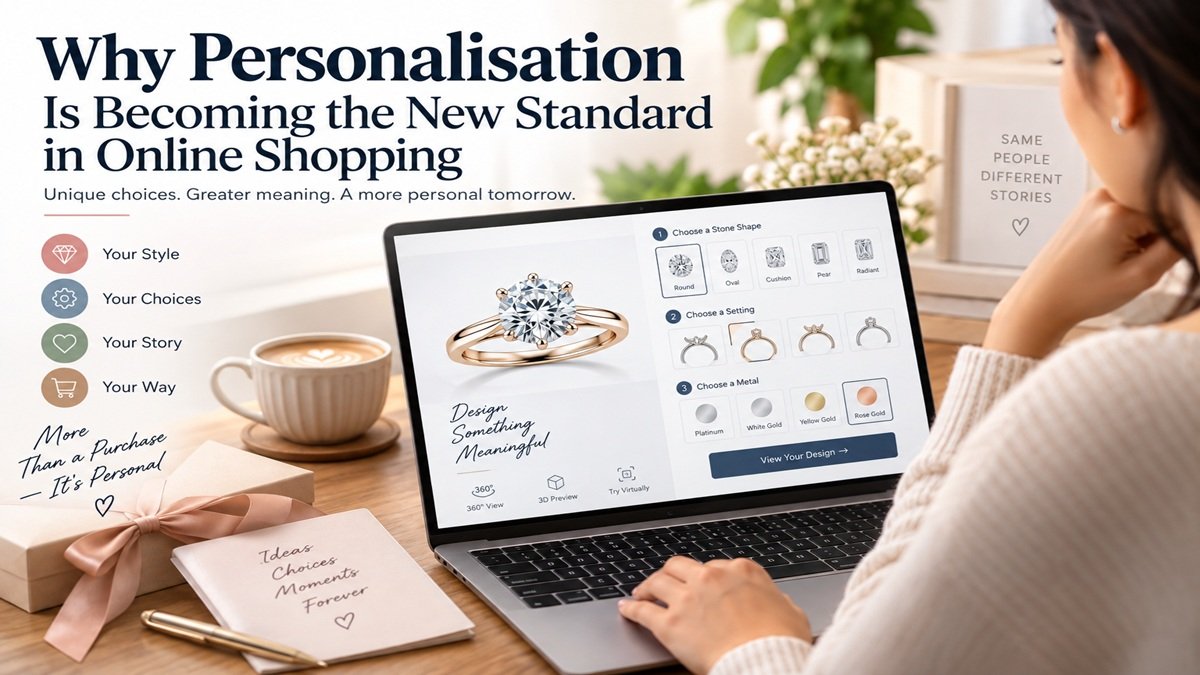
Why Personalisation Is Becoming the New Standard in Online Shopping
Online shopping used to be built around convenience. Consumers visited a website, selected a product from a fixed catalogue and completed the transaction.
Today, expectations are changing.
Customers increasingly want more than access to products. They want the ability to personalise what they buy, compare variations and create something that reflects their own preferences.
This shift can be seen across industries ranging from fashion and technology to furniture, travel and fine jewellery.
Consumers Want More Control Over Their Purchases
Traditional retail usually asks the customer to choose from what is already available.
Digital commerce makes it possible to reverse that process.
Instead of starting with a finished product, the customer can start with their preferences and build toward the final result.
Depending on the industry, that may involve choosing:
- materials;
- colours;
- sizes;
- features;
- components;
- finishes;
- technical specifications; or
- personal details.
The result is a buying experience that feels less like selecting inventory and more like creating a product.
Technology Has Made Customisation Easier
Personalisation is not new. Bespoke clothing, made-to-order furniture and custom jewellery have existed for centuries.
What has changed is accessibility.
Modern websites can guide customers through complex purchasing decisions using interactive configurators, filters, real-time pricing and visual previews.
A customer buying a computer can select the processor, memory and storage they want. Someone ordering furniture may choose dimensions, fabric and finishes. A jewellery customer can compare settings, stones and precious metals before placing an order.
These tools make customisation available to a much wider audience than traditional bespoke services alone.
Jewellery Is a Natural Fit for Personalisation
Few products are more personal than jewellery, particularly engagement rings.
An engagement ring can represent a relationship, an individual aesthetic and a substantial financial purchase at the same time.
For that reason, customers often care about details that may seem small individually but dramatically affect the finished piece.
Stone shape, setting style, metal colour, band width and proportions can completely change the character of a ring.
Online jewellery businesses such as Nura Lab New Zealand reflect this shift by allowing customers to explore different engagement-ring combinations online rather than relying only on a fixed selection of finished pieces.
The digital process gives customers time to understand those decisions before committing to a final design.
Personalisation Can Improve Price Transparency
Another advantage of digital customisation is the ability to understand how individual choices affect price.
When products are sold only as finished packages, customers may have little visibility into why one version costs considerably more than another.
A configuration-based approach can make those trade-offs much clearer.
For example, a customer may discover that changing the material has a larger impact on price than changing the colour. Another may decide that one technical specification matters significantly more than a premium cosmetic option.
This allows the buyer to allocate their budget toward the features they value most.
Choice Needs to Be Managed Carefully
More options are not always better.
If customers are presented with hundreds of decisions at once, personalisation can become overwhelming.
The strongest online customisation experiences therefore guide users through decisions in a logical order.
A well-designed process might begin with the largest visual or functional decision and gradually introduce smaller choices.
Helpful explanations also matter.
Customers should be able to understand why one material differs from another, what a specification means and whether a more expensive option provides a meaningful benefit.
Personalisation Builds Emotional Connection
Custom products often carry more emotional value because the buyer participated in creating them.
The finished item becomes associated with a series of deliberate decisions rather than simply being something selected from a shelf.
This can be especially powerful for products connected to important milestones.
An engagement ring, wedding band, personalised gift or custom piece of furniture may remain with someone for decades.
The ability to influence how the product looks and feels can therefore become part of the story behind the purchase.
Customers Still Need Expert Guidance
Digital tools are useful, but customisation often introduces questions that automated interfaces cannot fully answer.
A customer may understand what they like visually but not know which option is most durable, practical or appropriate for everyday use.
This is where human expertise continues to matter.
The strongest personalised shopping experiences often combine two elements:
- the freedom to explore options independently; and
- access to an expert when a more complicated decision appears.
This hybrid model allows customers to move at their own pace without removing professional guidance entirely.
Visualisation Is Becoming More Important
One challenge with customised products is that the final version may not physically exist when the customer places the order.
Digital visualisation helps reduce that uncertainty.
High-resolution renders, product previews, 3D models and augmented-reality tools can help customers understand how their choices may look before production begins.
As these technologies improve, the gap between shopping for a finished product and configuring one online will continue to narrow.
Personalisation Also Creates Better Customer Data
Customisation can benefit businesses as well as consumers.
When customers actively select colours, materials, dimensions or product features, companies gain clearer insight into what people actually prefer.
This information can help businesses improve product development, inventory planning and future recommendations.
Instead of relying only on what has already sold, retailers can understand which configurations customers repeatedly explore.
Used responsibly, this data can make future product experiences more relevant.
The Future of Online Shopping Will Be More Individual
E-commerce is gradually moving away from the idea that every customer should see and buy exactly the same product.
Artificial intelligence, interactive configuration and improved visualisation will make it easier for businesses to offer more individual experiences without requiring every item to be completely bespoke.
This does not mean traditional products will disappear.
Many consumers will still value simplicity and the ability to purchase something immediately.
But for products that are emotional, expensive or highly personal, customisation is likely to become increasingly important.
The future of online retail is therefore not simply about selling more products through websites. It is about giving customers greater control over what those products ultimately become.


