
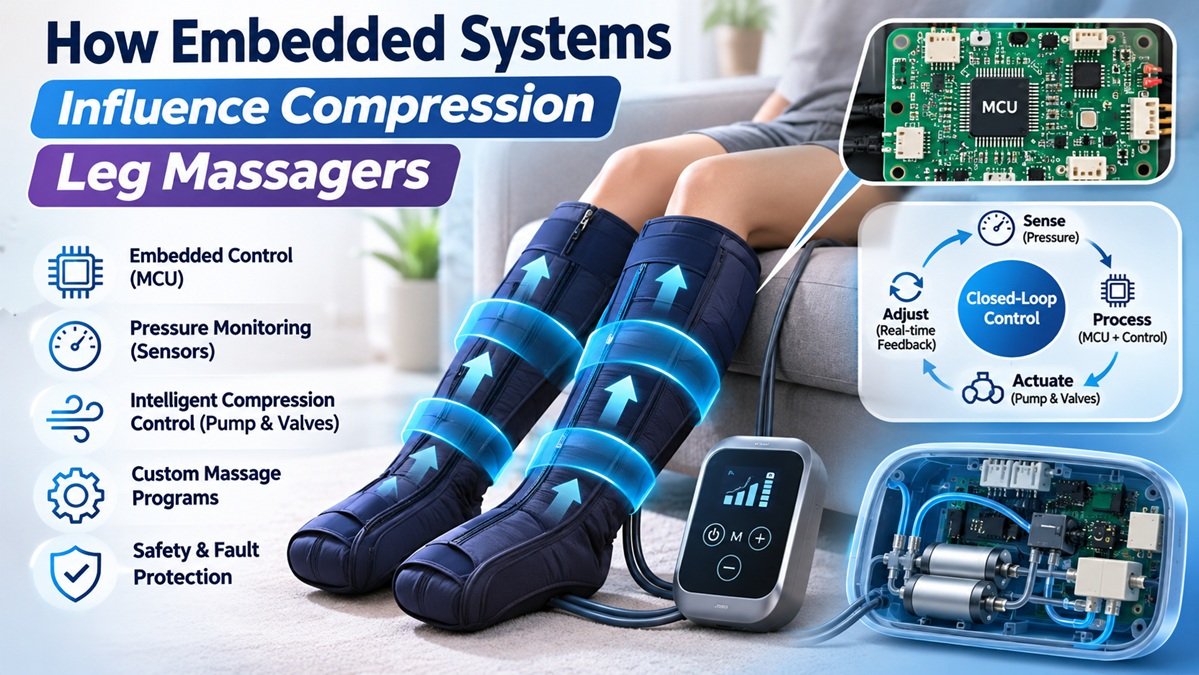
How Embedded Systems Influence Compression Leg Massagers

If you’re evaluating technology options for air compression leg massagers or considering ways to make your products smarter, you may notice a common limitation: many devices offer a rigid massage experience. Pressure settings are fixed, making it difficult to accommodate different leg sizes, while inflation and deflation cycles often lack flexibility.
Based on extensive product testing, user feedback, and comparisons of similar products on the market, we’ve found that the key to smarter, more adjustable compression massage isn’t just the air chambers or pump hardware. It’s the embedded control system.
By combining pressure sensors, a microcontroller, and solenoid valves, this system creates a closed-loop control process. Features such as sequential chamber control, PID-based pressure regulation, real-time sensor monitoring, and multiple safety mechanisms turn basic inflation and deflation into a more intelligent and adaptable massage experience.
Let’s take a closer look at how this system works and why it matters.
1. Compression Leg Massagers: How They Work and Why Embedded Systems Matter
How Air Compression Massage Works
Compression leg massagers use inflatable air chambers built into fabric wraps. As the chambers inflate, they apply pressure to the legs. When they deflate, the pressure is released, allowing the muscles to relax.
Repeated inflation and deflation create a rhythmic compression effect that mimics manual kneading and wave-like massage. This can help support circulation in the lower limbs and relieve discomfort associated with prolonged sitting.
Basic models typically use fixed inflation and deflation cycles, with little control over inflation speed or pressure. With an embedded system, however, the device can do much more than simply inflate and deflate. It can run more advanced and customizable pressure sequences.
Why Embedded Systems Matter
For manufacturers looking to differentiate their products from basic compression massagers, embedded systems are a key part of the solution.
The embedded microcontroller (MCU) acts as the device’s brain. It processes sensor signals, runs control algorithms, and manages the air pump and solenoid valves to coordinate the entire massage cycle.
Without embedded control, a device is limited to fixed operating sequences. With it, manufacturers can customize massage programs, implement pressure monitoring, detect operating faults, and build in safety features.
Simply put, hardware determines whether a massager can operate. Embedded systems determine how intelligently, safely, and flexibly it operates.
2. Embedded System Architecture: How Hardware and Software Work Together
Key Hardware Components
An embedded system is built from several interconnected hardware modules. Our teardown sample clearly illustrates this modular design, featuring a green main PCB, a separate digital display and control board, two miniature diaphragm air pumps, pressure-sensing components, and a power supply unit.
At Starbright, the integration of hardware and software is an important consideration in massage device development. A well-designed control architecture brings together the MCU, pressure sensors, pump drivers, and user interface to ensure that each component works together efficiently. This approach also provides a flexible foundation for future product improvements.
Each component serves a specific purpose:
| Hardware Component | Main Function | Component in the Sample |
| MCU | Processes data, runs firmware, and sends control commands | Green main PCB |
| Pressure Sensor | Monitors air pressure inside the chambers | Onboard sensing components |
| Solenoid Valve and Pump Drivers | Control inflation and deflation | Driver circuits and two miniature air pumps |
| Power Module | Supplies power and regulates voltage for the MCU and peripherals | Power management circuit |
| User Interface | Receives button inputs and displays settings and timers | Separate digital display and button board |
Embedded Software Architecture
Hardware provides the physical foundation, but software determines how the system operates. The firmware typically consists of three main layers:
- Signal Acquisition: Periodically reads pressure sensor data and button inputs.
- Task Scheduling: Coordinates pressure control, timing, and fault detection to prevent task conflicts.
- State Machine Management: Handles operating states such as standby, massage, pause, and fault.
State machine logic prevents conflicting operations. For example, if a fault is detected, the system can prevent the air pump from continuing to inflate the chambers. This is an essential foundation for reliable device operation.
How Hardware and Software Form a Closed-Loop Control System
The complete control process follows a simple cycle:
Sensing → Signal Processing → MCU Decision-Making → Control Commands → Hardware Execution
- Hardware sensors detect physical conditions, such as air pressure, while actuators perform the required actions.
- Software processes the signals, calculates the required response, and determines when to inflate or stop.
- After each action, the sensors collect updated pressure data and send it back to the MCU for further adjustment.
This continuous feedback loop allows the device to maintain more consistent pressure control.
3. Flexible Air Compression Control Through Embedded Systems

Independent Control of Multiple Air Chambers
Creating wave-like or alternating compression requires independent control of different air chambers.
In our teardown sample, a dual-pump configuration allows separate control of the left and right air circuits.
The embedded system can send individual inflation and deflation commands to each channel. For example, the lower-leg chambers can inflate first, followed by the upper-leg chambers a few seconds later, creating an upward compression sequence. Alternating pressure between the left and right legs is another possible control strategy.
These sequences are programmed directly into the firmware.
By comparison, basic systems without independent channel control may inflate all chambers simultaneously, limiting the variety of available massage patterns.
PID-Based Pressure Regulation
Simply running an air pump can cause pressure overshoot. If the pump continues operating after the target pressure is reached, the chambers may become overinflated, creating an uncomfortable compression experience.
A PID control algorithm can help regulate this process.
The MCU continuously reads pressure sensor data and compares it with the target pressure. It then adjusts pump operation based on the difference.
As the pressure approaches the target, the controller can reduce pump output or shorten operating cycles. If pressure exceeds the set limit, the system can activate a solenoid valve to release air.
This helps maintain more stable pressure and reduces sudden changes in compression intensity.
Customizable Massage Modes
Embedded systems also make it easier to develop new massage programs without changing the hardware.
Each mode can be configured through firmware parameters, including:
- Air chamber inflation sequence
- Inflation duration
- Target pressure
- Pressure hold time
- Deflation interval
Manufacturers can develop different programs, such as gentle, intensive, and intermittent compression modes, based on market requirements.
When new modes are needed, firmware adjustments can simplify product updates and shorten development cycles.
4. Sensor Feedback: Adding Intelligent Control to Compression Massagers
Pressure Signal Acquisition and Filtering
Raw sensor signals often contain electrical noise and interference caused by pump vibration. Using these signals directly can lead to inaccurate pressure readings.
Embedded software applies digital filtering to reduce noise and remove unwanted signal spikes, producing more stable pressure data.
Reliable signal processing is essential for accurate control and monitoring.
Adaptive Pressure Control for Different Leg Sizes
Users have different leg circumferences, and the tightness of the wrap can also vary. As a result, the same amount of air may produce different pressure levels.
In systems with suitable sensing and validated control algorithms, pressure response data can help estimate changes in chamber loading.
The controller can then adjust inflation limits or operating parameters to help maintain appropriate compression levels.
This type of adaptive control can reduce the need for repeated manual adjustments and improve user comfort.
Real-Time Fault Detection
The system can continuously monitor pressure changes to identify abnormal operating conditions.
For example:
If pressure fails to increase during inflation, the system may detect a possible air leak.
If pressure rises unexpectedly, it may indicate a blocked air path or another mechanical issue.
When an abnormal condition is detected, the firmware can trigger a protective response and stop the air pump.
5. Built-In Safety Mechanisms: The Foundation of Reliable Embedded Control
Software-Based Fault Monitoring
Embedded firmware can periodically check peripheral status and system operation, including::
- Sensor connection monitoring
- Air pump operation checks
- Watchdog timer monitoring
If a hardware fault is detected, the system can stop the massage cycle and enter a protective state to prevent continued abnormal inflation.
Multiple Layers of Hardware Protection
Reliable protection should not depend on software alone. Combining hardware and software safeguards provides an additional layer of protection.
Common hardware protection features include:
- Overcurrent Protection: Disconnects power when the pump draws excessive current.
- Overtemperature Protection: 过热Monitors the temperature of power and driver components and shuts down the system if limits are exceeded.
- Pressure Protection: Works with the control system to activate the solenoid valve and release excess air when pressure exceeds the defined limit.
These measures help improve operational safety and hardware reliability.
Fault Alerts and International Safety Compliance
When a fault is detected, the embedded system alerts users through the display or indicator lights and identifies the type of issue. For products targeting European and North American markets, the underlying safety logic must be designed to meet the applicable regional regulations and certification requirements.
Built-in safety responses help address market-specific requirements and keep the device operating safely under different conditions.
| Target Market | Regulatory Marking | Applicable Standards | Embedded System Safety Requirements |
| European Union | CE | EN 60335-2-32, EN 55014 series, RoHS | Fault alerts, overpressure protection, electromagnetic interference immunity, and automatic shutdown under abnormal conditions |
| United States | UL | UL 1647 | Software fault protection, hardware fault detection, abnormal pressure shutdown, and safety alerts |
| United Kingdom | UKCA | BS EN IEC 60335-2-32 | Fault notifications, overload protection, and validated safety response mechanisms |
Author Bio
I’m Viva, and my work focuses on massage product development and manufacturing, covering devices for different parts of the body. I’m particularly interested in the embedded technology behind these products, from MCU control and sensor feedback to temperature regulation, motor control, and system reliability.
I share practical insights into massage product design, engineering, and manufacturing, exploring how these elements shape product performance and user experience. You can connect with me on LinkedIn for more industry insights.


