
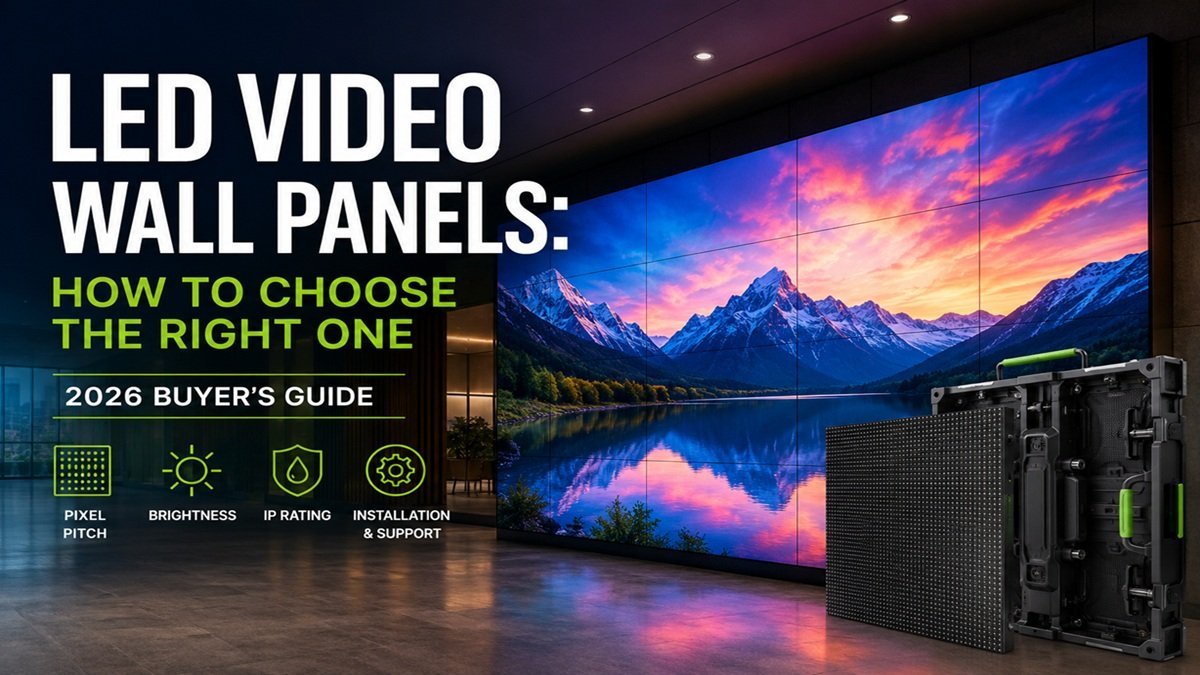
LED Video Wall Panels: How to Choose the Right One (2026 Buyer’s Guide)
Walk into a flagship store, a stadium concourse, or a modern lobby and you’ll see the same thing: a seamless wall of light doing the job a dozen flat-screens used to do. That shift is now measurable — the direct-view LED display market was worth about USD 7.7 billion in 2024 and is forecast to reach USD 14.4 billion by 2034 (Global Market Insights). If you’re buying your first LED video wall, here’s what actually matters, and what salespeople tend to gloss over.
What exactly is an LED video wall panel?
An LED video wall is a single large screen built from modular panels — often called tiles or cabinets — that lock together edge-to-edge with no visible bezels. Each panel carries thousands of tiny red-green-blue LEDs that emit their own light, so the picture stays bright and saturated even in daylight. Because the design is modular, you can build almost any size or shape, from a 2-by-2 meeting-room display to a stadium-scale board, and replace a single faulty tile instead of the whole screen.
Start with pixel pitch — it decides everything
Pixel pitch is the distance, in millimeters, between the center of one LED and the next. Smaller pitch means more pixels, a sharper image you can stand closer to, and a higher price. A rough rule of thumb for the minimum comfortable viewing distance is about one meter for every millimeter of pitch.
- Under P1.5 (fine pitch): lobbies, control rooms, broadcast sets, close-up retail.
- P2.5–P4: conference rooms, houses of worship, mid-size retail.
- P5–P10: outdoor billboards and large venues viewed from across a parking lot.
Don’t overspend on resolution your audience will never get close enough to notice.
Indoor or outdoor? Match brightness and IP rating
The LEDs work the same way indoors and out; the housing and tuning are what change. Indoor panels typically run 600–1,500 nits of brightness, while outdoor panels need 5,000 nits or more to compete with sunlight. Outdoors you also want an IP65 rating — fully dust-tight and protected against water jets, per the IEC 60529 standard — whereas indoor units are usually IP30–IP45. If the wall will appear on camera, check the refresh rate too: 3,840 Hz or higher avoids flicker on video, and premium broadcast panels reach 7,680 Hz.
What does an LED video wall cost — and why?
Turn-key indoor walls generally start around USD 10,000 and climb quickly with size and resolution. Four things drive the number: pixel pitch (finer costs more), total screen area, indoor versus outdoor build, and the video processor or controller. Get every line item in writing — panels, controller, rigging or mounting, cabling, shipping, taxes, and spare modules — before you sign. Surprise freight charges and forgotten spares are the two most common budget blowouts.
Installation, lifespan, and the part buyers forget
A good panel should be front-serviceable — you swap modules and power supplies from the front, even against a wall — and use magnetic modules for tool-free repair. Quality LEDs last 60,000–100,000 hours, which is years of daily use, but plan ahead anyway: buy 3–5% spare modules and power supplies up front, and confirm a warranty of at least two to three years. Your mounting method (wall-mounted, ground-supported, or flown overhead) affects both the safety hardware and the price, so settle it early rather than at install time.
Quick FAQ
Can I install an LED wall myself? Small fixed displays are doable, but anything flown overhead or wired to mains power should go to a certified integrator for safety and to keep your warranty intact.
Do LED walls use a lot of power? They’re far more efficient than older display tech, and most panels dim automatically to match ambient light. That said, an outdoor wall at full brightness still draws real power, so factor running costs into your budget.
How long until it pays off? For retail and venues, the return usually shows up as longer dwell time and content you can update instantly, not in hardware savings alone.


