
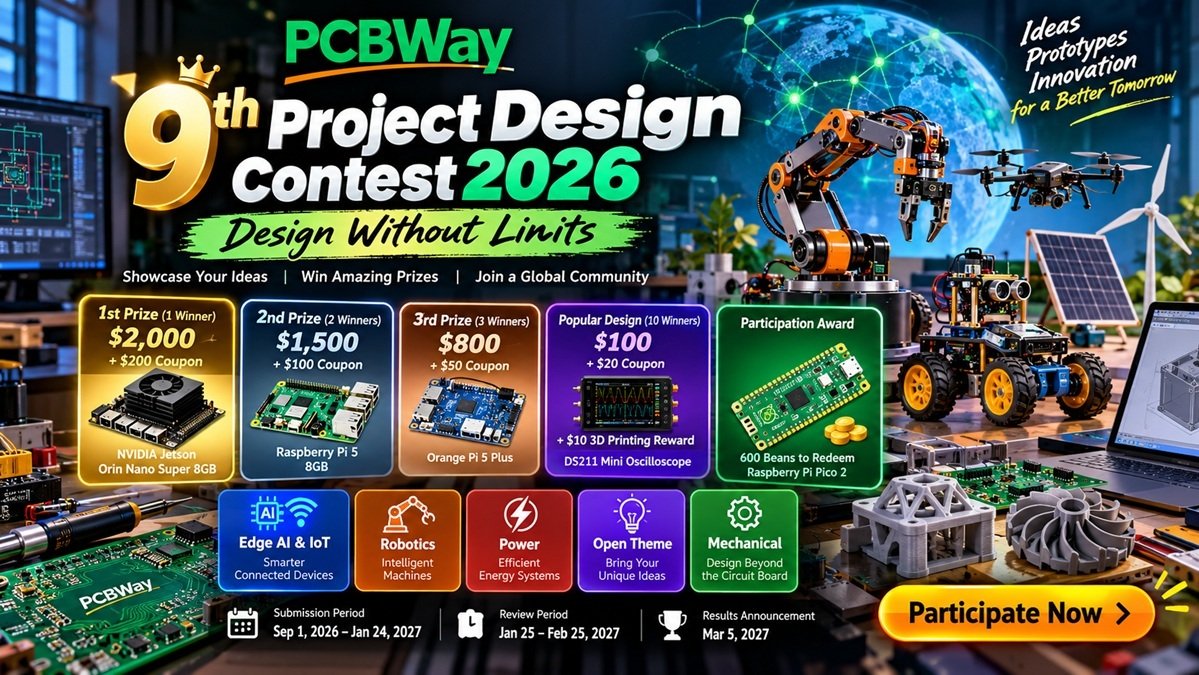
PCBWay 9th Project Design Contest 2026: Turn Your Engineering Ideas into Real-World Innovations
Every great engineering project begins with an idea. It might be a smart device designed to solve an everyday problem, a custom PCB that simplifies a complex circuit, an autonomous robot, or an energy-efficient power system. But turning an idea into a working prototype is only one part of the journey. Sharing it with the engineering community, receiving feedback, and discovering new opportunities can make the experience even more rewarding.
That is where the PCBWay 9th Project Design Contest 2026 comes in.
Built around the theme “Design Without Limits,” this international competition invites makers, electronics enthusiasts, students, engineers, and hardware innovators to showcase original projects across electronics, artificial intelligence, robotics, power engineering, and mechanical design. With cash awards of up to $2,000, valuable development hardware, PCBWay coupons, and an opportunity to present projects to a global community, the contest offers a compelling reason to take your next engineering idea further.
Whether you are developing an IoT prototype in your workshop, building an intelligent robotic system, designing a custom circuit board, or experimenting with a mechanical concept, this contest gives you a platform to demonstrate what you can create.
Contest website: PCBWay 9th Project Design Contest
What Is the PCBWay 9th Project Design Contest?
The PCBWay 9th Project Design Contest is a global engineering and maker competition organized through the PCBWay Community. Its purpose is to encourage creativity, technical experimentation, practical problem-solving, and knowledge sharing among people who build electronic and mechanical projects.
Unlike a competition restricted to one specific component, development board, or engineering discipline, this edition offers five distinct themes. Participants can choose the category that best matches their projects, allowing a wide range of hardware ideas to find a suitable place.
The contest also emphasizes project presentation and documentation. Participants are encouraged to share supporting materials such as PCB layouts, schematics, source code, bills of materials, CAD designs, and manufacturing files where applicable.
This makes the event about more than presenting a finished prototype. It also encourages participants to explain how their projects work, what problems they solve, and how other makers can learn from their development process.
PCBWay Contest 2026: Important Dates
If you are planning to participate, keep the following dates in mind.
| Contest milestone | Date |
|---|---|
| Submission period begins | September 1, 2026 |
| Submission deadline | January 24, 2027 |
| Review period | January 25–February 25, 2027 |
| Results announcement | March 5, 2027 |
The submission window gives participants several months to prepare and present their projects. As of October 2026, submissions are open, with the deadline scheduled for January 24, 2027.
It is worth preparing your project description, photographs, demonstration videos, and relevant technical files well before the deadline. A clearly documented project makes it easier for judges and other community members to understand the work behind your design.
For any schedule changes, consult the official PCBWay contest page.
Explore the Five Contest Themes
One of the most interesting aspects of this edition is its variety of engineering categories. You do not necessarily need to build a conventional electronics project to find a suitable theme. From connected devices to precision mechanical structures, there are several ways to participate.
1. Edge AI and IoT: Build Smarter Connected Devices
The Edge AI and IoT category is designed for projects that combine connected hardware, intelligent processing, sensing, and automation.
Potential project ideas include:
- ESP32-based smart home automation systems.
- Wireless sensor networks for agriculture and environmental monitoring.
- Edge AI devices that process data locally.
- Smart wearables and portable monitoring systems.
- Intelligent industrial monitoring hardware.
- Custom IoT development boards and sensor interfaces.
For example, imagine a smart irrigation controller that measures soil moisture, analyzes environmental conditions, and controls a water pump according to the collected data. A well-designed PCB could integrate the microcontroller, sensor interfaces, wireless communication, and power-management circuitry into a compact prototype.
Similarly, an edge AI device that identifies a condition locally instead of relying entirely on cloud processing could demonstrate practical engineering and intelligent hardware design.
The key is to explain the problem, the technical approach, and the benefits of your solution.
2. Robotics: Bring Intelligent Machines to Life
Robotics projects combine electronics, embedded programming, mechanical engineering, motion control, and automation. The contest welcomes ideas involving autonomous control, actuators, robotic systems, and intelligent mechanisms.
Possible projects include:
- Autonomous mobile robots.
- Robotic arms and grippers.
- Line-following and obstacle-avoiding robots.
- Motion-control systems using stepper motors or servos.
- Industrial automation prototypes.
- Custom motor-driver boards and robotic controller PCBs.
A particularly interesting project could be a robotic arm that uses sensors and a custom control board to perform repetitive pick-and-place operations. Another could be a mobile robot that navigates an environment using distance sensors and embedded decision-making.
Projects should clearly demonstrate their functionality and explain the engineering decisions behind their design.
3. Power: Develop Efficient and Reliable Energy Systems
Power engineering is essential to nearly every electronic device. This category focuses on energy management, power conversion, storage, charging, and efficient power-system design.
Ideas that may fit this theme include:
- Battery management systems (BMS).
- Solar charging controllers.
- High-efficiency DC-DC converters.
- Battery-powered embedded systems.
- Energy-monitoring circuits.
- Custom power-distribution and protection boards.
For example, a solar-powered monitoring system could combine a charging controller, battery protection, voltage monitoring, and a low-power microcontroller. A carefully documented design could explain how the system manages energy consumption and maintains reliable operation.
For power-related submissions, clear schematics, component selection, design calculations, and appropriate safety considerations can help reviewers understand the quality of the engineering work.
4. Open Theme: Give Your Original Idea a Place
Not every innovative project fits neatly into a predefined category. The Open Theme provides flexibility for original designs that do not align with the other listed themes.
This could be suitable for a custom electronic instrument, a new development board, an experimental communication device, or another engineering concept that falls outside the specified categories.
If your project has a distinctive purpose and a meaningful technical contribution but does not naturally belong under Edge AI and IoT, Robotics, Power, or Mechanical, consider the Open Theme.
Before submitting, check the official contest rules and select the category that best reflects your project.
5. Mechanical: Design Beyond the Circuit Board
Mechanical engineering is another important part of hardware innovation. This category covers physical product concepts, mechanisms, precision engineering, 3D designs, CNC designs, drone chassis, robot frames, and custom enclosures.
Possible submissions include:
- Custom enclosures for electronic products.
- Lightweight frames for drones and robots.
- 3D-printed mechanisms and functional components.
- CNC-machined engineering parts.
- Mechanical assemblies for automated systems.
- Structural designs that improve the usability of electronic devices.
Consider a compact enclosure designed around a custom PCB. The enclosure may improve protection, simplify assembly, manage cable routing, and make the prototype easier to use. A thoughtful mechanical design can significantly improve an otherwise functional electronic product.
This category is especially relevant to makers who combine CAD software, 3D printing, CNC machining, and physical prototyping.
PCBWay Contest 2026: Prizes and Rewards
The contest offers several award categories, combining cash prizes with hardware and PCBWay coupons. These rewards can be particularly useful for engineers and makers who want to continue experimenting with new projects.
The official contest page lists the following awards:
| Award | Winners | Cash prize per winner | Additional rewards |
|---|---|---|---|
| First Prize | 1 | $2,000 | $200 coupon and NVIDIA Jetson Orin Nano Super 8GB Developer Kit |
| Second Prize | 2 | $1,500 | $100 coupon and Raspberry Pi 5 8GB |
| Third Prize | 3 | $800 | $50 coupon and Orange Pi 5 Plus |
| Popular Design Prize | 10 | $100 | $20 coupon, $10 3D-printing reward, and DS211 mini oscilloscope |
| Participation Award | Subject to contest rules | — | Eligible approved projects can earn 600 Beans, redeemable for a Raspberry Pi Pico 2 in the PCBWay Store |
Hardware rewards and participation benefits are subject to the organizer’s official terms and eligibility requirements.
First Prize: $2,000 and an NVIDIA Jetson Developer Kit
The first-prize package combines a $2,000 cash award, a $200 PCBWay coupon, and an NVIDIA Jetson Orin Nano Super 8GB Developer Kit.
The Jetson platform is particularly relevant to developers experimenting with edge AI, computer vision, robotics, and machine-learning applications. It can provide a useful foundation for future hardware and intelligent computing projects.
For a maker working on an AI-enabled robot or an embedded vision system, this reward could help support further experimentation.
Second Prize: $1,500 and a Raspberry Pi 5
Two second-prize winners will each receive $1,500 in cash, a $100 coupon, and a Raspberry Pi 5 8GB.
The Raspberry Pi platform can support a wide range of applications, including home automation, network services, embedded development, data collection, and prototyping.
Third Prize: $800 and an Orange Pi 5 Plus
Three third-prize winners will each receive $800, a $50 coupon, and an Orange Pi 5 Plus.
Single-board computers can be useful for Linux-based development, hardware interfaces, automation, and experimental computing projects. The reward offers another way to continue building after the contest.
Popular Design Prize: Recognition from the Community
Ten projects will receive the Popular Design Prize, which includes $100 in cash, a $20 coupon, a $10 3D-printing reward, and a DS211 mini oscilloscope.
This award adds a community-engagement dimension to the competition. It gives project visibility and popularity a meaningful role alongside technical evaluation.
Participation Award: Keep Building and Learning
PCBWay also lists a participation reward associated with 600 Beans, which can be redeemed for a Raspberry Pi Pico 2 in the PCBWay Store.
However, the official rules specify that participation rewards depend on the quality and completeness of the submission. Only projects that meet the required standards and receive PCBWay approval are eligible for the full 600-Bean reward.
Review the contest terms rather than assuming that every submitted project automatically qualifies.
How Will Projects Be Evaluated?
A strong entry should do more than look impressive in photographs. The contest uses four evaluation criteria, each with a defined percentage.
Project Design — 30%
Judges will assess complexity, creativity, and technical innovation.
Explain what makes your design distinctive. If you have created a custom PCB, describe why you selected the components, how the circuit is organized, and which engineering challenges you addressed.
Practical Impact — 30%
The project should demonstrate how it addresses a real problem or improves an existing process.
Explain who could benefit from the design, where it could be used, and why the solution matters. Practical value does not necessarily require a commercial product; a well-designed educational tool or useful prototype can also demonstrate meaningful impact.
Project Documentation — 25%
Documentation accounts for a substantial portion of the evaluation.
A strong project page should include a clear introduction, the problem being solved, the design approach, major components, implementation details, photographs, and a demonstration where possible.
Where applicable, include PCB files, Gerber files, schematics, a bill of materials, source code, CAD files, and CNC files. Open-source resources are encouraged and may be considered favorably.
Project Popularity — 15%
Community popularity accounts for the remaining 15%.
Share your project with the maker community, explain what makes it interesting, and encourage genuine engagement. A clear demonstration and a useful project description can help other members understand your work and decide whether to support it.
The four criteria together show that a successful submission should balance originality, practical usefulness, documentation, and community participation.
Who Can Participate?
The contest is designed for a broad range of makers and engineering enthusiasts. Its five themes make it relevant to students, hobbyists, independent developers, electronics engineers, robotics enthusiasts, and people working on hardware prototypes.
Projects can be submitted individually or as a team. Participants may also submit multiple original projects under different themes, provided each entry satisfies the official rules.
One important requirement concerns originality: projects must be original works created or updated and submitted during the designated submission period. Copied or plagiarized projects can be disqualified.
Participants retain their intellectual property rights and are responsible for ensuring that their submissions do not infringe on third-party rights.
By submitting a project, participants also agree that PCBWay may showcase and promote the project, including its text, images, and videos, on its website, social media channels, and promotional materials, with appropriate credit to the creator.
Team entries have an additional consideration: the prize is awarded to the designated team leader, who is responsible for distributing it among team members.
Read the complete rules on the official contest page before entering.
How to Submit Your Project
Entering the contest involves a straightforward submission process.
Step 1: Choose your project.
Identify an original project that you have created or updated during the submission period. Select the theme that best matches its primary purpose.
Step 2: Prepare your documentation.
Write a clear project overview and explain the problem, design, implementation, and results. Include relevant photographs, diagrams, demonstration videos, and supporting files.
For an electronics project, useful resources may include PCB layouts, Gerber files, schematics, a bill of materials, and source code. For mechanical projects, consider including CAD models, assembly details, and CNC files where applicable.
Step 3: Open the official contest page.
Visit the PCBWay 9th Project Design Contest page and select Participate Now.
Alternatively, create a project in the PCBWay Community, choose the Submit Project to… option, and select the appropriate contest theme.
Step 4: Review your submission.
Make sure the description is understandable, the technical details are accurate, and the project files are relevant. Confirm that your entry follows the contest requirements.
Step 5: Submit before the deadline.
The published submission deadline is January 24, 2027. Submit early enough to resolve any documentation or eligibility issues.
Tips for Making Your Entry Stand Out
With design, practical impact, documentation, and popularity all contributing to evaluation, a little preparation can make your project easier to understand and appreciate.
Start with a clearly defined problem. Explain what inspired the project and why the problem deserves a solution.
Show the engineering, not just the final result. Include relevant design decisions, circuit diagrams, PCB layouts, mechanical drawings, or software architecture.
Demonstrate that the project works. Use real photographs, testing results, or a short video to show the system in operation. Distinguish completed functionality from planned features.
Make documentation easy to follow. Organize the information into logical sections and explain technical terms when necessary. Include component specifications and instructions that help readers understand or reproduce the work.
Share useful project files. When appropriate, provide schematics, source code, BOMs, manufacturing files, and CAD resources. Ensure that you have the right to share any third-party material included.
Explain the practical benefits. Describe how your design might save energy, simplify a task, improve accessibility, support automation, or enable further research.
Engage with the community. Share your project, answer questions, and encourage genuine discussion. Community engagement is relevant to the Popular Design Prize, but it does not replace technical quality or documentation.
Most importantly, choose a project you can explain confidently. A thoughtful, well-documented solution to a real problem can be more compelling than a complicated design whose purpose is unclear.
Why the PCBWay Project Design Contest Matters
Hardware development often requires a combination of technical knowledge, experimentation, prototyping, and persistence. A circuit may work on a breadboard, but turning it into a reliable PCB-based system introduces additional design considerations. A mechanical assembly may look promising in CAD, but physical testing can reveal challenges that were not obvious on screen.
Competitions like the PCBWay Project Design Contest create an opportunity to share this engineering journey with a wider community.
For students, the contest can provide experience in presenting technical work. For hobbyists, it offers a platform to showcase personal projects. For independent developers, it creates an opportunity to connect with other makers and gain visibility for their ideas.
The contest also brings together disciplines that increasingly overlap in modern product development. IoT devices rely on electronics and embedded software. Robotics combines mechanical structures, control systems, and sensors. Energy-efficient products depend on power engineering, thermal considerations, and thoughtful circuit design.
By providing several categories, PCBWay encourages participants to explore these connections rather than limiting innovation to a single area.
Final Thoughts: Your Next Engineering Project Deserves to Be Seen
The PCBWay 9th Project Design Contest 2026 offers an opportunity to turn engineering effort into a more visible achievement. With five themes covering Edge AI and IoT, Robotics, Power, Open Theme, and Mechanical design, the competition welcomes a broad range of original ideas.
The prizes are attractive, but the opportunity extends beyond the rewards. Preparing a complete submission encourages better documentation, sharing your work creates opportunities for feedback, and presenting your design helps others understand the thinking behind your solution.
Whether you are building a smart sensor node, designing a power-management board, developing a robotic mechanism, or creating a custom mechanical component, consider taking the next step and sharing your work.
Ready to showcase your innovation?
Visit the official PCBWay 9th Project Design Contest 2026 page, explore the five themes, review the eligibility requirements, and submit your project before January 24, 2027.
Your next engineering idea could be the one that inspires another maker to start building.


