
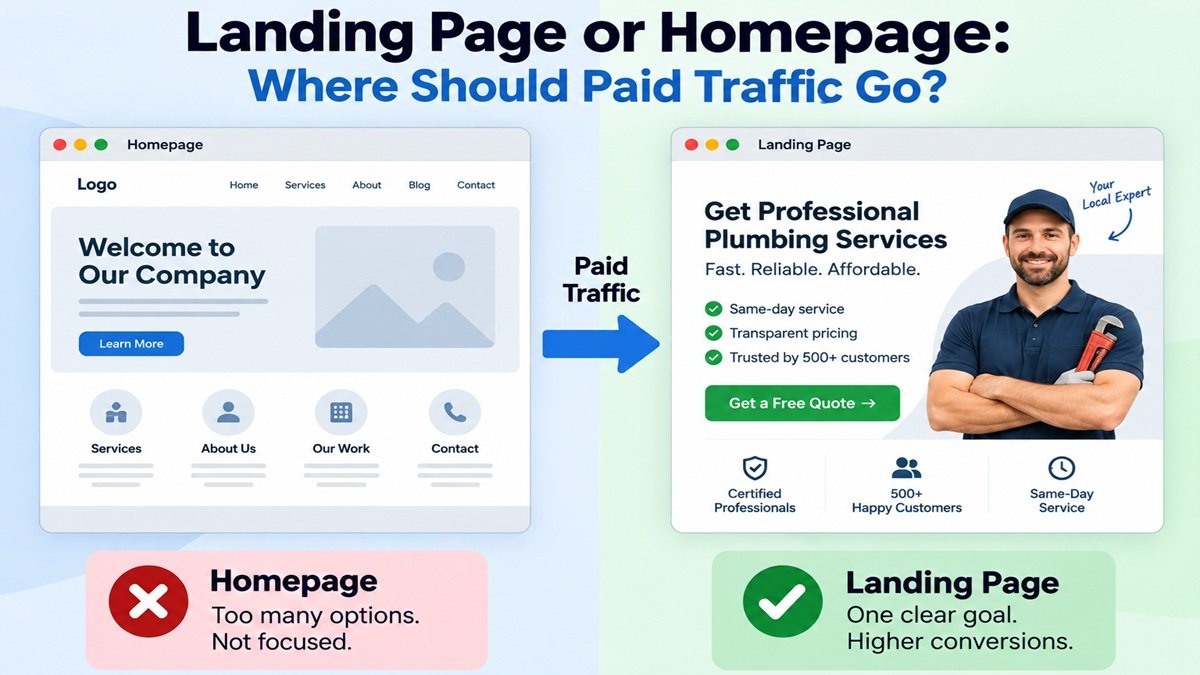
Landing Page or Homepage: Where Should Paid Traffic Go?
A homepage has to introduce a company, list everything it does, serve existing customers, and satisfy someone who arrived by accident. A landing page has one job. That difference usually shows up as a two to three times gap in conversion rate for the same traffic.
Why homepages underperform for ads
Someone who searched for a specific service and clicked an ad promising that service arrives on a homepage and has to find it again. Every extra decision loses a share of visitors. A typical homepage offers a navigation bar with eight options, three calls to action of equal weight, and a hero section describing the company rather than the thing that was searched for.
Paid traffic is expensive and impatient. It converts best when the page continues the sentence the ad started.
When a homepage is genuinely fine
There are exceptions worth knowing, because building landing pages for everything wastes effort:
- Branded search. Someone typing your company name wants your company. Send them home.
- Single-service businesses. If the homepage already is the service page, there is nothing to gain.
- Very low volume. Below roughly 200 clicks a month to a campaign, you will not gather enough data to justify or improve a separate page.
What an ad landing page needs
| Element | What it does |
|---|---|
| Headline matching the query | Confirms in one second that the visitor is in the right place |
| Price or price range | Removes the single biggest reason people leave to compare |
| Proof | Reviews, photos of real work, certifications, client names |
| One primary action | Every competing button reduces the main one |
| Short form | Two or three fields. Every extra field costs conversions |
| Phone and messaging | Many people will never fill in a form but will message instantly |
| Objection handling | Delivery time, guarantee, cancellation terms, what happens next |
| Reduced navigation | Fewer exits from the page than a normal site section |
How many pages do you need
One per meaningful service or product category, not one per keyword. A plumber needs pages for emergency callouts, bathroom installation and boiler servicing, because those are three different customers with three different urgencies. That same plumber does not need forty pages built around keyword variations of the same job.
Start with your highest-spend campaign, build one page, and compare it against the existing destination for three weeks. The difference is usually obvious enough that the case for the next page makes itself. Teams that manage paid social campaigns often need a different page again, because traffic from a feed arrives colder and needs more persuasion before the form.
Testing without a big audience
Formal split tests need traffic most small businesses do not have. Sequential testing is a practical substitute: run version A for three weeks, version B for three weeks, and compare, keeping spend and targeting identical. It is less rigorous, but it is far better than changing nothing.
Test one thing at a time and start with the elements that move the most: the headline, the offer, and the form length. Button colours are the last thing worth your attention, whatever the internet says.
A quick sanity check
Show your landing page to someone unfamiliar with the business for five seconds, then take it away and ask what the company sells, what it costs, and what they were supposed to do next. If they cannot answer all three, no amount of campaign optimisation will rescue the traffic you are buying.


